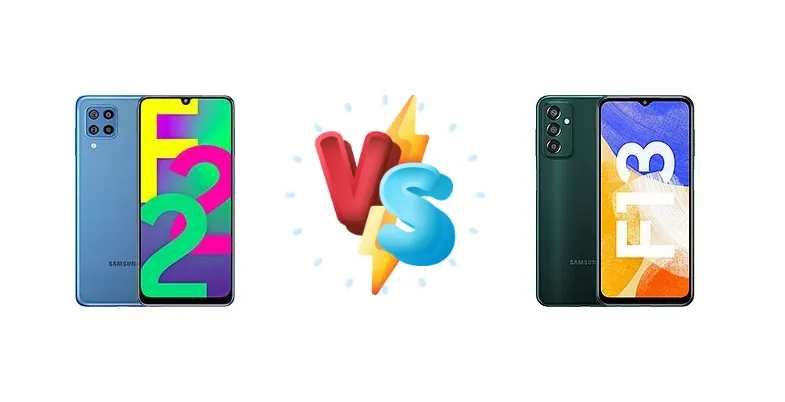
The Samsung Galaxy F13 and F22 represent Samsung’s continued push into the competitive budget smartphone market. While both aim to deliver a compelling experience at an accessible price point, they diverge significantly in their core hardware, particularly the chipset. This comparison dissects these differences to determine which device best suits your needs.
🏆 Quick Verdict
For most users, the Samsung Galaxy F13 offers a more balanced experience. Its Exynos 850 chipset, built on an 8nm process, provides a noticeable efficiency advantage over the F22’s Helio G80, translating to better sustained performance and potentially improved battery life, despite both phones sharing the same 15W charging.
| Network |
|---|
| 2G bands | GSM 850 / 900 / 1800 / 1900 | GSM 850 / 900 / 1800 / 1900 |
| 3G bands | HSDPA 850 / 900 / 2100 | HSDPA 850 / 900 / 2100 |
| 4G bands | 1, 3, 5, 8, 20, 38, 40, 41 | 1, 3, 5, 7, 8, 20, 28, 38, 40, 41 |
| Speed | HSPA, LTE | HSPA, LTE |
| Technology | GSM / HSPA / LTE | GSM / HSPA / LTE |
| Launch |
|---|
| Announced | 2021, July 06 | 2022, June 22 |
| Status | Available. Released 2021, July 13 | Available. Released 2022, June 29 |
| Body |
|---|
| Build | Glass front, plastic frame, plastic back | Glass front (Gorilla Glass 5), plastic back, plastic frame |
| Dimensions | 160 x 74 x 9.4 mm (6.30 x 2.91 x 0.37 in) | 165.4 x 76.9 x 9.3 mm (6.51 x 3.03 x 0.37 in) |
| SIM | Nano-SIM + Nano-SIM | Nano-SIM + Nano-SIM |
| Weight | 203 g (7.16 oz) | 207 g (7.30 oz) |
| Display |
|---|
| Protection | - | Corning Gorilla Glass 5 |
| Resolution | 720 x 1600 pixels, 20:9 ratio (~274 ppi density) | 1080 x 2408 pixels, 20:9 ratio (~400 ppi density) |
| Size | 6.4 inches, 98.9 cm2 (~83.5% screen-to-body ratio) | 6.6 inches, 104.9 cm2 (~82.5% screen-to-body ratio) |
| Type | Super AMOLED, 90Hz, 600 nits (HDR) | PLS LCD |
| Platform |
|---|
| CPU | Octa-core (2x2.0 GHz Cortex-A75 & 6x1.8 GHz Cortex-A55) | Octa-core (4x2.0 GHz Cortex-A55 & 4x2.0 GHz Cortex-A55) |
| Chipset | Mediatek MT6769V/CU Helio G80 (12 nm) | Exynos 850 (8 nm) |
| GPU | Mali-G52 MC2 | Mali-G52 |
| OS | Android 11, upgradable to Android 13, One UI core 5.1 | Android 12, upgradable to Android 13, One UI Core 5 |
| Memory |
|---|
| Card slot | microSDXC (dedicated slot) | microSDXC (dedicated slot) |
| Internal | 64GB 4GB RAM, 128GB 6GB RAM | 64GB 4GB RAM, 128GB 4GB RAM, 128GB 6GB RAM |
| | - | eMMC 5.1 |
| Main Camera |
|---|
| Features | LED flash, panorama, HDR | LED flash, panorama, HDR |
| Quad | 48 MP, f/1.8, (wide), PDAF
8 MP, f/2.2, 123˚ (ultrawide), 1/4.0", 1.12µm
2 MP (macro)
Auxiliary lens | - |
| Single | 13 MP, f/2.2, (wide), 1/3.1", 1.12µm | 8 MP, f/2.2, (wide) |
| Triple | - | 50 MP, f/1.8, (wide), PDAF
5 MP, f/2.2, 123˚ (ultrawide)
Auxiliary lens |
| Video | 1080p@30fps | 1080p@30fps |
| Selfie camera |
|---|
| Features | - | HDR |
| Single | 13 MP, f/2.2, (wide), 1/3.1", 1.12µm | 8 MP, f/2.2, (wide) |
| Video | 1080p@30fps | 1080p@30fps |
| Sound |
|---|
| 3.5mm jack | Yes | Yes |
| 35mm jack | Yes | Yes |
| Loudspeaker | Yes | Yes |
| Comms |
|---|
| Bluetooth | 5.0, A2DP, LE | 5.0, A2DP, LE |
| NFC | No | Yes |
| Positioning | GPS, GLONASS, GALILEO, BDS | GPS, GLONASS, GALILEO, BDS |
| Radio | FM radio, recording | FM radio |
| USB | USB Type-C 2.0, OTG | USB Type-C 2.0, OTG |
| WLAN | Wi-Fi 802.11 a/b/g/n/ac, dual-band, Wi-Fi Direct | Wi-Fi 802.11 a/b/g/n/ac, dual-band |
| Features |
|---|
| Sensors | Fingerprint (side-mounted), accelerometer, gyro, compass | Fingerprint (side-mounted), accelerometer, compass |
| | Virtual Proximity Sensing | Virtual proximity sensing |
| Battery |
|---|
| Charging | 15W wired | 15W wired |
| Type | Li-Po 6000 mAh | Li-Po 6000 mAh |
| Misc |
|---|
| Colors | Denim Black, Denim Blue | Waterfall Blue, Sunrise Copper, Nightsky Green |
| Models | SM-E225F, SM-E225F/DS | SM-E135F, SM-E135F/DS |
| Price | About 170 EUR | About 150 EUR |
| SAR | 0.62 W/kg (head) | 0.55 W/kg (head) |
| SAR EU | - | 0.45 W/kg (head) 1.36 W/kg (body) |
Samsung Galaxy F22
- Potentially higher single-core CPU performance for quick tasks.
- Helio G80 offers decent gaming capabilities for casual gamers.
- May be available at a slightly lower price point.
- Less efficient 12nm process leads to higher power consumption.
- Helio G80 is more prone to thermal throttling.
- Potentially shorter battery life compared to the F13.
Samsung Galaxy F13
- More efficient Exynos 850 (8nm) for longer battery life.
- Better sustained performance due to improved thermal management.
- Potentially superior image processing thanks to the Exynos ISP.
- Smoother overall user experience.
- May have slightly lower peak single-core CPU performance.
- Cortex-A55 only architecture may not appeal to power users.
- Potentially slightly higher price.
Display Comparison
Both the F13 and F22 likely feature similar LCD panels, given their market positioning. However, detailed display specs (resolution, brightness, color gamut) are missing. The focus here is on the internal processing. The chipset impacts the display’s responsiveness and ability to handle demanding visual tasks. While both can likely handle standard video playback, the Exynos 850 in the F13 should offer a smoother experience with UI animations and scrolling due to its more efficient architecture.
Camera Comparison
Without detailed camera sensor information, a direct comparison is difficult. However, both phones likely feature a primary camera accompanied by auxiliary lenses (depth, macro). The image signal processor (ISP) within the chipset plays a crucial role in image quality. The Exynos 850’s ISP is likely more advanced than the Helio G80’s, potentially resulting in better dynamic range, noise reduction, and overall image processing. The F13 may also benefit from Samsung’s software optimizations for its Exynos chips. The presence of a 2MP macro camera on both devices is largely a marketing feature with limited practical utility.
Performance
The core difference lies in the chipsets. The Galaxy F22’s MediaTek Helio G80 (12nm) utilizes a dual-cluster configuration with two Cortex-A75 cores for peak performance and six Cortex-A55 cores for efficiency. The F13, however, employs Samsung’s Exynos 850 (8nm), featuring eight Cortex-A55 cores clocked at 2.0 GHz. While the F22’s A75 cores offer higher single-core performance, the Exynos 850’s 8nm process and eight A55 cores provide superior multi-core performance and thermal efficiency. This means the F13 is less likely to throttle under sustained load, making it better for longer gaming sessions or video editing. The smaller fabrication node of the Exynos 850 is a significant advantage.
Battery Life
Both devices are equipped with 15W wired charging, suggesting similar charging speeds. The actual battery capacity isn’t specified, but the Exynos 850’s superior power efficiency in the F13 will likely translate to longer battery life despite potentially similar capacity. The 8nm process allows the F13 to accomplish more per watt, reducing power consumption during everyday tasks and extending usage time between charges. The F22’s Helio G80, while capable, is less efficient, potentially requiring more frequent charging.
Buying Guide
Buy the Samsung Galaxy F22 if you prioritize raw CPU burst performance for occasional tasks and are comfortable with potentially shorter battery life. Its Helio G80’s Cortex-A75 cores offer a slight edge in single-core tasks. Buy the Samsung Galaxy F13 if you value consistent performance, efficiency, and a smoother overall experience, especially for everyday tasks and moderate gaming. The Exynos 850’s architecture is better suited for sustained workloads.
Frequently Asked Questions
❓ Does the Exynos 850 in the Galaxy F13 overheat during prolonged gaming sessions?
The Exynos 850 is built on an 8nm process, which inherently generates less heat than the 12nm Helio G80 in the F22. While some heat generation is inevitable during gaming, the F13 is less likely to experience significant thermal throttling, allowing for more consistent performance over extended periods.
❓ Is the 2MP macro camera on either phone actually useful for taking detailed close-up photos?
Generally, 2MP macro cameras on budget smartphones offer limited utility. The low resolution results in images lacking detail and sharpness. They are primarily a marketing feature and are unlikely to deliver impressive macro photography results. Expect soft, often blurry images.
❓ Can the Samsung Galaxy F13 reliably run PUBG Mobile at 60fps?
The Exynos 850 should be capable of running PUBG Mobile at 60fps on medium settings. However, sustained performance will depend on the phone’s thermal management. The F13’s more efficient chipset gives it a better chance of maintaining a stable frame rate during longer gaming sessions compared to the F22.
❓ Which phone is better for multitasking and switching between apps?
The Samsung Galaxy F13 is better suited for multitasking. The Exynos 850’s architecture and efficient memory management contribute to smoother app switching and a more responsive user experience when running multiple applications simultaneously.