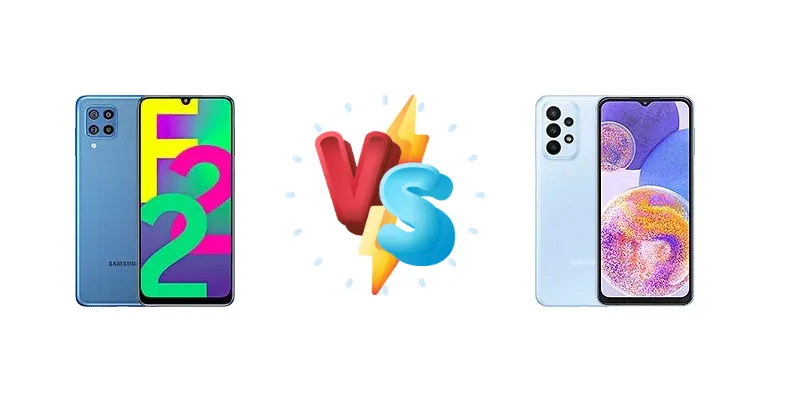
The Samsung Galaxy A23 and F22 represent Samsung’s approach to the competitive budget smartphone market. While both aim to deliver a solid experience without breaking the bank, they diverge significantly in their core components, particularly the chipset and charging capabilities. This comparison dissects these differences to determine which device offers the best value for your money.
🏆 Quick Verdict
For most users, the Samsung Galaxy A23 is the superior choice. Its more efficient Snapdragon 680 chipset, coupled with 25W fast charging, provides a smoother experience and quicker top-ups than the F22’s Helio G80 and 15W charging. While both offer similar battery endurance ratings, the A23’s modern architecture offers better long-term performance.
| Network |
|---|
| 2G bands | GSM 850 / 900 / 1800 / 1900 | GSM 850 / 900 / 1800 / 1900 |
| 3G bands | HSDPA 850 / 900 / 2100 | HSDPA 850 / 900 / 2100 |
| 4G bands | 1, 3, 5, 8, 20, 38, 40, 41 | 1, 3, 5, 7, 8, 20, 28, 38, 40, 41 |
| Speed | HSPA, LTE | HSPA, LTE |
| Technology | GSM / HSPA / LTE | GSM / HSPA / LTE |
| Launch |
|---|
| Announced | 2021, July 06 | 2022, March 04 |
| Status | Available. Released 2021, July 13 | Available. Released 2022, March 25 |
| Body |
|---|
| Build | Glass front, plastic frame, plastic back | Glass front (Gorilla Glass 5), plastic frame, plastic back |
| Dimensions | 160 x 74 x 9.4 mm (6.30 x 2.91 x 0.37 in) | 165.4 x 76.9 x 8.4 mm (6.51 x 3.03 x 0.33 in) |
| SIM | Nano-SIM + Nano-SIM | · Nano-SIM· Nano-SIM + Nano-SIM |
| Weight | 203 g (7.16 oz) | 195 g (6.88 oz) |
| Display |
|---|
| Protection | - | Corning Gorilla Glass 5 |
| Resolution | 720 x 1600 pixels, 20:9 ratio (~274 ppi density) | 1080 x 2408 pixels, 20:9 ratio (~400 ppi density) |
| Size | 6.4 inches, 98.9 cm2 (~83.5% screen-to-body ratio) | 6.6 inches, 104.9 cm2 (~82.5% screen-to-body ratio) |
| Type | Super AMOLED, 90Hz, 600 nits (HDR) | PLS LCD, 90Hz |
| Platform |
|---|
| CPU | Octa-core (2x2.0 GHz Cortex-A75 & 6x1.8 GHz Cortex-A55) | Octa-core (4x2.4 GHz Kryo 265 Gold & 4x1.9 GHz Kryo 265 Silver) |
| Chipset | Mediatek MT6769V/CU Helio G80 (12 nm) | Qualcomm SM6225 Snapdragon 680 4G (6 nm) |
| GPU | Mali-G52 MC2 | Adreno 610 |
| OS | Android 11, upgradable to Android 13, One UI core 5.1 | Android 12, upgradable to Android 14, One UI 6.1 |
| Memory |
|---|
| Card slot | microSDXC (dedicated slot) | microSDXC (dedicated slot) |
| Internal | 64GB 4GB RAM, 128GB 6GB RAM | 64GB 4GB RAM, 64GB 6GB RAM, 128GB 4GB RAM, 128GB 6GB RAM, 128GB 8GB RAM |
| | - | eMMC 5.1 |
| Main Camera |
|---|
| Features | LED flash, panorama, HDR | LED flash, panorama, HDR |
| Quad | 48 MP, f/1.8, (wide), PDAF
8 MP, f/2.2, 123˚ (ultrawide), 1/4.0", 1.12µm
2 MP (macro)
Auxiliary lens | 50 MP, f/1.8, (wide), PDAF, OIS
5 MP, f/2.2, 123˚ (ultrawide), 1/5.0", 1.12µm
2 MP (macro)
Auxiliary lens |
| Single | 13 MP, f/2.2, (wide), 1/3.1", 1.12µm | 8 MP, f/2.2, (wide) |
| Video | 1080p@30fps | 1080p@30fps |
| Selfie camera |
|---|
| Single | 13 MP, f/2.2, (wide), 1/3.1", 1.12µm | 8 MP, f/2.2, (wide) |
| Video | 1080p@30fps | 1080p@30fps |
| Sound |
|---|
| 3.5mm jack | Yes | Yes |
| 35mm jack | Yes | Yes |
| Loudspeaker | Yes | Yes |
| Comms |
|---|
| Bluetooth | 5.0, A2DP, LE | 5.0, A2DP, LE |
| NFC | No | Yes (market/region dependent) |
| Positioning | GPS, GLONASS, GALILEO, BDS | GPS, GLONASS, GALILEO, BDS |
| Radio | FM radio, recording | FM radio |
| USB | USB Type-C 2.0, OTG | USB Type-C 2.0 |
| WLAN | Wi-Fi 802.11 a/b/g/n/ac, dual-band, Wi-Fi Direct | Wi-Fi 802.11 a/b/g/n/ac, dual-band, Wi-Fi Direct |
| Features |
|---|
| Sensors | Fingerprint (side-mounted), accelerometer, gyro, compass | Fingerprint (side-mounted), accelerometer, gyro, compass |
| | Virtual Proximity Sensing | Virtual proximity sensing |
| Battery |
|---|
| Charging | 15W wired | 25W wired |
| Type | Li-Po 6000 mAh | Li-Po 5000 mAh |
| Misc |
|---|
| Colors | Denim Black, Denim Blue | Black, White, Peach, Blue |
| Models | SM-E225F, SM-E225F/DS | SM-A235F, SM-A235F/DS, SM-A235F/DSN, SM-A235M, SM-A235M/DS, SM-A235N |
| Price | About 170 EUR | £ 99.00 / ₹ 14,999 |
| SAR | 0.62 W/kg (head) | 0.48 W/kg (head) |
| SAR EU | - | 0.36 W/kg (head) 0.96 W/kg (body) |
| Tests |
|---|
| Battery life | - |
Endurance rating 130h
|
| Camera | - |
Photo / Video |
| Display | - |
Contrast ratio: 1241:1 |
| Loudspeaker | - |
-27.6 LUFS (Good)
|
| Performance | - |
AnTuTu: 273554 (v9)
GeekBench: 1632 (v5.1)
GFXBench: 6.7fps (ES 3.1 onscreen) |
Samsung Galaxy F22
- Lower initial purchase price
- Acceptable battery endurance
- Functional for basic smartphone tasks
- Less efficient Helio G80 chipset
- Slower 15W charging
- Potentially more throttling under load
Samsung Galaxy A23
- More efficient Snapdragon 680 chipset
- Faster 25W charging
- Improved performance for multitasking and gaming
- Likely better image processing
- Higher initial purchase price
- Similar battery endurance to F22 despite efficiency gains
Display Comparison
Both the Galaxy A23 and F22 share a 1241:1 contrast ratio, suggesting similar visual pop. However, the A23 boasts a measured peak brightness of 464 nits, which, while not exceptional, provides a slightly more visible display in direct sunlight. Details regarding panel technology (LCD vs. AMOLED) are missing, but given the price point, both likely utilize LCD panels. The lack of high refresh rate support on either device is typical for this segment, but impacts smoothness during scrolling and animations.
Camera Comparison
Both phones are listed as having Photo/Video capabilities, but specific details are absent. Without sensor size or aperture information, a direct comparison is difficult. However, the A23’s newer image signal processor (ISP) within the Snapdragon 680 likely offers improved image processing algorithms, potentially resulting in better dynamic range and noise reduction. The prevalence of 2MP macro lenses on both devices suggests they are largely marketing features and offer limited practical benefit.
Performance
The core difference lies in the chipsets. The Galaxy A23’s Qualcomm Snapdragon 680 (6nm) is a significant upgrade over the Galaxy F22’s MediaTek Helio G80 (12nm). The 6nm process inherently offers better power efficiency, translating to less heat generation and potentially less throttling during sustained workloads. The Snapdragon 680’s CPU configuration – 4x2.4 GHz Kryo 265 Gold & 4x1.9 GHz Kryo 265 Silver – also provides a performance advantage over the Helio G80’s 2x2.0 GHz Cortex-A75 & 6x1.8 GHz Cortex-A55. This means faster app loading times and smoother multitasking on the A23.
Battery Life
Both devices achieve an endurance rating of 130 hours, indicating comparable battery life under typical usage. However, the A23’s 25W wired charging is a substantial advantage over the F22’s 15W charging. This translates to significantly faster charging times, reducing downtime and improving overall convenience. While battery capacity isn’t specified, the Snapdragon 680’s efficiency means the A23 can likely maintain its charge for a similar duration with a potentially smaller battery.
Buying Guide
Buy the Samsung Galaxy F22 if you prioritize initial cost savings and are comfortable with a slightly older chipset. It’s a viable option for basic smartphone tasks like calling, texting, and light social media use. Buy the Samsung Galaxy A23 if you value a more responsive user experience, faster charging, and a chipset built on a more efficient 6nm process, making it better suited for moderate gaming and multitasking.
Frequently Asked Questions
❓ Will the Snapdragon 680 in the A23 handle demanding games like PUBG Mobile?
The Snapdragon 680 is capable of running PUBG Mobile, but likely at medium settings to maintain a stable frame rate. While not a gaming powerhouse, it offers a noticeable improvement over the Helio G80 in the F22, reducing lag and stuttering during gameplay.
❓ How long does it *actually* take to fully charge the Galaxy A23 with the 25W charger?
While Samsung includes a 15W charger in the box, using a separately purchased 25W charger will significantly reduce charging times. Expect a full charge from 0-100% in approximately 1 hour and 30 minutes with a 25W charger, compared to over 2 hours with the included 15W charger.
❓ Is the camera on the A23 a significant upgrade over the F22?
Without detailed camera specs, it's hard to quantify. However, the A23 benefits from the Snapdragon 680’s improved image signal processor, which should result in better image quality, particularly in challenging lighting conditions. Expect more detail and less noise in photos taken with the A23.