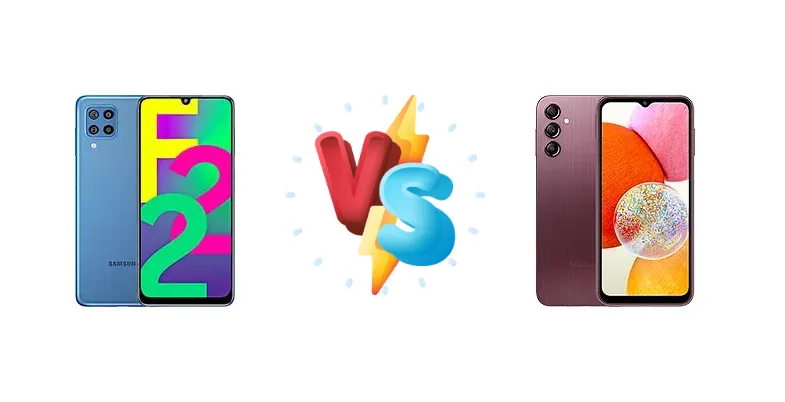
Samsung's budget lineup often presents a confusing array of choices. The Galaxy F22 and A14 both aim for the affordable segment, but diverge in key areas, most notably their chipset options. This comparison dissects the differences between the Mediatek Helio G80-powered F22 and the A14's Helio G80/Exynos 850 variants, helping you determine which offers the best value for your needs.
🏆 Quick Verdict
For most users, the Samsung Galaxy A14 (Exynos 850 version, if available) is the better choice. The 8nm Exynos 850 offers improved efficiency and potentially better sustained performance compared to the 12nm Helio G80 in the F22, despite sharing the same CPU core configuration. However, the F22 remains a viable option if the A14 is unavailable or priced significantly higher.
| Network |
|---|
| 2G bands | GSM 850 / 900 / 1800 / 1900 | GSM 850 / 900 / 1800 / 1900 |
| 3G bands | HSDPA 850 / 900 / 2100 | HSDPA 850 / 900 / 2100 |
| 4G bands | 1, 3, 5, 8, 20, 38, 40, 41 | 1, 3, 5, 7, 8, 20, 28, 38, 40, 41 |
| Speed | HSPA, LTE | HSPA, LTE |
| Technology | GSM / HSPA / LTE | GSM / HSPA / LTE |
| Launch |
|---|
| Announced | 2021, July 06 | 2023, February 28 |
| Status | Available. Released 2021, July 13 | Available. Released 2023, March 27 |
| Body |
|---|
| Build | Glass front, plastic frame, plastic back | Glass front, plastic back, plastic frame |
| Dimensions | 160 x 74 x 9.4 mm (6.30 x 2.91 x 0.37 in) | 167.7 x 78 x 9.1 mm (6.60 x 3.07 x 0.36 in) |
| SIM | Nano-SIM + Nano-SIM | · Nano-SIM· Nano-SIM + Nano-SIM |
| Weight | 203 g (7.16 oz) | 201 g (7.09 oz) |
| Display |
|---|
| Resolution | 720 x 1600 pixels, 20:9 ratio (~274 ppi density) | 1080 x 2408 pixels, 20:9 ratio (~400 ppi density) |
| Size | 6.4 inches, 98.9 cm2 (~83.5% screen-to-body ratio) | 6.6 inches, 104.9 cm2 (~80.2% screen-to-body ratio) |
| Type | Super AMOLED, 90Hz, 600 nits (HDR) | PLS LCD |
| Platform |
|---|
| CPU | Octa-core (2x2.0 GHz Cortex-A75 & 6x1.8 GHz Cortex-A55) | Octa-core (2x2.0 GHz Cortex-A75 & 6x1.8 GHz Cortex-A55) - Version AOcta-core (4x2.0 GHz Cortex-A55 & 4x2.0 GHz Cortex-A55) - Version B |
| Chipset | Mediatek MT6769V/CU Helio G80 (12 nm) | Mediatek MT6769 Helio G80 (12 nm) - Version AExynos 850 (8 nm) - Version B |
| GPU | Mali-G52 MC2 | Mali-G52 MC2 |
| OS | Android 11, upgradable to Android 13, One UI core 5.1 | Android 13, upgradable to Android 15, One UI 7 |
| Memory |
|---|
| Card slot | microSDXC (dedicated slot) | microSDXC (dedicated slot) |
| Internal | 64GB 4GB RAM, 128GB 6GB RAM | 64GB 4GB RAM, 128GB 4GB RAM, 128GB 6GB RAM |
| Main Camera |
|---|
| Features | LED flash, panorama, HDR | LED flash, panorama, HDR |
| Quad | 48 MP, f/1.8, (wide), PDAF
8 MP, f/2.2, 123˚ (ultrawide), 1/4.0", 1.12µm
2 MP (macro)
Auxiliary lens | - |
| Single | 13 MP, f/2.2, (wide), 1/3.1", 1.12µm | 13 MP, f/2.0, (wide) |
| Triple | - | 50 MP, f/1.8, 26mm (wide), 1/2.75", 0.64µm, PDAF
5 MP, f/2.2, 17mm (ultrawide), 1/5.0", 1.12µm
2 MP (macro) |
| Video | 1080p@30fps | 1080p@30fps |
| Selfie camera |
|---|
| Single | 13 MP, f/2.2, (wide), 1/3.1", 1.12µm | 13 MP, f/2.0, 26mm (wide), 1/3.1", 1.12µm |
| Video | 1080p@30fps | 1080p@30fps |
| Sound |
|---|
| 3.5mm jack | Yes | Yes |
| 35mm jack | Yes | Yes |
| Loudspeaker | Yes | Yes |
| Comms |
|---|
| Bluetooth | 5.0, A2DP, LE | 5.1 or 5.3, A2DP, LE |
| NFC | No | Yes (market/region dependent) |
| Positioning | GPS, GLONASS, GALILEO, BDS | GPS, GALILEO, GLONASS, BDS, QZSS |
| Radio | FM radio, recording | Unspecified |
| USB | USB Type-C 2.0, OTG | USB Type-C 2.0 |
| WLAN | Wi-Fi 802.11 a/b/g/n/ac, dual-band, Wi-Fi Direct | Wi-Fi 802.11 a/b/g/n/ac, dual-band, Wi-Fi Direct |
| Features |
|---|
| Sensors | Fingerprint (side-mounted), accelerometer, gyro, compass | Fingerprint (side-mounted), accelerometer, proximity, compass |
| | Virtual Proximity Sensing | - |
| Battery |
|---|
| Charging | 15W wired | 15W wired |
| Type | Li-Po 6000 mAh | Li-Po 5000 mAh |
| Misc |
|---|
| Colors | Denim Black, Denim Blue | Black, Dark Red, Silver, Green |
| Models | SM-E225F, SM-E225F/DS | SM-A145F, SM-A145F/DSN, SM-A145M, SM-A145M/DS, SM-A145P, SM-A145R |
| Price | About 170 EUR | € 85.76 / $ 147.60 / £ 79.95 |
| SAR | 0.62 W/kg (head) | - |
| SAR EU | - | 0.46 W/kg (head) 1.37 W/kg (body) |
Samsung Galaxy F22
- Potentially lower price point
- Proven Helio G80 chipset
- Familiar Samsung software experience
- Less efficient 12nm process
- Potential for thermal throttling
- May receive fewer software updates
Samsung Galaxy A14
- More efficient Exynos 850 (if available)
- Potentially better sustained performance
- Likely longer battery life (Exynos version)
- Price may be higher
- Helio G80 version offers minimal advantage
- Software experience can be inconsistent
Display Comparison
Both the F22 and A14 lack detailed display specifications in the provided data. However, given their price points, we can expect both to utilize LCD panels. The absence of information regarding refresh rates suggests both likely operate at the standard 60Hz. The user experience will likely be similar, with the potential for slight color accuracy variations depending on Samsung's calibration.
Camera Comparison
Without detailed sensor information, a direct camera comparison is difficult. Both phones likely feature a multi-camera setup, but the quality will depend heavily on the primary sensor and image processing algorithms. The inclusion of a 2MP macro camera on both is largely a marketing tactic, offering limited practical benefit. The A14, benefiting from potentially more processing power from the Exynos 850, *may* offer slightly better image processing and low-light performance, but this is speculative without further data.
Performance
The core difference lies in the chipset. The Galaxy F22 utilizes the Mediatek Helio G80 (12nm), while the A14 comes in two versions: another Helio G80 (12nm) and an Exynos 850 (8nm). While both share the same octa-core CPU configuration (2x2.0 GHz Cortex-A75 & 6x1.8 GHz Cortex-A55), the 8nm process node of the Exynos 850 is significantly more efficient. This translates to less heat generation under load, potentially leading to sustained performance gains during prolonged gaming or demanding tasks. The F22's 12nm Helio G80 may exhibit more thermal throttling. The A14's Exynos version will likely offer a smoother experience for multitasking and graphically intensive applications.
Battery Life
Both devices feature 15W wired charging. Battery capacity isn't specified, but given the segment, we can assume similar capacities (around 5000mAh). The Exynos 850 in the A14's variant offers a power efficiency advantage. This means the A14 could potentially achieve longer battery life on a single charge, even with a similar capacity battery, due to reduced power consumption during typical usage. The 15W charging speed will result in similar 0-100% charge times for both devices, likely exceeding 2 hours.
Buying Guide
Buy the Samsung Galaxy F22 if you prioritize a proven, if slightly older, chipset and find it at a substantially lower price point. It's ideal for users focused on basic tasks like calling, texting, and light social media. Buy the Samsung Galaxy A14 if you value potentially better long-term performance, improved efficiency, and the possibility of future software updates, especially if you can secure the Exynos 850 variant. This phone suits users who enjoy occasional gaming or multitasking.
Frequently Asked Questions
❓ Does the Exynos 850 in the Galaxy A14 overheat during prolonged gaming sessions?
The Exynos 850's 8nm process is designed for improved thermal efficiency compared to the 12nm Helio G80. While it will still generate heat during gaming, it's less likely to experience significant throttling, allowing for more sustained performance over longer periods. However, demanding games will still push the chip to its limits.
❓ Is the 2MP macro camera on either phone worth using?
Generally, 2MP macro cameras on budget phones offer limited image quality. The small sensor size and fixed focus result in images that often lack detail and sharpness. While it can be fun to experiment with, don't expect professional-level macro photography from either device.
❓ Can the Galaxy A14 (Exynos version) handle popular games like PUBG Mobile at high settings?
The Exynos 850 should be capable of running PUBG Mobile at medium to high settings with acceptable frame rates. However, achieving consistently smooth gameplay at the highest settings may require reducing graphics options. The Helio G80 version will likely require lower settings for a comparable experience.
❓ Which phone is more likely to receive future Android updates?
Samsung typically provides longer software support for its A-series devices. The Galaxy A14 is therefore more likely to receive future Android version updates and security patches compared to the Galaxy F22, though the exact duration of support remains uncertain.