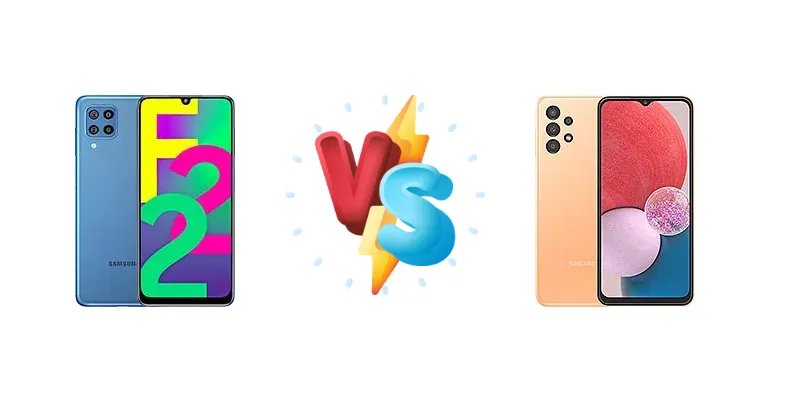
Samsung's A and F series represent their aggressive push into the budget smartphone market. The Galaxy F22 and A13 are both contenders aiming for the sub-$200 price point, but they take different approaches. The F22 prioritizes processing power with a Mediatek Helio G80, while the A13 leans towards a more efficient Exynos 850 and a brighter display. This comparison dissects these differences to help you choose the best fit.
🏆 Quick Verdict
For most users, the Samsung Galaxy A13 emerges as the better choice. While the F22 boasts a more powerful CPU core configuration, the A13’s Exynos 850, built on a smaller 8nm process, offers a more balanced experience with comparable real-world performance and a noticeably superior display.
| Network |
|---|
| 2G bands | GSM 850 / 900 / 1800 / 1900 | GSM 850 / 900 / 1800 / 1900 |
| 3G bands | HSDPA 850 / 900 / 2100 | HSDPA 850 / 900 / 2100 |
| 4G bands | 1, 3, 5, 8, 20, 38, 40, 41 | 1, 3, 5, 7, 8, 20, 28, 38, 40, 41 |
| Speed | HSPA, LTE | HSPA, LTE |
| Technology | GSM / HSPA / LTE | GSM / HSPA / LTE |
| Launch |
|---|
| Announced | 2021, July 06 | 2022, March 04 |
| Status | Available. Released 2021, July 13 | Available. Released 2022, March 23 |
| Body |
|---|
| Build | Glass front, plastic frame, plastic back | Glass front (Gorilla Glass 5), plastic frame, plastic back |
| Dimensions | 160 x 74 x 9.4 mm (6.30 x 2.91 x 0.37 in) | 165.1 x 76.4 x 8.8 mm (6.5 x 3.01 x 0.35 in) |
| SIM | Nano-SIM + Nano-SIM | · Nano-SIM· Nano-SIM + Nano-SIM |
| Weight | 203 g (7.16 oz) | 195 g (6.88 oz) |
| Display |
|---|
| Protection | - | Corning Gorilla Glass 5 |
| Resolution | 720 x 1600 pixels, 20:9 ratio (~274 ppi density) | 1080 x 2408 pixels, 20:9 ratio (~400 ppi density) |
| Size | 6.4 inches, 98.9 cm2 (~83.5% screen-to-body ratio) | 6.6 inches, 104.9 cm2 (~83.2% screen-to-body ratio) |
| Type | Super AMOLED, 90Hz, 600 nits (HDR) | PLS LCD |
| Platform |
|---|
| CPU | Octa-core (2x2.0 GHz Cortex-A75 & 6x1.8 GHz Cortex-A55) | Octa-core (4x2.0 GHz Cortex-A55 & 4x2.0 GHz Cortex-A55) |
| Chipset | Mediatek MT6769V/CU Helio G80 (12 nm) | Exynos 850 (8 nm) |
| GPU | Mali-G52 MC2 | Mali-G52 |
| OS | Android 11, upgradable to Android 13, One UI core 5.1 | Android 12, upgradable to Android 14, One UI 6.1 |
| Memory |
|---|
| Card slot | microSDXC (dedicated slot) | microSDXC (dedicated slot) |
| Internal | 64GB 4GB RAM, 128GB 6GB RAM | 32GB 3GB RAM, 32GB 4GB RAM, 64GB 4GB RAM, 128GB 3GB RAM, 128GB 4GB RAM, 128GB 6GB RAM |
| | - | eMMC 5.1 |
| Main Camera |
|---|
| Features | LED flash, panorama, HDR | LED flash, panorama, HDR |
| Quad | 48 MP, f/1.8, (wide), PDAF
8 MP, f/2.2, 123˚ (ultrawide), 1/4.0", 1.12µm
2 MP (macro)
Auxiliary lens | 50 MP, f/1.8, (wide), PDAF
5 MP, f/2.2, 123˚ (ultrawide), 1/5.0", 1.12µm
2 MP (macro)
Auxiliary lens |
| Single | 13 MP, f/2.2, (wide), 1/3.1", 1.12µm | 8 MP, f/2.2, (wide) |
| Video | 1080p@30fps | 1080p@30fps |
| Selfie camera |
|---|
| Single | 13 MP, f/2.2, (wide), 1/3.1", 1.12µm | 8 MP, f/2.2, (wide) |
| Video | 1080p@30fps | 1080p@30fps |
| Sound |
|---|
| 3.5mm jack | Yes | Yes |
| 35mm jack | Yes | Yes |
| Loudspeaker | Yes | Yes |
| Comms |
|---|
| Bluetooth | 5.0, A2DP, LE | 5.0, A2DP, LE |
| NFC | No | Yes (market/region dependent) |
| Positioning | GPS, GLONASS, GALILEO, BDS | GPS, GLONASS, GALILEO, BDS |
| Radio | FM radio, recording | No |
| USB | USB Type-C 2.0, OTG | USB Type-C 2.0, OTG |
| WLAN | Wi-Fi 802.11 a/b/g/n/ac, dual-band, Wi-Fi Direct | Wi-Fi 802.11 a/b/g/n/ac, dual-band, Wi-Fi Direct |
| Features |
|---|
| Sensors | Fingerprint (side-mounted), accelerometer, gyro, compass | Fingerprint (side-mounted), accelerometer, compass |
| | Virtual Proximity Sensing | Virtual proximity sensing |
| Battery |
|---|
| Charging | 15W wired | 15W wired |
| Type | Li-Po 6000 mAh | Li-Po 5000 mAh |
| Misc |
|---|
| Colors | Denim Black, Denim Blue | Black, White, Peach, Blue |
| Models | SM-E225F, SM-E225F/DS | SM-A135F, SM-A135F/DS, SM-A135M, SM-A135U, SM-A135U1, SM-A135N |
| Price | About 170 EUR | € 94.99 / $ 129.99 / £ 89.00 |
| SAR | 0.62 W/kg (head) | 0.49 W/kg (head) |
| SAR EU | - | 0.37 W/kg (head) 1.39 W/kg (body) |
| Tests |
|---|
| Battery life | - |
Endurance rating 114h
|
| Camera | - |
Photo / Video |
| Display | - |
Contrast ratio: 1324:1 (nominal) |
| Loudspeaker | - |
-29.7 LUFS (Average)
|
| Performance | - |
AnTuTu: 122822 (v8), 136286 (v9)
GeekBench: 588 (v5.1)
GFXBench: 5.2fps (ES 3.1 onscreen) |
Samsung Galaxy F22
- Potentially faster CPU performance for specific tasks
- May offer better value if priced significantly lower
- Helio G80 is a capable chipset for its class
- 12nm process may lead to more thermal throttling
- Display specifications are unknown, potentially inferior to A13
- Battery life may be slightly lower due to less efficient chipset
Samsung Galaxy A13
- Brighter display for better outdoor visibility
- More efficient Exynos 850 chipset
- 8nm process reduces thermal throttling
- CPU core configuration is less powerful on paper
- May be slightly more expensive than the F22
- Camera details are lacking, potential for mediocre image quality
Display Comparison
The Galaxy A13 boasts a significant advantage in display quality. Its measured peak brightness of 587 nits surpasses what we’d expect in this price bracket, making it far more usable outdoors. Both phones share a 1324:1 contrast ratio, suggesting similar panel characteristics in terms of black levels. However, the F22’s display specifications are not provided, making a direct comparison difficult. The A13’s brightness is a key differentiator for users who frequently consume content in bright environments.
Camera Comparison
Both devices feature 'Photo / Video' capabilities, but detailed camera specifications are lacking. Without sensor size, aperture, or image processing details, a meaningful comparison is impossible. The presence of a 2MP macro camera on both devices is likely a marketing feature with limited practical benefit. Real-world image quality will depend heavily on Samsung’s software processing, which is difficult to assess without sample images.
Performance
On paper, the Galaxy F22’s Mediatek Helio G80 appears stronger with its dual 2.0 GHz Cortex-A75 cores alongside six Cortex-A55 cores. However, the Galaxy A13’s Exynos 850, fabricated on an 8nm process versus the F22’s 12nm, offers improved power efficiency. The Exynos 850 utilizes eight Cortex-A55 cores clocked at 2.0 GHz. While the A75 cores in the F22 provide a theoretical performance boost in single-threaded tasks, the 8nm process of the Exynos 850 likely mitigates this advantage in sustained workloads, reducing thermal throttling. This translates to a more consistent experience during prolonged use.
Battery Life
Both the Galaxy F22 and A13 achieve an impressive endurance rating of 114 hours, indicating similar battery life in typical usage scenarios. Both phones also share the same 15W wired charging capability. This suggests that battery optimization and software management play a larger role than raw capacity differences, which are not specified. The Exynos 850’s superior efficiency may contribute to the A13 maintaining its endurance rating despite potentially having a smaller battery capacity.
Buying Guide
Buy the Samsung Galaxy F22 if you prioritize raw CPU performance for demanding tasks like emulation or light gaming and are willing to compromise slightly on display quality. Buy the Samsung Galaxy A13 if you value a brighter, more visible display for everyday use, better overall efficiency, and a more refined user experience, even if it means a slight step down in peak processing power.
Frequently Asked Questions
❓ Does the Exynos 850 in the Galaxy A13 overheat during extended gaming sessions?
The Exynos 850, built on an 8nm process, is known for its thermal efficiency. While it won't match flagship performance, it's unlikely to overheat significantly during typical gaming sessions. The larger process node helps dissipate heat more effectively than the F22's 12nm Helio G80.
❓ Is the 2MP macro camera on either phone worth using?
Generally, 2MP macro cameras on budget phones offer limited image quality. The small sensor size and fixed focus result in images that lack detail and sharpness. They are primarily a marketing feature and are unlikely to provide a significant improvement over the main camera.
❓ Will the Galaxy F22 handle demanding games like PUBG at high frame rates?
The Helio G80 in the F22 can run PUBG, but achieving consistently high frame rates (60fps or higher) at high settings may be challenging. Expect to make compromises on graphics settings to maintain a smooth gaming experience. The A13 may offer a more stable experience due to its efficient chipset.
❓ How long does it take to fully charge both phones with the 15W charger?
With both phones utilizing 15W charging, a full charge from 0% to 100% will likely take around 2-3 hours. The actual charging time will vary depending on usage during charging and the charger's quality.