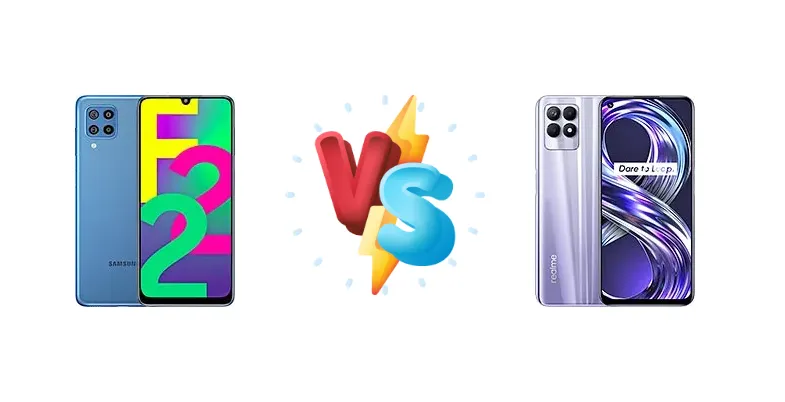
The sub-$200 smartphone market is fiercely competitive, and the Realme 8i and Samsung Galaxy F22 are two strong contenders. Both aim to deliver essential features without breaking the bank, but they take different approaches. The Realme 8i boasts a newer Mediatek Helio G96 chipset and faster charging, while the Samsung Galaxy F22 relies on the Helio G80 and Samsung's brand recognition. This comparison dives deep into the specifics to determine which phone offers the best value.
🏆 Quick Verdict
For most users, the Realme 8i emerges as the better choice. Its Helio G96 chipset provides a noticeable performance uplift over the Galaxy F22’s Helio G80, and the 18W charging is a welcome addition. While both phones offer similar battery endurance ratings, the Realme 8i’s faster charging speeds provide a more convenient user experience.
| Network |
|---|
| 2G bands | GSM 850 / 900 / 1800 / 1900 | GSM 850 / 900 / 1800 / 1900 |
| 3G bands | HSDPA 850 / 900 / 2100 | HSDPA 850 / 900 / 2100 |
| 4G bands | 1, 3, 5, 8, 20, 38, 40, 41 | 1, 3, 5, 8, 38, 40, 41 |
| Speed | HSPA, LTE | HSPA, LTE |
| Technology | GSM / HSPA / LTE | GSM / HSPA / LTE |
| Launch |
|---|
| Announced | 2021, July 06 | 2021, September 09 |
| Status | Available. Released 2021, July 13 | Available. Released 2021, September 14 |
| Body |
|---|
| Build | Glass front, plastic frame, plastic back | Glass front, plastic frame, plastic back |
| Dimensions | 160 x 74 x 9.4 mm (6.30 x 2.91 x 0.37 in) | 164.1 x 75.5 x 8.5 mm (6.46 x 2.97 x 0.33 in) |
| SIM | Nano-SIM + Nano-SIM | Nano-SIM + Nano-SIM |
| Weight | 203 g (7.16 oz) | 194 g (6.84 oz) |
| Display |
|---|
| Resolution | 720 x 1600 pixels, 20:9 ratio (~274 ppi density) | 1080 x 2412 pixels, 20:9 ratio (~400 ppi density) |
| Size | 6.4 inches, 98.9 cm2 (~83.5% screen-to-body ratio) | 6.6 inches, 104.8 cm2 (~84.6% screen-to-body ratio) |
| Type | Super AMOLED, 90Hz, 600 nits (HDR) | IPS LCD, 120Hz, 600 nits (peak) |
| Platform |
|---|
| CPU | Octa-core (2x2.0 GHz Cortex-A75 & 6x1.8 GHz Cortex-A55) | Octa-core (2x2.05 GHz Cortex-A76 & 6x2.0 GHz Cortex-A55) |
| Chipset | Mediatek MT6769V/CU Helio G80 (12 nm) | Mediatek MT6781 Helio G96 (12 nm) |
| GPU | Mali-G52 MC2 | Mali-G57 MC2 |
| OS | Android 11, upgradable to Android 13, One UI core 5.1 | Android 11, Realme UI 2.0 |
| Memory |
|---|
| Card slot | microSDXC (dedicated slot) | microSDXC (dedicated slot) |
| Internal | 64GB 4GB RAM, 128GB 6GB RAM | 64GB 4GB RAM, 128GB 4GB RAM, 128GB 6GB RAM |
| | - | UFS 2.1 |
| Main Camera |
|---|
| Features | LED flash, panorama, HDR | LED flash, HDR, panorama |
| Quad | 48 MP, f/1.8, (wide), PDAF
8 MP, f/2.2, 123˚ (ultrawide), 1/4.0", 1.12µm
2 MP (macro)
Auxiliary lens | - |
| Single | 13 MP, f/2.2, (wide), 1/3.1", 1.12µm | 16 MP, f/2.1, (wide), 1/3.0", 1.0µm |
| Triple | - | 50 MP, f/1.8, 26mm (wide), 1/2.76", 0.64µm, PDAF
2 MP (macro)
Auxiliary lens |
| Video | 1080p@30fps | 1080p@30fps |
| Selfie camera |
|---|
| Features | - | Panorama |
| Single | 13 MP, f/2.2, (wide), 1/3.1", 1.12µm | 16 MP, f/2.1, (wide), 1/3.0", 1.0µm |
| Video | 1080p@30fps | 1080p@30fps |
| Sound |
|---|
| 3.5mm jack | Yes | Yes |
| 35mm jack | Yes | Yes |
| Loudspeaker | Yes | Yes |
| Comms |
|---|
| Bluetooth | 5.0, A2DP, LE | 5.1, A2DP, LE |
| NFC | No | Yes (market/region dependent) |
| Positioning | GPS, GLONASS, GALILEO, BDS | GPS, GLONASS, GALILEO, BDS |
| Radio | FM radio, recording | No |
| USB | USB Type-C 2.0, OTG | USB Type-C 2.0, OTG |
| WLAN | Wi-Fi 802.11 a/b/g/n/ac, dual-band, Wi-Fi Direct | Wi-Fi 802.11 a/b/g/n/ac, dual-band |
| Features |
|---|
| Sensors | Fingerprint (side-mounted), accelerometer, gyro, compass | Fingerprint (side-mounted), accelerometer, gyro, proximity, compass |
| | Virtual Proximity Sensing | - |
| Battery |
|---|
| Charging | 15W wired | 18W wired |
| Type | Li-Po 6000 mAh | 5000 mAh |
| Misc |
|---|
| Colors | Denim Black, Denim Blue | Space Black, Space Purple |
| Models | SM-E225F, SM-E225F/DS | RMX3151 |
| Price | About 170 EUR | About 440 EUR |
| SAR | 0.62 W/kg (head) | - |
| Tests |
|---|
| Battery life | - |
Endurance rating 131h
|
| Camera | - |
Photo / Video |
| Loudspeaker | - |
-28.4 LUFS (Average)
|
Samsung Galaxy F22
- Established Brand Reputation
- Reliable Software Experience (typically)
- Comparable Battery Endurance
- Older Helio G80 Chipset
- Slower 15W Charging
- Potentially Lower Peak Display Brightness
Realme 8i
- More Powerful Helio G96 Chipset
- Faster 18W Charging
- Higher Display Contrast Ratio
- Less Brand Recognition
- Realme UI may not appeal to all users
- Potential for more pre-installed apps
Display Comparison
The Realme 8i features a display capable of reaching 540 nits of peak brightness and a 1244:1 contrast ratio. While the Galaxy F22’s display specifications aren’t explicitly provided, it’s likely to offer a similar level of brightness. The Realme 8i’s higher contrast ratio suggests deeper blacks and a more vibrant image. Neither phone is expected to feature high refresh rate panels, focusing instead on maximizing battery life. The Realme 8i’s measured brightness gives it a slight edge for outdoor visibility.
Camera Comparison
Both phones are equipped with photo and video capabilities, but detailed camera specifications are limited. Without sensor size or aperture information, a direct comparison is difficult. However, the Realme 8i’s newer chipset likely includes a more advanced image signal processor (ISP), potentially leading to better image processing and low-light performance. The presence of a dedicated ISP in the G96 could offer improvements in noise reduction and dynamic range. It's reasonable to assume both phones include standard features like HDR and portrait modes, but the Realme 8i has the potential for superior image quality.
Performance
The core difference lies in the chipsets. The Realme 8i’s Mediatek Helio G96 (12nm) utilizes two Cortex-A76 cores clocked at 2.05 GHz, paired with six Cortex-A55 cores at 2.0 GHz. This is a step up from the Samsung Galaxy F22’s Helio G80 (12nm), which features two Cortex-A75 cores at 2.0 GHz and six Cortex-A55 cores at 1.8 GHz. The G96’s newer architecture and slightly higher clock speeds translate to improved CPU and GPU performance, making the Realme 8i better suited for demanding tasks and gaming. While both phones likely share similar RAM configurations, the G96’s more efficient architecture could lead to better sustained performance under load.
Battery Life
Both the Realme 8i and Samsung Galaxy F22 achieve an endurance rating of 131 hours, indicating comparable battery life under typical usage. However, the Realme 8i’s 18W wired charging is significantly faster than the Galaxy F22’s 15W charging. This means the Realme 8i can replenish its battery more quickly, reducing downtime. While the actual 0-100% charging time isn’t specified, the 3W difference in charging wattage is substantial in this price segment, offering a tangible benefit to Realme 8i users.
Buying Guide
Buy the Samsung Galaxy F22 if you prioritize brand familiarity and a generally reliable software experience, even if it means sacrificing some performance. Buy the Realme 8i if you’re a budget-conscious user who values performance for gaming and media consumption, and appreciate faster charging capabilities. The 8i is the clear choice for those seeking the most bang for their buck.
Frequently Asked Questions
❓ Will the Realme 8i’s Helio G96 handle demanding games like PUBG Mobile smoothly?
Yes, the Helio G96 is a capable chipset for gaming. While it won’t deliver flagship-level performance, it should handle PUBG Mobile at medium to high settings with playable frame rates. The G96’s improved CPU and GPU architecture compared to the G80 in the Galaxy F22 provide a noticeable advantage.
❓ How significant is the difference between 15W and 18W charging in real-world use?
While a 3W difference may seem small, it translates to a faster charging time, especially in the initial stages. The Realme 8i’s 18W charging will noticeably reduce the time it takes to reach a usable charge level, making it more convenient for users who frequently need to top up their battery quickly.
❓ Does the Realme 8i’s software (Realme UI) come with a lot of bloatware?
Realme UI, like many Android skins, does include some pre-installed apps. However, many of these can be uninstalled. The amount of bloatware is generally considered moderate and doesn’t significantly impact the user experience, but it's something to be aware of.