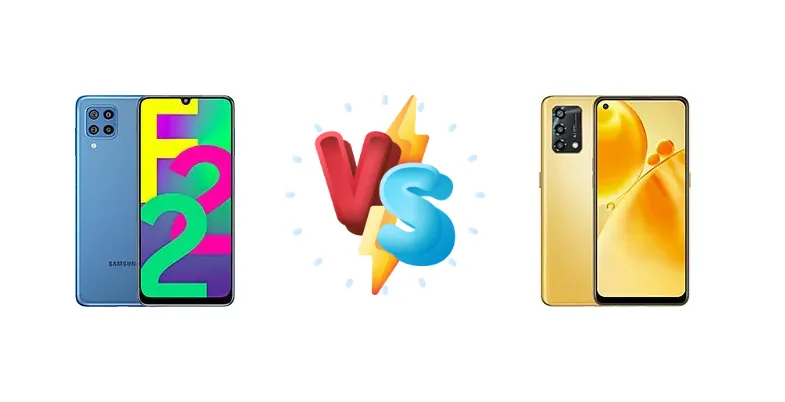
The Samsung Galaxy F22 and Oppo F19s represent compelling options in the crowded budget smartphone market. While both aim to deliver essential features at an accessible price point, they diverge significantly in their core hardware, particularly in their chipset and charging capabilities. This comparison dissects these differences to determine which device offers the best value for your money.
🏆 Quick Verdict
For the average user prioritizing quick top-ups and consistent performance, the Oppo F19s emerges as the stronger contender. Its Snapdragon 662 chipset, coupled with the significantly faster 33W charging, provides a smoother experience and reduces downtime compared to the Galaxy F22’s Helio G80 and 15W charging.
| Network |
|---|
| 2G bands | GSM 850 / 900 / 1800 / 1900 | GSM 850 / 900 / 1800 / 1900 |
| 3G bands | HSDPA 850 / 900 / 2100 | HSDPA 850 / 900 / 2100 |
| 4G bands | 1, 3, 5, 8, 20, 38, 40, 41 | 1, 3, 5, 8, 38, 40, 41 |
| Speed | HSPA, LTE | HSPA, LTE |
| Technology | GSM / HSPA / LTE | GSM / HSPA / LTE |
| Launch |
|---|
| Announced | 2021, July 06 | 2021, September 27 |
| Status | Available. Released 2021, July 13 | Available. Released 2021, September 27 |
| Body |
|---|
| Build | Glass front, plastic frame, plastic back | - |
| Dimensions | 160 x 74 x 9.4 mm (6.30 x 2.91 x 0.37 in) | 160.3 x 73.8 x 8 mm (6.31 x 2.91 x 0.31 in) |
| SIM | Nano-SIM + Nano-SIM | Nano-SIM + Nano-SIM |
| Weight | 203 g (7.16 oz) | 175 g (6.17 oz) |
| Display |
|---|
| Resolution | 720 x 1600 pixels, 20:9 ratio (~274 ppi density) | 1080 x 2400 pixels, 20:9 ratio (~409 ppi density) |
| Size | 6.4 inches, 98.9 cm2 (~83.5% screen-to-body ratio) | 6.43 inches, 99.8 cm2 (~84.4% screen-to-body ratio) |
| Type | Super AMOLED, 90Hz, 600 nits (HDR) | AMOLED, 430 nits (typ), 800 nits (peak) |
| Platform |
|---|
| CPU | Octa-core (2x2.0 GHz Cortex-A75 & 6x1.8 GHz Cortex-A55) | Octa-core (4x2.0 GHz Kryo 260 Gold & 4x1.8 GHz Kryo 260 Silver) |
| Chipset | Mediatek MT6769V/CU Helio G80 (12 nm) | Qualcomm SM6115 Snapdragon 662 (11 nm) |
| GPU | Mali-G52 MC2 | Adreno 610 |
| OS | Android 11, upgradable to Android 13, One UI core 5.1 | Android 11, ColorOS 11.1 |
| Memory |
|---|
| Card slot | microSDXC (dedicated slot) | No |
| Internal | 64GB 4GB RAM, 128GB 6GB RAM | 128GB 6GB RAM |
| Main Camera |
|---|
| Features | LED flash, panorama, HDR | LED flash, panorama |
| Quad | 48 MP, f/1.8, (wide), PDAF
8 MP, f/2.2, 123˚ (ultrawide), 1/4.0", 1.12µm
2 MP (macro)
Auxiliary lens | - |
| Single | 13 MP, f/2.2, (wide), 1/3.1", 1.12µm | 16 MP, f/2.4, 27mm (wide), 1/3.09", 1.0µm |
| Triple | - | 48 MP, f/1.7, 26mm (wide), PDAF
2 MP (macro)
Auxiliary lens |
| Video | 1080p@30fps | 1080p@30fps, gyro-EIS |
| Selfie camera |
|---|
| Single | 13 MP, f/2.2, (wide), 1/3.1", 1.12µm | 16 MP, f/2.4, 27mm (wide), 1/3.09", 1.0µm |
| Video | 1080p@30fps | 1080p@30fps |
| Sound |
|---|
| 3.5mm jack | Yes | Yes |
| 35mm jack | Yes | Yes |
| Loudspeaker | Yes | Yes |
| Comms |
|---|
| Bluetooth | 5.0, A2DP, LE | 5.0, A2DP, LE, aptX |
| NFC | No | No |
| Positioning | GPS, GLONASS, GALILEO, BDS | GPS, GLONASS, GALILEO, BDS |
| Radio | FM radio, recording | FM radio |
| USB | USB Type-C 2.0, OTG | USB Type-C 2.0, OTG |
| WLAN | Wi-Fi 802.11 a/b/g/n/ac, dual-band, Wi-Fi Direct | Wi-Fi 802.11 a/b/g/n/ac, dual-band, Wi-Fi Direct |
| Features |
|---|
| Sensors | Fingerprint (side-mounted), accelerometer, gyro, compass | Fingerprint (under display, optical), accelerometer, gyro, proximity, compass |
| | Virtual Proximity Sensing | - |
| Battery |
|---|
| Charging | 15W wired | 33W wired, 54% in 30 min |
| Type | Li-Po 6000 mAh | Li-Po 5000 mAh |
| Misc |
|---|
| Colors | Denim Black, Denim Blue | Glowing Black, Glowing Gold |
| Models | SM-E225F, SM-E225F/DS | CPH2219, CPH2223 |
| Price | About 170 EUR | About 230 EUR |
| SAR | 0.62 W/kg (head) | - |
Samsung Galaxy F22
- Potentially wider brand recognition and support network.
- May offer a slightly larger battery capacity (unconfirmed).
- Competitive price point.
- Slower 15W charging.
- Helio G80 chipset prone to thermal throttling.
- Less efficient processor compared to Snapdragon 662.
Oppo F19s
- Significantly faster 33W charging.
- More efficient Snapdragon 662 chipset.
- Better sustained performance due to thermal management.
- Less established brand in some markets.
- May have a slightly smaller battery capacity (unconfirmed).
- Potentially less software update support.
Display Comparison
Neither device boasts a standout display. Both likely feature LCD panels, common in this price bracket. The key difference lies under the hood; without specific display specs, we can infer that the F19s’ Snapdragon 662 has a more capable ISP which *could* translate to slightly better image processing for display output. However, this is a minor advantage. Bezels are likely comparable, and color accuracy will be standard for budget phones.
Camera Comparison
Without detailed camera sensor information, a direct comparison is difficult. However, the Snapdragon 662’s image signal processor (ISP) is generally superior to the Helio G80’s. This translates to better image processing, particularly in low-light conditions. While both phones likely include a standard macro lens, the F19s’ ISP will likely extract more detail and dynamic range from the main sensor. The 11nm process also contributes to lower noise in images. We can assume both phones will have similar limitations in terms of zoom capabilities.
Performance
The core battleground is the chipset. The Oppo F19s utilizes the Qualcomm Snapdragon 662 (11nm), while the Samsung Galaxy F22 features the MediaTek Helio G80 (12nm). While both are octa-core CPUs with similar clock speeds (2.0 GHz for the performance cores), the Snapdragon 662’s Kryo cores and the more efficient 11nm process give it an edge in sustained performance and power efficiency. The Helio G80, while capable, is known to exhibit more thermal throttling under prolonged load. This means the F19s will likely maintain higher frame rates in games for longer periods. The Snapdragon 662 also benefits from Qualcomm’s optimized software and GPU drivers.
Battery Life
The battery capacity isn’t specified, but the charging speed is a significant differentiator. The Oppo F19s’ 33W wired charging is a game-changer, capable of reaching 54% charge in just 30 minutes. The Samsung Galaxy F22’s 15W charging is considerably slower. Even if the F22 has a slightly larger battery, the F19s’ faster charging mitigates any capacity difference, offering more convenience and less downtime. The Snapdragon 662’s efficiency also contributes to better overall battery life, potentially offsetting any capacity disadvantage.
Buying Guide
Buy the Samsung Galaxy F22 if you prioritize a potentially larger community support and are comfortable with slower charging speeds. It’s a reasonable choice for basic tasks and light usage. Buy the Oppo F19s if you value faster charging, a more efficient chipset for sustained performance, and a generally more responsive user experience, even if it means sacrificing brand recognition.
Frequently Asked Questions
❓ Will the Helio G80 in the Galaxy F22 struggle with demanding games like PUBG?
The Helio G80 can run PUBG, but you'll likely need to lower graphics settings to maintain a stable frame rate. The chipset is prone to thermal throttling, meaning performance will decrease over extended gaming sessions. The Snapdragon 662 in the F19s offers a smoother, more consistent gaming experience.
❓ How much faster is the 33W charging on the Oppo F19s compared to the 15W charging on the Galaxy F22?
The 33W charging on the F19s is significantly faster. Oppo claims 54% charge in 30 minutes. The Galaxy F22’s 15W charging will take considerably longer – likely over an hour to reach the same charge level. This makes the F19s much more convenient for users who need a quick power boost.
❓ Does the Snapdragon 662 in the Oppo F19s offer noticeable improvements in everyday tasks like browsing and social media?
Yes, the Snapdragon 662 provides a snappier and more responsive experience for everyday tasks. Its more efficient architecture and optimized software result in faster app loading times and smoother multitasking compared to the Helio G80.