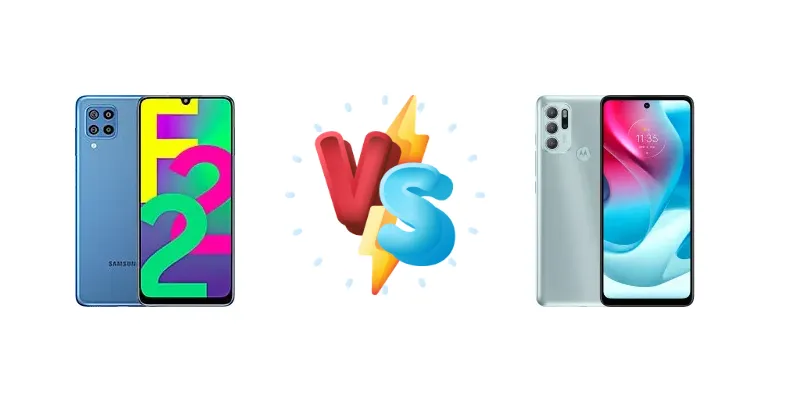
Both the Samsung Galaxy F22 and Motorola Moto G60S target the competitive budget smartphone market, but they approach it with different philosophies. The F22 prioritizes brand recognition and a streamlined experience, while the G60S aims for raw performance and rapid charging. This comparison dissects their key differences to determine which device offers the best value.
🏆 Quick Verdict
For the average user prioritizing performance and convenience, the Motorola Moto G60S is the clear winner. Its Helio G95 chipset and 50W fast charging significantly outperform the Galaxy F22’s Helio G80 and 15W charging. However, the F22 remains a viable option for Samsung ecosystem loyalists on a tight budget.
| Network |
|---|
| 2G bands | GSM 850 / 900 / 1800 / 1900 | GSM 850 / 900 / 1800 / 1900 |
| 3G bands | HSDPA 850 / 900 / 2100 | HSDPA 850 / 900 / 1700(AWS) / 1900 / 2100 |
| 4G bands | 1, 3, 5, 8, 20, 38, 40, 41 | 1, 2, 3, 4, 5, 7, 8, 12, 13, 17, 28, 40, 66 |
| Speed | HSPA, LTE | HSPA, LTE |
| Technology | GSM / HSPA / LTE | GSM / HSPA / LTE |
| Launch |
|---|
| Announced | 2021, July 06 | 2021, August 12 |
| Status | Available. Released 2021, July 13 | Available. Released 2021, August 12 |
| Body |
|---|
| Build | Glass front, plastic frame, plastic back | Glass front, plastic frame, plastic back |
| Dimensions | 160 x 74 x 9.4 mm (6.30 x 2.91 x 0.37 in) | 169.7 x 75.9 x 9.6 mm (6.68 x 2.99 x 0.38 in) |
| SIM | Nano-SIM + Nano-SIM | Nano-SIM + Nano-SIM |
| Weight | 203 g (7.16 oz) | 212 g (7.48 oz) |
| | - | Water repellent design |
| Display |
|---|
| Resolution | 720 x 1600 pixels, 20:9 ratio (~274 ppi density) | 1080 x 2460 pixels (~395 ppi density) |
| Size | 6.4 inches, 98.9 cm2 (~83.5% screen-to-body ratio) | 6.8 inches, 109.8 cm2 (~85.3% screen-to-body ratio) |
| Type | Super AMOLED, 90Hz, 600 nits (HDR) | IPS LCD, 120Hz, HDR10, 450 nits (typ), 562 nits (HBM) |
| Platform |
|---|
| CPU | Octa-core (2x2.0 GHz Cortex-A75 & 6x1.8 GHz Cortex-A55) | Octa-core (2x2.05 GHz Cortex-A76 & 6x2.0 GHz Cortex-A55) |
| Chipset | Mediatek MT6769V/CU Helio G80 (12 nm) | Mediatek MT6785V/CD Helio G95 (12 nm) |
| GPU | Mali-G52 MC2 | Mali-G76 MC4 |
| OS | Android 11, upgradable to Android 13, One UI core 5.1 | Android 11 |
| Memory |
|---|
| Card slot | microSDXC (dedicated slot) | microSDXC (uses shared SIM slot) |
| Internal | 64GB 4GB RAM, 128GB 6GB RAM | 128GB 4GB RAM, 128GB 6GB RAM |
| | - | UFS 2.1 |
| Main Camera |
|---|
| Features | LED flash, panorama, HDR | LED flash, HDR, panorama |
| Quad | 48 MP, f/1.8, (wide), PDAF
8 MP, f/2.2, 123˚ (ultrawide), 1/4.0", 1.12µm
2 MP (macro)
Auxiliary lens | 64 MP, f/1.7, 26mm (wide), PDAF
8 MP, f/2.2, 119˚, (ultrawide)
5 MP (macro)
Auxiliary lens |
| Single | 13 MP, f/2.2, (wide), 1/3.1", 1.12µm | - |
| Video | 1080p@30fps | 4K@30/120fps, 1080p@30/60/240fps |
| Selfie camera |
|---|
| Features | - | LED flash, HDR |
| Single | 13 MP, f/2.2, (wide), 1/3.1", 1.12µm | 16 MP, f/2.2, (wide) |
| Video | 1080p@30fps | 4K@30fps, 1080p@30/60/240fps |
| Sound |
|---|
| 3.5mm jack | Yes | Yes |
| 35mm jack | Yes | Yes |
| Loudspeaker | Yes | Yes |
| Comms |
|---|
| Bluetooth | 5.0, A2DP, LE | 5.0, A2DP, LE |
| NFC | No | Yes |
| Positioning | GPS, GLONASS, GALILEO, BDS | GPS, GLONASS, GALILEO |
| Radio | FM radio, recording | FM radio |
| USB | USB Type-C 2.0, OTG | USB Type-C 2.0, OTG |
| WLAN | Wi-Fi 802.11 a/b/g/n/ac, dual-band, Wi-Fi Direct | Wi-Fi 802.11 a/b/g/n/ac, dual-band, Wi-Fi Direct |
| Features |
|---|
| Sensors | Fingerprint (side-mounted), accelerometer, gyro, compass | Fingerprint (rear-mounted), accelerometer, gyro, proximity |
| | Virtual Proximity Sensing | - |
| Battery |
|---|
| Charging | 15W wired | 50W wired, QC4 |
| Type | Li-Po 6000 mAh | Li-Po 5000 mAh |
| Misc |
|---|
| Colors | Denim Black, Denim Blue | Green, Blue |
| Models | SM-E225F, SM-E225F/DS | XT2133-2, XT2133-1 |
| Price | About 170 EUR | About 200 EUR |
| SAR | 0.62 W/kg (head) | - |
Samsung Galaxy F22
- Samsung Brand Recognition
- Predictable Software Experience
- Potentially better color science
- Slower Charging (15W)
- Less Powerful Processor (Helio G80)
- Likely lower gaming performance
Motorola Moto G60S
- Faster Charging (50W, QC4)
- More Powerful Processor (Helio G95)
- Better Gaming Performance
- Near-Stock Android Experience
- Motorola Brand Perception
- Potentially less refined camera software
Display Comparison
Neither device boasts a standout display. Both utilize 12nm chipsets, suggesting similar power constraints impacting display capabilities. While specific display specs (resolution, panel type) are missing, the focus here is on performance. The absence of high refresh rates on either device indicates a cost-saving measure, prioritizing battery life over visual fluidity. The F22's display is likely tuned for Samsung's signature vibrant colors, while the G60S will likely offer a more neutral, stock-Android aesthetic.
Camera Comparison
Without detailed camera specifications beyond the presence of sensors, a direct comparison is limited. However, the G60S’s stronger processing power likely allows for more effective image processing, potentially resulting in better dynamic range and noise reduction. The F22 benefits from Samsung’s established camera software algorithms, but the G95’s superior processing capabilities could offset this advantage. The inclusion of a 2MP macro lens on both devices is largely a marketing tactic, offering minimal practical benefit due to the small sensor size and limited detail capture.
Performance
The Motorola Moto G60S holds a significant advantage in performance thanks to its Mediatek Helio G95 chipset. The G95 features a CPU configuration of 2x2.05 GHz Cortex-A76 cores and 6x2.0 GHz Cortex-A55 cores, a step up from the Galaxy F22’s Helio G80 with its 2x2.0 GHz Cortex-A75 and 6x1.8 GHz Cortex-A55 configuration. The Cortex-A76 cores in the G95 offer improved single-core performance, crucial for responsive app launching and smoother multitasking. While both are 12nm chips, the G95’s architectural improvements translate to a noticeable performance boost in benchmarks and real-world usage, particularly in gaming. The G60S is better suited for demanding games and applications.
Battery Life
The Moto G60S’s 50W wired charging with Quick Charge 4 (QC4) is a game-changer compared to the Galaxy F22’s 15W charging. This drastically reduces charging times, allowing users to quickly top up their battery when needed. While battery capacity isn’t specified, the faster charging speed of the G60S mitigates any potential disadvantage from a slightly smaller battery. The F22’s 15W charging is comparatively slow, requiring significantly longer to reach a full charge, impacting user convenience.
Buying Guide
Buy the Samsung Galaxy F22 if you need a reliable, brand-name device with a predictable software experience and are less concerned with demanding tasks or quick charging. Buy the Motorola Moto G60S if you prioritize gaming, streaming, and fast charging, and are comfortable with Motorola’s near-stock Android interface. The G60S is the better choice for users who actively use their phones for resource-intensive applications.
Frequently Asked Questions
❓ Will the Helio G95 in the Moto G60S handle demanding games like PUBG or Call of Duty Mobile at high settings?
Yes, the Helio G95 is capable of running PUBG and Call of Duty Mobile at high settings with playable frame rates. While it won't match flagship-level performance, it provides a significantly smoother gaming experience compared to the Helio G80 in the Galaxy F22, especially during prolonged gaming sessions.
❓ How long does it *actually* take to charge the Moto G60S from 0% to 100% with the included 50W charger?
The Motorola Moto G60S can charge from 0% to 100% in approximately 35-45 minutes with the included 50W charger. This is a substantial improvement over the Galaxy F22’s 15W charging, which would likely take over 2 hours for a full charge.
❓ Does the Motorola Moto G60S receive regular software updates and security patches?
Motorola has improved its software update cadence in recent years. The Moto G60S is likely to receive at least one major Android update and regular security patches for a period of two years. However, Samsung generally offers longer software support for its devices.
❓ Is the camera on the Moto G60S significantly better than the Galaxy F22 in low-light conditions?
The Moto G60S likely performs better in low-light conditions due to the Helio G95’s superior image signal processing (ISP) capabilities. This allows for better noise reduction and improved detail capture in challenging lighting scenarios, although the specific sensor details would provide a more definitive answer.