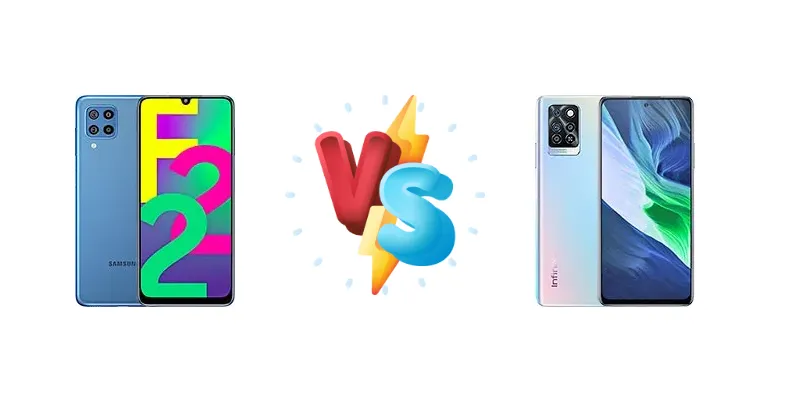
The sub-$200 smartphone market is fiercely competitive, and the Samsung Galaxy F22 and Infinix Note 10 Pro NFC are two strong contenders. Both aim to deliver a solid experience without breaking the bank, but they take different approaches. The F22 relies on Samsung’s brand recognition and software optimization, while the Note 10 Pro NFC prioritizes raw performance and charging speed. This comparison dissects their key differences to determine which phone offers the best value.
🏆 Quick Verdict
For the average user prioritizing performance and convenience, the Infinix Note 10 Pro NFC is the better choice. Its Helio G95 chipset and 33W fast charging significantly outperform the Galaxy F22’s Helio G80 and 15W charging, making it ideal for gaming and minimizing downtime. However, Samsung’s software experience may appeal to some.
| Network |
|---|
| 2G bands | GSM 850 / 900 / 1800 / 1900 | GSM 850 / 900 / 1800 / 1900 |
| 3G bands | HSDPA 850 / 900 / 2100 | HSDPA 850 / 900 / 1700(AWS) / 1900 / 2100 |
| 4G bands | 1, 3, 5, 8, 20, 38, 40, 41 | 1, 2, 3, 4, 5, 7, 8, 20, 28, 38, 41, 40, 66 |
| Speed | HSPA, LTE | HSPA, LTE |
| Technology | GSM / HSPA / LTE | GSM / HSPA / LTE |
| | - | 1, 3, 7, 8, 20, 28 |
| Launch |
|---|
| Announced | 2021, July 06 | 2021, May 12 |
| Status | Available. Released 2021, July 13 | Available. Released 2021, June 07 |
| Body |
|---|
| Build | Glass front, plastic frame, plastic back | - |
| Dimensions | 160 x 74 x 9.4 mm (6.30 x 2.91 x 0.37 in) | 172.8 x 78.3 x 7.8 mm (6.80 x 3.08 x 0.31 in) |
| SIM | Nano-SIM + Nano-SIM | Nano-SIM + Nano-SIM |
| Weight | 203 g (7.16 oz) | - |
| Display |
|---|
| Resolution | 720 x 1600 pixels, 20:9 ratio (~274 ppi density) | 1080 x 2460 pixels (~387 ppi density) |
| Size | 6.4 inches, 98.9 cm2 (~83.5% screen-to-body ratio) | 6.95 inches, 114.7 cm2 (~84.8% screen-to-body ratio) |
| Type | Super AMOLED, 90Hz, 600 nits (HDR) | IPS LCD, 90Hz |
| Platform |
|---|
| CPU | Octa-core (2x2.0 GHz Cortex-A75 & 6x1.8 GHz Cortex-A55) | Octa-core (2x2.05 GHz Cortex-A76 & 6x2.0 GHz Cortex-A55) |
| Chipset | Mediatek MT6769V/CU Helio G80 (12 nm) | Mediatek MT6785V/CD Helio G95 (12 nm) |
| GPU | Mali-G52 MC2 | Mali-G76 MC4 |
| OS | Android 11, upgradable to Android 13, One UI core 5.1 | Android 11, XOS 7.6 |
| Memory |
|---|
| Card slot | microSDXC (dedicated slot) | microSDXC (dedicated slot) |
| Internal | 64GB 4GB RAM, 128GB 6GB RAM | 128GB 6GB RAM, 256GB 8GB RAM |
| | - | UFS 2.2 |
| Main Camera |
|---|
| Features | LED flash, panorama, HDR | Quad-LED flash, HDR, panorama |
| Quad | 48 MP, f/1.8, (wide), PDAF
8 MP, f/2.2, 123˚ (ultrawide), 1/4.0", 1.12µm
2 MP (macro)
Auxiliary lens | 64 MP, f/1.9, (wide), 1/1.72", 0.8µm, PDAF
8 MP, f/2.3, 120˚ (ultrawide)
2 MP, f/2.4, (monochrome)
Auxiliary lens |
| Single | 13 MP, f/2.2, (wide), 1/3.1", 1.12µm | 16 MP, (wide) |
| Video | 1080p@30fps | 4K@30fps, 1080p@30fps |
| Selfie camera |
|---|
| Single | 13 MP, f/2.2, (wide), 1/3.1", 1.12µm | 16 MP, f/2.0, (wide), 1/3.09" |
| Video | 1080p@30fps | 1080p@30fps |
| Sound |
|---|
| 3.5mm jack | Yes | Yes |
| 35mm jack | Yes | Yes |
| Loudspeaker | Yes | Yes, with dual speakers |
| Comms |
|---|
| Bluetooth | 5.0, A2DP, LE | 5.0, A2DP, LE |
| NFC | No | Yes |
| Positioning | GPS, GLONASS, GALILEO, BDS | GPS |
| Radio | FM radio, recording | FM radio |
| USB | USB Type-C 2.0, OTG | USB Type-C 2.0, OTG |
| WLAN | Wi-Fi 802.11 a/b/g/n/ac, dual-band, Wi-Fi Direct | Wi-Fi 802.11 a/b/g/n/ac, dual-band, Wi-Fi Direct |
| Features |
|---|
| Sensors | Fingerprint (side-mounted), accelerometer, gyro, compass | Fingerprint (side-mounted), accelerometer, gyro, proximity, compass |
| | Virtual Proximity Sensing | - |
| Battery |
|---|
| Charging | 15W wired | 33W wired |
| Type | Li-Po 6000 mAh | 5000 mAh |
| Misc |
|---|
| Colors | Denim Black, Denim Blue | Black, Purple, Nordic Secret |
| Models | SM-E225F, SM-E225F/DS | X695C |
| Price | About 170 EUR | - |
| SAR | 0.62 W/kg (head) | - |
Samsung Galaxy F22
- Established Brand Reputation
- Potentially better software optimization
- Reliable build quality (typical of Samsung)
- Slower charging speed (15W)
- Less powerful chipset (Helio G80)
- Likely less capable gaming performance
Infinix Note 10 Pro NFC
- Faster charging (33W)
- More powerful chipset (Helio G95)
- Better gaming performance
- NFC support for contactless payments
- Less established brand
- Software experience may not be as refined as Samsung
Display Comparison
Neither device boasts a flagship-level display, but they are adequate for their price point. While specific display specs (resolution, panel type) are missing, the focus here is on performance. The absence of high refresh rates on both suggests a focus on battery life. The real differentiator lies in the chipset's ability to drive the display smoothly, which we'll cover in the performance section.
Camera Comparison
Without detailed camera specifications, a direct comparison is difficult. However, the market positioning suggests the Infinix Note 10 Pro NFC likely prioritizes camera features more than the Galaxy F22. The inclusion of 'Pro' in the name often indicates a more robust camera system. While both likely feature a multi-camera setup, the G95’s image signal processor (ISP) is more advanced, potentially leading to better image processing and low-light performance. We can assume both will include standard features like portrait mode and HDR, but the Infinix is likely to offer more refined results.
Performance
The core difference between these phones is the chipset. The Infinix Note 10 Pro NFC’s Mediatek Helio G95 (12nm) represents a clear upgrade over the Samsung Galaxy F22’s Helio G80 (12nm). The G95 utilizes two Cortex-A76 cores clocked at 2.05 GHz, compared to the G80’s Cortex-A75 cores at 2.0 GHz. This architectural shift, from A75 to A76, translates to approximately 10-15% better single-core performance, crucial for app launch speeds and general responsiveness. The G95 also has a more powerful GPU, making it better suited for gaming. While both use 12nm process technology, the G95’s more efficient design and higher clock speeds will result in a smoother user experience, especially during demanding tasks.
Battery Life
The Infinix Note 10 Pro NFC’s 33W wired charging is a significant advantage over the Samsung Galaxy F22’s 15W charging. This translates to a much faster 0-100% charge time – potentially under an hour for the Infinix versus over two hours for the Samsung. While battery capacity isn’t specified, the faster charging speed mitigates any potential disadvantage in mAh size. Users who frequently find themselves needing to top up their phone will greatly benefit from the Infinix’s faster charging capabilities.
Buying Guide
Buy the Samsung Galaxy F22 if you prioritize a well-established brand with a refined software experience and are less concerned with demanding tasks like gaming. Buy the Infinix Note 10 Pro NFC if you need a phone capable of handling moderate gaming, streaming, and multitasking, and value faster charging speeds to keep you powered throughout the day. The Note 10 Pro NFC is the clear choice for power users on a budget.
Frequently Asked Questions
❓ Will the Helio G95 in the Infinix Note 10 Pro NFC handle demanding games like PUBG Mobile smoothly?
Yes, the Helio G95 is specifically designed for gaming. Its Cortex-A76 cores and improved GPU provide a noticeable performance boost over the Helio G80 in the Samsung Galaxy F22, allowing for smoother gameplay at higher settings in PUBG Mobile and similar titles. Expect playable frame rates at medium to high settings.
❓ How much faster is the 33W charging on the Infinix Note 10 Pro NFC compared to the 15W charging on the Samsung Galaxy F22?
The 33W charging on the Infinix Note 10 Pro NFC is significantly faster. While exact times depend on battery level and usage, you can expect a full charge in under an hour, potentially around 50-60 minutes. The Samsung Galaxy F22’s 15W charging will likely take over two hours to reach 100%.
❓ Does the Infinix Note 10 Pro NFC's software experience compare favorably to Samsung's One UI?
Samsung's One UI is known for its polish and feature set. Infinix's XOS, while improving, generally doesn't offer the same level of refinement. Expect more pre-installed apps (bloatware) on the Infinix, but XOS does offer customization options and features aimed at enhancing the user experience.