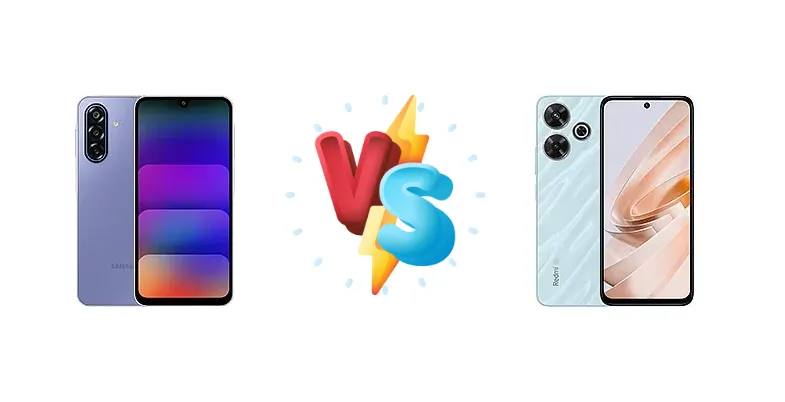
The Samsung Galaxy F17 and Xiaomi Redmi Note 13R represent compelling options in the crowded budget smartphone market. While both aim to deliver a solid experience without breaking the bank, they take different approaches to achieving this goal, primarily through their chipset choices. This comparison dissects the key differences between the Exynos 1330-powered F17 and the Snapdragon 4+ Gen 2-equipped Note 13R, helping you determine which device best suits your needs.
🏆 Quick Verdict
For the average user prioritizing sustained performance and slightly faster charging, the Xiaomi Redmi Note 13R emerges as the winner. Its Snapdragon 4+ Gen 2, built on a 4nm process, offers a more efficient architecture than the Galaxy F17’s 5nm Exynos 1330, translating to better thermal management and potentially longer gaming sessions.
| Network |
|---|
| 2G bands | GSM 850 / 900 / 1800 / 1900 | GSM 850 / 900 / 1800 / 1900 |
| 3G bands | HSDPA 850 / 900 / 1700(AWS) / 1900 / 2100 | HSDPA 850 / 900 / 2100 |
| 4G bands | 1, 2, 3, 4, 5, 7, 8, 12, 17, 20, 28, 38, 40, 41, 66 | 1, 3, 5, 8, 34, 38, 39, 40, 41 |
| 5G bands | 1, 3, 5, 7, 8, 26, 28, 40, 41, 66, 77, 78 SA/NSA/Sub6 | 1, 5, 8, 28, 41, 78 SA/NSA |
| Speed | HSPA, LTE, 5G | HSPA, LTE, 5G |
| Technology | GSM / HSPA / LTE / 5G | GSM / CDMA / HSPA / EVDO / LTE / 5G |
| Launch |
|---|
| Announced | 2025, September 11 | 2024, May 17 |
| Status | Available. Released 2025, September 14 | Available. Released 2024, May 17 |
| Body |
|---|
| Build | Glass front (Gorilla Glass Victus), plastic frame, fiber-reinforced plastic back | Glass front, plastic frame, glass back |
| Dimensions | 164.4 x 77.9 x 7.5 mm (6.47 x 3.07 x 0.30 in) | 168.6 x 76.3 x 8.2 mm (6.64 x 3.00 x 0.32 in) |
| SIM | Nano-SIM + Nano-SIM | Nano-SIM + Nano-SIM |
| Weight | 192 g (6.77 oz) | 205 g (7.23 oz) |
| Display |
|---|
| Protection | Corning Gorilla Glass Victus | - |
| Resolution | 1080 x 2340 pixels, 19.5:9 ratio (~385 ppi density) | 1080 x 2460 pixels (~396 ppi density) |
| Size | 6.7 inches, 110.2 cm2 (~86.0% screen-to-body ratio) | 6.79 inches, 109.5 cm2 (~85.1% screen-to-body ratio) |
| Type | Super AMOLED, 90Hz, 1100 nits (HBM) | IPS LCD, 120Hz, 550 nits |
| Platform |
|---|
| CPU | Octa-core (2x2.4 GHz Cortex-A78 & 6x2.0 GHz Cortex-A55) | Octa-core (2x2.3 GHz Cortex-A78 & 6x1.95 GHz Cortex-A55) |
| Chipset | Exynos 1330 (5 nm) | Qualcomm SM4450 Snapdragon 4+ Gen 2 (4 nm) |
| GPU | Mali-G68 MP2 | Adreno 613 |
| OS | Android 15, up to 6 major Android upgrades, One UI 7 | Android 14, HyperOS |
| Memory |
|---|
| Card slot | microSDXC (uses shared SIM slot) | No |
| Internal | 128GB 4GB RAM, 128GB 6GB RAM, 128GB 8GB RAM | 128GB 6GB RAM, 128GB 8GB RAM, 256GB 8GB RAM, 256GB 12GB RAM, 512GB 12GB RAM |
| Main Camera |
|---|
| Dual | - | 50 MP, f/1.8, (wide), 1/2.76", 0.64µm, PDAF
2 MP (macro) |
| Features | LED flash, panorama, HDR | LED flash, HDR |
| Triple | 50 MP, f/1.8, (wide), 1/2.76", 0.64µm, AF, OIS
5 MP, f/2.2, (ultrawide), 1/5.0", 1.12µm
2 MP (macro) | - |
| Video | 1080p@30fps, gyro-EIS | 1080p@30fps |
| Selfie camera |
|---|
| Single | 13 MP, f/2.0, (wide), 1/3.1", 1.12µm | 8 MP, (wide), 1/4.0", 1.12µm |
| Video | 1080p@30fps | 1080p@30fps |
| Sound |
|---|
| 35mm jack | No | Yes |
| Loudspeaker | Yes | Yes |
| Comms |
|---|
| Bluetooth | 5.3, A2DP, LE | 5.3, A2DP, LE |
| Infrared port | - | Yes |
| NFC | Yes | Yes |
| Positioning | GPS, GALILEO, GLONASS, BDS, QZSS | GPS, GLONASS, GALILEO, BDS |
| Radio | No | No |
| USB | USB Type-C 2.0, OTG | USB Type-C |
| WLAN | Wi-Fi 802.11 a/b/g/n/ac, dual-band, Wi-Fi Direct | Wi-Fi 802.11 a/b/g/n/ac, dual-band |
| Features |
|---|
| Sensors | Fingerprint (side-mounted), accelerometer, gyro, compass | Fingerprint (side-mounted), accelerometer, compass |
| Battery |
|---|
| Charging | 25W wired | 33W wired |
| Type | Li-Ion 5000 mAh | 5030 mAh |
| Misc |
|---|
| Colors | Black, Violet | Black, Blue, Silver |
| Models | SM-E176B/DS | 2406ERN9CC |
| Price | ₹ 12,914 | About 180 EUR |
| SAR | 0.64 W/kg (head) | - |
Samsung Galaxy F17
- Samsung Brand Recognition
- Potentially more refined software experience
- Access to Samsung ecosystem
- Less efficient chipset (5nm Exynos 1330)
- Slower charging speed (25W)
- Potential for more thermal throttling
Xiaomi Redmi Note 13R
- More efficient chipset (4nm Snapdragon 4+ Gen 2)
- Faster charging speed (33W)
- Better thermal management
- Xiaomi’s MIUI software can be polarizing
- Potentially less brand recognition than Samsung
Display Comparison
Display specifications are not provided, so we must infer. Given the price bracket, both devices likely feature LCD panels with FHD+ resolution. However, the Redmi Note 13R, following Xiaomi’s recent trends, may offer a higher refresh rate (90Hz or 120Hz) than the F17. The absence of LTPO technology on either device suggests standard refresh rate control, impacting battery consumption during dynamic content. Bezels are likely comparable, with both aiming for maximized screen real estate within their respective form factors.
Camera Comparison
Camera details are limited. Both phones likely feature a multi-camera setup, but the quality will depend heavily on sensor size and image processing. Without specific sensor information, it’s difficult to declare a clear winner. However, Xiaomi’s image processing algorithms are generally known for vibrant, saturated colors, while Samsung tends towards more natural tones. The presence of Optical Image Stabilization (OIS) on either device is unknown, but would significantly improve low-light photography and video stabilization. Any 2MP macro cameras on either device should be considered largely for marketing purposes, offering minimal practical benefit.
Performance
The core of the difference lies in the chipsets. The Xiaomi Redmi Note 13R’s Qualcomm SM4450 Snapdragon 4+ Gen 2 (4nm) benefits from a more modern architecture and a smaller fabrication process compared to the Samsung Galaxy F17’s Exynos 1330 (5nm). While both CPUs feature a 2x2.4 GHz Cortex-A78 and 6x2.0 GHz Cortex-A55 configuration, the Snapdragon’s 4nm process allows for greater transistor density and improved power efficiency. This translates to less heat generation under load, potentially mitigating thermal throttling during extended gaming or demanding tasks. The Exynos 1330, while capable, will likely exhibit more aggressive throttling. RAM speed (LPDDR4x vs LPDDR5x) is unknown, but a faster RAM standard on the Redmi Note 13R would further enhance its performance advantage.
Battery Life
Battery capacity is not specified, but both devices likely fall in the 5000mAh range, typical for this price segment. The Redmi Note 13R’s 33W wired charging is a clear advantage over the Galaxy F17’s 25W charging. This translates to a faster 0-100% charge time, reducing downtime. While a larger battery on the F17 could offset the slower charging, the Snapdragon 4+ Gen 2’s superior efficiency means the Note 13R will likely deliver comparable or even better battery life despite potentially having a similar capacity.
Buying Guide
Buy the Samsung Galaxy F17 if you prioritize the Samsung ecosystem and a potentially more refined software experience, even if it means slightly less raw processing power. Buy the Xiaomi Redmi Note 13R if you value efficient performance, faster charging speeds, and a chipset known for its balance of power and battery life, making it ideal for demanding users and gamers on a budget.
Frequently Asked Questions
❓ Does the Exynos 1330 in the Galaxy F17 overheat during prolonged gaming sessions?
The 5nm Exynos 1330 is a capable chip, but its larger fabrication process compared to the Snapdragon 4+ Gen 2 means it's more prone to thermal throttling under sustained load. Expect performance to dip slightly after 30-45 minutes of demanding gaming, whereas the Redmi Note 13R should maintain higher frame rates for longer.
❓ Is the 33W charging on the Redmi Note 13R significantly faster than the 25W charging on the Galaxy F17?
Yes, the 33W charging on the Redmi Note 13R will noticeably reduce charging times. While exact figures depend on battery capacity, expect a 0-100% charge to be approximately 30-60 minutes faster on the Redmi Note 13R compared to the Galaxy F17.
❓ How does the Snapdragon 4+ Gen 2 handle multitasking compared to the Exynos 1330?
The Snapdragon 4+ Gen 2’s more efficient architecture and potentially faster RAM (if LPDDR5x is used) will result in smoother multitasking. Expect quicker app switching and less lag when running multiple applications simultaneously on the Redmi Note 13R.