
Samsung Galaxy F17 vs vivo V30e: A Deep Dive into Mid-Range Performance
| Phones Images | |||||
|---|---|---|---|---|---|
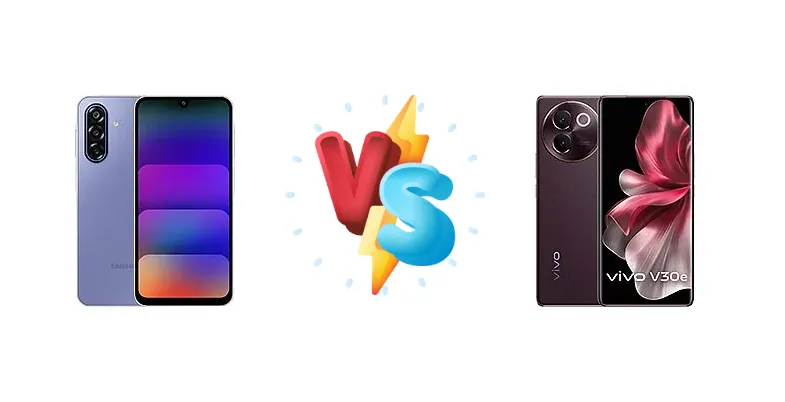
|
🏆 Quick Verdict
For the average user prioritizing fast charging and potentially better sustained performance, the vivo V30e emerges as the stronger contender. Its Snapdragon 6 Gen 1, built on a 4nm process, offers improved efficiency and the 44W charging with Power Delivery significantly reduces downtime. However, the F17 remains a viable option for those deeply embedded in the Samsung ecosystem.
| PHONES | ||
|---|---|---|
| Phone Names | Samsung Galaxy F17 | vivo V30e |
| Network | ||
|---|---|---|
| 2G bands | GSM 850 / 900 / 1800 / 1900 | GSM 850 / 900 / 1800 / 1900 |
| 3G bands | HSDPA 850 / 900 / 1700(AWS) / 1900 / 2100 | HSDPA 850 / 900 / 1700(AWS) / 1900 / 2100 - Malaysia |
| 4G bands | 1, 2, 3, 4, 5, 7, 8, 12, 17, 20, 28, 38, 40, 41, 66 | 1, 2, 3, 4, 5, 7, 8, 18, 19, 20, 26, 28, 38, 39, 40, 41 - Malaysia |
| 5G bands | 1, 3, 5, 7, 8, 26, 28, 40, 41, 66, 77, 78 SA/NSA/Sub6 | 1, 3, 5, 7, 8, 20, 28, 38, 40, 41, 77, 78 SA/NSA - Malaysia |
| Speed | HSPA, LTE, 5G | HSPA, LTE, 5G |
| Technology | GSM / HSPA / LTE / 5G | GSM / HSPA / LTE / 5G |
| Launch | ||
|---|---|---|
| Announced | 2025, September 11 | 2024, May 02 |
| Status | Available. Released 2025, September 14 | Available. Released 2024, May 09 |
| Body | ||
|---|---|---|
| Build | Glass front (Gorilla Glass Victus), plastic frame, fiber-reinforced plastic back | Glass front, plastic frame, glass back or plastic back |
| Dimensions | 164.4 x 77.9 x 7.5 mm (6.47 x 3.07 x 0.30 in) | 164.4 x 74.8 x 7.7 mm (6.47 x 2.94 x 0.30 in) |
| SIM | Nano-SIM + Nano-SIM | Nano-SIM + Nano-SIM |
| Weight | 192 g (6.77 oz) | 179 g or 188 g (6.31 oz) |
| Display | ||
|---|---|---|
| Protection | Corning Gorilla Glass Victus | Schott Xensation |
| Resolution | 1080 x 2340 pixels, 19.5:9 ratio (~385 ppi density) | 1080 x 2400 pixels, 20:9 ratio (~388 ppi density) |
| Size | 6.7 inches, 110.2 cm2 (~86.0% screen-to-body ratio) | 6.78 inches, 111.0 cm2 (~90.3% screen-to-body ratio) |
| Type | Super AMOLED, 90Hz, 1100 nits (HBM) | AMOLED, 1B colors, 120Hz, 1300 nits (peak) |
| Platform | ||
|---|---|---|
| CPU | Octa-core (2x2.4 GHz Cortex-A78 & 6x2.0 GHz Cortex-A55) | Octa-core (4x2.2 GHz Cortex-A78 & 4x1.8 GHz Cortex-A55) |
| Chipset | Exynos 1330 (5 nm) | Qualcomm SM6450 Snapdragon 6 Gen 1 (4 nm) |
| GPU | Mali-G68 MP2 | Adreno 710 |
| OS | Android 15, up to 6 major Android upgrades, One UI 7 | Android 14, Funtouch 14 |
| Memory | ||
|---|---|---|
| Card slot | microSDXC (uses shared SIM slot) | microSDXC (uses shared SIM slot) |
| Internal | 128GB 4GB RAM, 128GB 6GB RAM, 128GB 8GB RAM | 128GB 8GB RAM, 256GB 8GB RAM, 256GB 12GB RAM |
| Main Camera | ||
|---|---|---|
| Dual | - | 50 MP, f/1.8, 26mm (wide), 1/1.95", 0.8µm, PDAF, OIS (India only) 8 MP, f/2.2, 120˚ (ultrawide), 1/4.0", 1.12µm |
| Features | LED flash, panorama, HDR | Ring-LED flash, panorama, HDR |
| Triple | 50 MP, f/1.8, (wide), 1/2.76", 0.64µm, AF, OIS 5 MP, f/2.2, (ultrawide), 1/5.0", 1.12µm 2 MP (macro) | - |
| Video | 1080p@30fps, gyro-EIS | 4K@30fps, 1080p@30fps |
| Selfie camera | ||
|---|---|---|
| Single | 13 MP, f/2.0, (wide), 1/3.1", 1.12µm | 50 MP, f/2.5, 25mm (wide), AF - India 32 MP, f/2.0, 24mm (wide) - Malaysia |
| Video | 1080p@30fps | 4K@30fps (India only), 1080p@30fps |
| Sound | ||
|---|---|---|
| 35mm jack | No | No |
| Loudspeaker | Yes | Yes |
| Comms | ||
|---|---|---|
| Bluetooth | 5.3, A2DP, LE | 5.1, A2DP, LE |
| NFC | Yes | Yes (market/region dependent) |
| Positioning | GPS, GALILEO, GLONASS, BDS, QZSS | GPS, GLONASS, GALILEO, BDS, QZSS, NavIC |
| Radio | No | No |
| USB | USB Type-C 2.0, OTG | USB Type-C 2.0, OTG |
| WLAN | Wi-Fi 802.11 a/b/g/n/ac, dual-band, Wi-Fi Direct | Wi-Fi 802.11 a/b/g/n/ac, dual-band |
| Features | ||
|---|---|---|
| Sensors | Fingerprint (side-mounted), accelerometer, gyro, compass | Fingerprint (under display, optical), accelerometer, gyro, proximity, compass |
| Battery | ||
|---|---|---|
| Charging | 25W wired | 44W wired, PD Reverse wired |
| Type | Li-Ion 5000 mAh | Li-Ion 5500 mAh |
| Misc | ||
|---|---|---|
| Colors | Black, Violet | Velvet Red (Coco Brown), Silk Blue, Sky Mirror |
| Models | SM-E176B/DS | V2339 |
| Price | ₹ 12,914 | ₹ 23,999 |
| SAR | 0.64 W/kg (head) | - |
Samsung Galaxy F17
- Familiar Samsung One UI experience
- Potentially lower price point (depending on region)
- Established Samsung brand reputation
- Slower 25W charging
- Less efficient Exynos 1330 chipset
- Potential for more thermal throttling
vivo V30e
- Faster 44W charging with PD
- More efficient Snapdragon 6 Gen 1 chipset
- Reverse wired charging capability
- Less established brand recognition (in some markets)
- vivo’s Funtouch OS may not appeal to all users
- Potential for software update delays
Display Comparison
Neither device’s display specifications are provided, so we must infer. Given the price bracket, both likely feature FHD+ AMOLED panels. However, the V30e, being a newer release, may benefit from slightly improved color calibration and peak brightness. The absence of LTPO technology on either suggests standard 60Hz or 90Hz refresh rates, impacting smoothness during scrolling and animations. Bezels are likely comparable, focusing on maximizing screen real estate within the mid-range segment.
Camera Comparison
Without detailed camera specs, a direct comparison is limited. However, the market trend suggests the V30e, as a newer device, may incorporate more advanced image processing algorithms. Both phones likely feature a multi-camera setup, but the quality will hinge on sensor size and lens apertures – information not provided. The inclusion of Optical Image Stabilization (OIS) on either device would be a significant advantage for low-light photography and video recording. We can assume both will include a standard wide, ultrawide, and potentially a macro lens, though the utility of a 2MP macro lens is often questionable.
Performance
The core difference lies in the chipsets. The vivo V30e’s Snapdragon 6 Gen 1 (4nm) boasts a more efficient architecture than the Samsung Galaxy F17’s Exynos 1330 (5nm). While both utilize an octa-core configuration with Cortex-A78 performance cores, the Snapdragon’s 4x2.2 GHz cores are paired with 4x1.8 GHz efficiency cores, compared to the Exynos’ 2x2.4 GHz and 6x2.0 GHz setup. The 4nm process node of the Snapdragon translates to lower power consumption and potentially less thermal throttling under sustained load, benefiting gamers and power users. The F17’s Exynos, while capable, may exhibit more noticeable performance dips during prolonged intensive tasks.
Battery Life
Battery capacity isn’t specified for either device. However, the V30e’s 44W wired charging with Power Delivery (PD) is a clear advantage over the F17’s 25W charging. This translates to significantly faster charging times – potentially reducing a full charge from over 90 minutes on the F17 to under an hour on the V30e. The V30e also supports reverse wired charging, allowing it to act as a power bank for other devices, a feature absent on the F17. Even with a similar battery capacity, the V30e’s charging speed provides a more convenient user experience.
Buying Guide
Buy the Samsung Galaxy F17 if you prioritize Samsung’s One UI software experience and are comfortable with a slower charging speed. It’s a solid choice for everyday tasks and light gaming. Buy the vivo V30e if you value faster charging, potentially better thermal management during extended use, and a more modern chipset architecture, making it ideal for users who frequently game or multitask.