
Samsung Galaxy F17 vs OnePlus Nord CE 3 Lite: A Deep Dive into Mid-Range Performance
| Phones Images | |||||
|---|---|---|---|---|---|
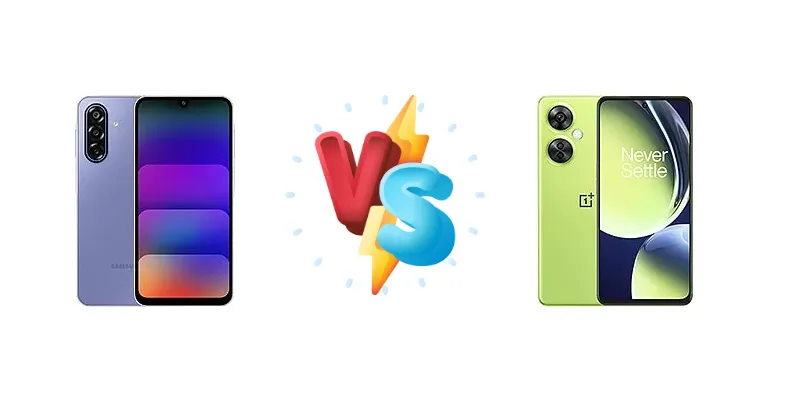
|
🏆 Quick Verdict
For the average user prioritizing rapid charging and a generally smoother experience, the OnePlus Nord CE 3 Lite emerges as the winner. Its 67W charging significantly outperforms the F17’s 25W, and the Snapdragon 695, despite being built on a 6nm process, offers a competitive experience for everyday tasks and light gaming.
| PHONES | ||
|---|---|---|
| Phone Names | Samsung Galaxy F17 | OnePlus Nord CE 3 Lite |
| Network | ||
|---|---|---|
| 2G bands | GSM 850 / 900 / 1800 / 1900 | GSM 850 / 900 / 1800 / 1900 |
| 3G bands | HSDPA 850 / 900 / 1700(AWS) / 1900 / 2100 | HSDPA 800 / 850 / 900 / 1700(AWS) / 1900 / 2100 - International |
| 4G bands | 1, 2, 3, 4, 5, 7, 8, 12, 17, 20, 28, 38, 40, 41, 66 | 1, 2, 3, 4, 5, 7, 8, 12, 13, 17, 18, 19, 20, 26, 28, 32, 38, 39, 40, 41, 66 - International |
| 5G bands | 1, 3, 5, 7, 8, 26, 28, 40, 41, 66, 77, 78 SA/NSA/Sub6 | 1, 3, 5, 7, 8, 20, 28, 38, 40, 41, 66, 77, 78 SA/NSA - International |
| Speed | HSPA, LTE, 5G | HSPA, LTE, 5G |
| Technology | GSM / HSPA / LTE / 5G | GSM / HSPA / LTE / 5G |
| - | 1, 3, 5, 8, 28, 40, 41, 77, 78 SA/NSA - India | |
| Launch | ||
|---|---|---|
| Announced | 2025, September 11 | 2023, April 04 |
| Status | Available. Released 2025, September 14 | Available. Released 2023, April 11 |
| Body | ||
|---|---|---|
| Build | Glass front (Gorilla Glass Victus), plastic frame, fiber-reinforced plastic back | Glass front, plastic frame, plastic back |
| Dimensions | 164.4 x 77.9 x 7.5 mm (6.47 x 3.07 x 0.30 in) | 165.5 x 76 x 8.3 mm (6.52 x 2.99 x 0.33 in) |
| SIM | Nano-SIM + Nano-SIM | Nano-SIM + Nano-SIM |
| Weight | 192 g (6.77 oz) | 195 g (6.88 oz) |
| Display | ||
|---|---|---|
| Protection | Corning Gorilla Glass Victus | Corning Gorilla Glass |
| Resolution | 1080 x 2340 pixels, 19.5:9 ratio (~385 ppi density) | 1080 x 2400 pixels, 20:9 ratio (~391 ppi density) |
| Size | 6.7 inches, 110.2 cm2 (~86.0% screen-to-body ratio) | 6.72 inches, 109.6 cm2 (~87.1% screen-to-body ratio) |
| Type | Super AMOLED, 90Hz, 1100 nits (HBM) | IPS LCD, 120Hz, 550 nits (typ), 680 nits (peak) |
| Platform | ||
|---|---|---|
| CPU | Octa-core (2x2.4 GHz Cortex-A78 & 6x2.0 GHz Cortex-A55) | Octa-core (2x2.2 GHz Kryo 660 Gold & 6x1.7 GHz Kryo 660 Silver) |
| Chipset | Exynos 1330 (5 nm) | Qualcomm SM6375 Snapdragon 695 5G (6 nm) |
| GPU | Mali-G68 MP2 | Adreno 619 |
| OS | Android 15, up to 6 major Android upgrades, One UI 7 | Android 13, OxygenOS 13.1 |
| Memory | ||
|---|---|---|
| Card slot | microSDXC (uses shared SIM slot) | microSDXC (uses shared SIM slot) |
| Internal | 128GB 4GB RAM, 128GB 6GB RAM, 128GB 8GB RAM | 128GB 8GB RAM, 256GB 8GB RAM |
| - | UFS 2.2 | |
| Main Camera | ||
|---|---|---|
| Features | LED flash, panorama, HDR | LED flash, HDR, panorama |
| Triple | 50 MP, f/1.8, (wide), 1/2.76", 0.64µm, AF, OIS 5 MP, f/2.2, (ultrawide), 1/5.0", 1.12µm 2 MP (macro) | 108 MP, f/1.8, (wide), 1/1.67", 0.64µm, PDAF 2 MP (macro) Auxiliary lens |
| Video | 1080p@30fps, gyro-EIS | 1080p@30fps |
| Selfie camera | ||
|---|---|---|
| Features | - | HDR, panorama |
| Single | 13 MP, f/2.0, (wide), 1/3.1", 1.12µm | 16 MP, f/2.4, (wide), 1.0µm |
| Video | 1080p@30fps | 1080p@30fps |
| Sound | ||
|---|---|---|
| 3.5mm jack | - | Yes |
| 35mm jack | No | Yes |
| Loudspeaker | Yes | Yes, with stereo speakers |
| Comms | ||
|---|---|---|
| Bluetooth | 5.3, A2DP, LE | 5.1, A2DP, LE, aptX HD |
| NFC | Yes | Yes (market/region dependent) |
| Positioning | GPS, GALILEO, GLONASS, BDS, QZSS | GPS, GALILEO, GLONASS, BDS, QZSS |
| Radio | No | No |
| USB | USB Type-C 2.0, OTG | USB Type-C 2.0, OTG |
| WLAN | Wi-Fi 802.11 a/b/g/n/ac, dual-band, Wi-Fi Direct | Wi-Fi 802.11 a/b/g/n/ac, dual-band |
| Features | ||
|---|---|---|
| Sensors | Fingerprint (side-mounted), accelerometer, gyro, compass | Fingerprint (side-mounted), accelerometer, gyro, proximity, compass |
| Battery | ||
|---|---|---|
| Charging | 25W wired | 67W wired, 80% in 30 min |
| Type | Li-Ion 5000 mAh | Li-Po 5000 mAh |
| Misc | ||
|---|---|---|
| Colors | Black, Violet | Pastel Lime, Chromatic Gray |
| Models | SM-E176B/DS | CPH2467, CPH2465 |
| Price | ₹ 12,914 | £ 169.98 / € 209.99 |
| SAR | 0.64 W/kg (head) | 1.17 W/kg (head) 0.70 W/kg (body) |
| Tests | ||
|---|---|---|
| Performance | - | AnTuTu: 412006 (v9) GeekBench: 2052 (v5) GFXBench: 17fps (ES 3.1 onscreen) |
Samsung Galaxy F17
- Potentially more powerful CPU for demanding tasks
- Samsung’s One UI ecosystem
- 5nm Chipset for potentially better efficiency
- Slower 25W charging
- Potential for thermal throttling under sustained load
- Less efficient chipset compared to Snapdragon 695
OnePlus Nord CE 3 Lite
- Incredibly fast 67W charging
- More power-efficient Snapdragon 695 chipset
- Streamlined OxygenOS software experience
- Slightly less powerful CPU cores
- May lack some of Samsung’s software features
- Potentially less advanced ISP
Display Comparison
Neither device boasts a flagship-level display, but key differences exist. While specific display specs (resolution, refresh rate) are missing for both, the focus here is on the underlying processing power impacting display responsiveness. The Exynos 1330’s GPU may offer slightly better graphical performance, potentially translating to smoother animations, but this is highly dependent on the display panel itself. Without knowing the panel technology (LCD vs AMOLED) or refresh rate, a definitive winner is difficult to declare.
Camera Comparison
Without detailed camera specifications (sensor size, aperture, OIS), a direct comparison is limited. However, the market positioning suggests both phones will feature a primary camera focused on daylight photography. The Exynos 1330’s ISP (Image Signal Processor) *could* offer slightly more advanced image processing capabilities, but this is speculative. The presence or absence of Optical Image Stabilization (OIS) would be a significant differentiator, favoring the device equipped with it. We can assume both will include standard features like portrait mode and night mode, but image quality will ultimately depend on the quality of the sensors and software tuning.
Performance
The chipset battle is central here. The Samsung Galaxy F17’s Exynos 1330 (5nm) features a more powerful CPU configuration with 2x2.4 GHz Cortex-A78 cores compared to the OnePlus Nord CE 3 Lite’s Snapdragon 695 (6nm) with 2x2.2 GHz Kryo 660 Gold cores. However, the Snapdragon 695’s 6nm process offers improved power efficiency. This means the Snapdragon 695 is likely to run cooler under sustained load, potentially mitigating thermal throttling. The Exynos 1330 *should* win in raw CPU benchmarks, but real-world performance will depend on software optimization and thermal management. The Snapdragon 695’s integrated 5G modem is a benefit for users in areas with 5G coverage.
Battery Life
The OnePlus Nord CE 3 Lite’s 67W wired charging is a game-changer. Claimed 80% charge in 30 minutes drastically reduces downtime compared to the Samsung Galaxy F17’s 25W charging. While battery capacity isn’t specified, the faster charging speed effectively mitigates any potential disadvantage from a smaller battery. The Snapdragon 695’s superior power efficiency further contributes to longer battery life between charges, making the Nord CE 3 Lite the clear winner in this category.
Buying Guide
Buy the Samsung Galaxy F17 if you prioritize Samsung’s One UI ecosystem and potentially benefit from the Exynos 1330’s Cortex-A78 cores for more demanding, sustained workloads. Buy the OnePlus Nord CE 3 Lite if you value incredibly fast charging, a streamlined software experience with OxygenOS, and a more efficient chipset for everyday use, making it ideal for users who frequently top up their battery throughout the day.