
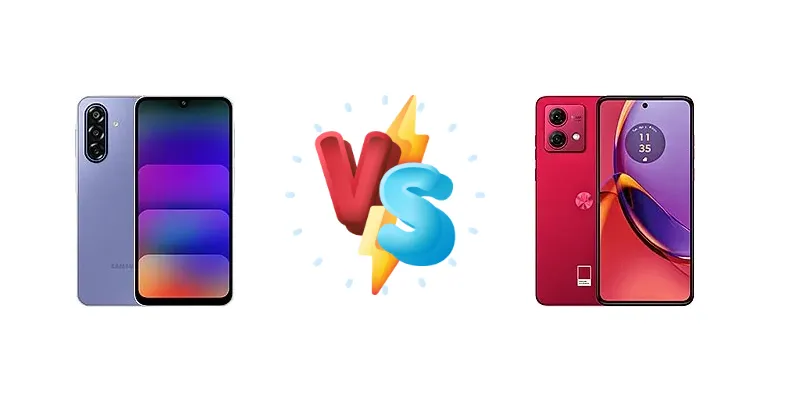
Samsung Galaxy F17 vs Motorola Moto G84: A Detailed Comparison
| Phones Images | |||||
|---|---|---|---|---|---|
|
🏆 Quick Verdict
For most users, the Motorola Moto G84 emerges as the stronger choice. Its impressive 12:31h active use battery life and 996 nits peak brightness provide a tangible advantage over the Galaxy F17, despite the Exynos 1330’s theoretical performance edge. The 30W charging also offers a quicker top-up.
| PHONES | ||
|---|---|---|
| Phone Names | Samsung Galaxy F17 | Motorola Moto G84 |
| Network | ||
|---|---|---|
| 2G bands | GSM 850 / 900 / 1800 / 1900 | GSM 850 / 900 / 1800 / 1900 |
| 3G bands | HSDPA 850 / 900 / 1700(AWS) / 1900 / 2100 | HSDPA 850 / 900 / 1700(AWS) / 1900 / 2100 - LATAM |
| 4G bands | 1, 2, 3, 4, 5, 7, 8, 12, 17, 20, 28, 38, 40, 41, 66 | 1, 2, 3, 4, 5, 7, 8, 12, 13, 17, 25, 26, 28, 38, 40, 41, 42, 66 - LATAM |
| 5G bands | 1, 3, 5, 7, 8, 26, 28, 40, 41, 66, 77, 78 SA/NSA/Sub6 | 1, 2, 3, 5, 7, 26, 28, 40, 66, 78 SA/NSA/Sub6 - LATAM |
| Speed | HSPA, LTE, 5G | HSPA, LTE, 5G |
| Technology | GSM / HSPA / LTE / 5G | GSM / HSPA / LTE / 5G |
| Launch | ||
|---|---|---|
| Announced | 2025, September 11 | 2023, August 24 |
| Status | Available. Released 2025, September 14 | Available. Released 2023, September 08 |
| Body | ||
|---|---|---|
| Build | Glass front (Gorilla Glass Victus), plastic frame, fiber-reinforced plastic back | Glass front, plastic frame, plastic back or eco leather back |
| Dimensions | 164.4 x 77.9 x 7.5 mm (6.47 x 3.07 x 0.30 in) | 160 x 74.4 x 7.6 mm (6.30 x 2.93 x 0.30 in) |
| SIM | Nano-SIM + Nano-SIM | Nano-SIM + Nano-SIM |
| Weight | 192 g (6.77 oz) | 166.8 g (5.86 oz) |
| Display | ||
|---|---|---|
| Protection | Corning Gorilla Glass Victus | - |
| Resolution | 1080 x 2340 pixels, 19.5:9 ratio (~385 ppi density) | 1080 x 2400 pixels, 20:9 ratio (~405 ppi density) |
| Size | 6.7 inches, 110.2 cm2 (~86.0% screen-to-body ratio) | 6.5 inches, 102.0 cm2 (~85.7% screen-to-body ratio) |
| Type | Super AMOLED, 90Hz, 1100 nits (HBM) | P-OLED, 1B colors, 120Hz, 1300 nits (peak) |
| Platform | ||
|---|---|---|
| CPU | Octa-core (2x2.4 GHz Cortex-A78 & 6x2.0 GHz Cortex-A55) | Octa-core (2x2.2 GHz Kryo 660 Gold & 6x1.7 GHz Kryo 660 Silver) |
| Chipset | Exynos 1330 (5 nm) | Qualcomm SM6375 Snapdragon 695 5G (6 nm) |
| GPU | Mali-G68 MP2 | Adreno 619 |
| OS | Android 15, up to 6 major Android upgrades, One UI 7 | Android 13, upgradable to Android 15 |
| Memory | ||
|---|---|---|
| Card slot | microSDXC (uses shared SIM slot) | microSDXC (uses shared SIM slot) |
| Internal | 128GB 4GB RAM, 128GB 6GB RAM, 128GB 8GB RAM | 256GB 8GB RAM, 256GB 12GB RAM |
| Main Camera | ||
|---|---|---|
| Dual | - | 50 MP, f/1.9 (wide), 1/1.5", 1.0µm, PDAF, OIS 8 MP, f/2.2, 120˚ (ultrawide), 1/4.0", 1.12µm, AF |
| Features | LED flash, panorama, HDR | LED flash, HDR, panorama |
| Triple | 50 MP, f/1.8, (wide), 1/2.76", 0.64µm, AF, OIS 5 MP, f/2.2, (ultrawide), 1/5.0", 1.12µm 2 MP (macro) | - |
| Video | 1080p@30fps, gyro-EIS | 1080p@30/60fps |
| Selfie camera | ||
|---|---|---|
| Single | 13 MP, f/2.0, (wide), 1/3.1", 1.12µm | 16 MP, f/2.5, (wide), 1.0µm |
| Video | 1080p@30fps | 1080p@30fps |
| Sound | ||
|---|---|---|
| 35mm jack | No | Yes |
| Loudspeaker | Yes | Yes, with stereo speakers |
| Comms | ||
|---|---|---|
| Bluetooth | 5.3, A2DP, LE | 5.1, A2DP, LE |
| NFC | Yes | Yes (market/region dependent) |
| Positioning | GPS, GALILEO, GLONASS, BDS, QZSS | GPS, GLONASS, GALILEO |
| Radio | No | FM radio (market/region dependent) |
| USB | USB Type-C 2.0, OTG | USB Type-C 2.0 |
| WLAN | Wi-Fi 802.11 a/b/g/n/ac, dual-band, Wi-Fi Direct | Wi-Fi 802.11 a/b/g/n/ac, dual-band, Wi-Fi Direct |
| Features | ||
|---|---|---|
| Sensors | Fingerprint (side-mounted), accelerometer, gyro, compass | Fingerprint (under display, optical), accelerometer, gyro, proximity, compass |
| Battery | ||
|---|---|---|
| Charging | 25W wired | 30W wired |
| Type | Li-Ion 5000 mAh | Li-Po 5000 mAh |
| Misc | ||
|---|---|---|
| Colors | Black, Violet | Marshmallow Blue, Midnight Blue, Viva Magenta |
| Models | SM-E176B/DS | XT2347, XT2347-1, XT2347-2 |
| Price | ₹ 12,914 | $ 399.00 / £ 189.99 / € 169.00 |
| SAR | 0.64 W/kg (head) | - |
Samsung Galaxy F17
- Potentially faster CPU performance with Exynos 1330
- Samsung’s software ecosystem and potential for longer software support
- 5nm Chipset could offer better thermal efficiency
- Likely shorter battery life compared to Moto G84
- Slower 25W charging
- Display brightness not specified, potentially lower than Moto G84
Motorola Moto G84
- Excellent battery life (12:31h active use, 117h endurance)
- Bright 996 nits display for outdoor visibility
- Faster 30W charging
- Snapdragon 695 may offer less raw CPU power than Exynos 1330
- Camera specs are vague
- Motorola’s software update policy can be inconsistent
Display Comparison
The Motorola Moto G84 boasts a significantly brighter display, reaching a measured 996 nits peak brightness. This is a crucial advantage for outdoor use, where the Galaxy F17’s display brightness is not specified, likely falling short. While panel technology isn’t detailed, the G84’s brightness suggests a well-optimized LCD or OLED panel. Bezels are not specified for either device, but the G84’s brightness is a clear win for visibility. Color accuracy is also unknown for both, but the G84’s higher brightness generally correlates with better color vibrancy.
Camera Comparison
Camera details are limited. Both devices are listed as having 'Photo / Video' capabilities, offering little insight. Without sensor size, aperture, or OIS information, a direct comparison is difficult. The presence of a 2MP macro camera on either device is unlikely to significantly impact image quality, serving primarily as a marketing feature. Image processing style will likely differ – Samsung typically favors vibrant, saturated colors, while Motorola often aims for a more natural look. The lack of detailed camera specs makes it impossible to declare a clear winner.
Performance
The Samsung Galaxy F17’s Exynos 1330 (5nm) features a more complex CPU configuration – octa-core with 2x2.4 GHz Cortex-A78 and 6x2.0 GHz Cortex-A55 cores – compared to the Motorola Moto G84’s Snapdragon 695 (6nm) with 2x2.2 GHz Kryo 660 Gold and 6x1.7 GHz Kryo 660 Silver. The 5nm process of the Exynos 1330 *should* offer better power efficiency, but the Snapdragon 695’s 6nm node is also efficient. However, the G84’s real-world battery performance suggests better overall efficiency. The Exynos 1330’s Cortex-A78 cores provide a theoretical performance advantage in CPU-intensive tasks, but the Snapdragon 695 is optimized for 5G connectivity and sustained performance.
Battery Life
The Motorola Moto G84 shines in battery performance, achieving an impressive 12:31h active use score and an endurance rating of 117h. The Samsung Galaxy F17’s battery capacity is not specified, but its 25W charging is slower than the Moto G84’s 30W charging. The G84’s superior endurance suggests a larger battery capacity or more efficient power management. The faster charging on the G84 also means less downtime plugged into the wall.
Buying Guide
Buy the Samsung Galaxy F17 if you prioritize raw processing power for demanding applications and potentially benefit from Samsung’s software ecosystem. However, be prepared for potentially shorter battery life. Buy the Motorola Moto G84 if you value all-day battery life, a brighter display for outdoor visibility, and faster charging speeds, making it ideal for users who prioritize practicality and longevity.