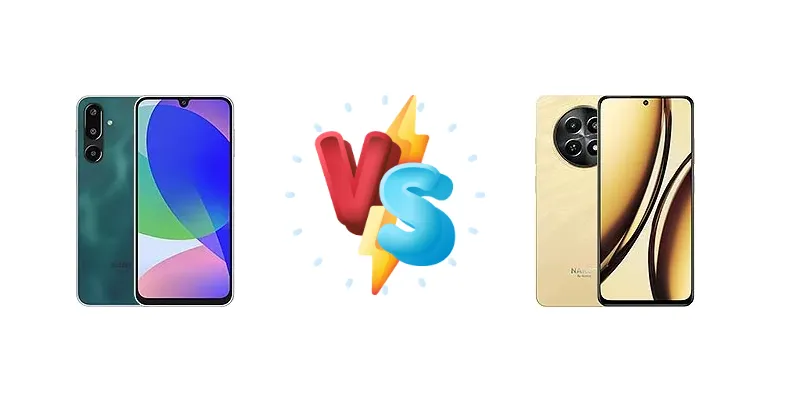
The Samsung Galaxy F16 and Realme Narzo N65 represent a fascinating intersection in the budget smartphone market. Both devices are powered by the Mediatek Dimensity 6300, suggesting similar performance capabilities. However, subtle differences in charging speed and potentially other areas could make one a more compelling choice than the other, particularly for users prioritizing specific features.
🏆 Quick Verdict
For the average user, the Samsung Galaxy F16 emerges as the slightly better option. While both phones share the same Dimensity 6300 chipset, the F16’s 25W charging significantly reduces downtime, making it ideal for those constantly on the go. The Narzo N65 remains a strong contender, especially for budget-conscious buyers.
| Network |
|---|
| 2G bands | GSM 850 / 900 / 1800 / 1900 | GSM 850 / 900 / 1800 / 1900 |
| 3G bands | HSDPA 850 / 900 / 1700(AWS) / 1900 / 2100 | HSDPA 850 / 900 / 2100 |
| 4G bands | 1, 2, 3, 4, 5, 7, 8, 12, 17, 20, 26, 28, 38, 40, 41, 66 | 1, 3, 5, 8, 28, 40, 41 |
| 5G bands | 1, 3, 5, 7, 8, 28, 40, 41, 66, 77, 78 SA/NSA/Sub6 | 1, 3, 5, 8, 28, 40, 41, 77, 78 SA/NSA |
| Speed | HSPA, LTE, 5G | HSPA, LTE, 5G |
| Technology | GSM / HSPA / LTE / 5G | GSM / HSPA / LTE / 5G |
| Launch |
|---|
| Announced | 2025, March 11 | 2024, May 28 |
| Status | Available. Released 2025, March 13 | Available. Released 2024, May 31 |
| Body |
|---|
| Build | Glass front, plastic back, plastic frame | - |
| Dimensions | 164.4 x 77.9 x 7.9 mm (6.47 x 3.07 x 0.31 in) | 165.6 x 76.1 x 7.9 mm (6.52 x 3.00 x 0.31 in) |
| SIM | Nano-SIM + Nano-SIM | Nano-SIM + Nano-SIM |
| Weight | 191 g (6.74 oz) | 190 g (6.70 oz) |
| Display |
|---|
| Resolution | 1080 x 2340 pixels, 19.5:9 ratio (~385 ppi density) | 720 x 1604 pixels, 20:9 ratio (~264 ppi density) |
| Size | 6.7 inches, 110.2 cm2 (~86.0% screen-to-body ratio) | 6.67 inches, 107.2 cm2 (~85.1% screen-to-body ratio) |
| Type | Super AMOLED, 90Hz, 800 nits (HBM) | IPS LCD, 120Hz, 500 nits (typ), 625 nits (HBM) |
| Platform |
|---|
| CPU | Octa-core (2x2.4 GHz Cortex-A76 & 6x2.0 GHz Cortex-A55) | Octa-core (2x2.4 GHz Cortex-A76 & 6x2.0 GHz Cortex-A55) |
| Chipset | Mediatek Dimensity 6300 (6 nm) | Mediatek Dimensity 6300 (6 nm) |
| GPU | Mali-G57 MC2 | Mali-G57 MC2 |
| OS | Android 15, up to 6 major Android upgrades, One UI 7 | Android 14, Realme UI 5.0 |
| Memory |
|---|
| Card slot | microSDXC (uses shared SIM slot) | microSDXC (uses shared SIM slot) |
| Internal | 128GB 4GB RAM, 128GB 6GB RAM, 128GB 8GB RAM | 128GB 4GB RAM, 128GB 6GB RAM, 128GB 8GB RAM |
| Main Camera |
|---|
| Features | LED flash, panorama, HDR | LED flash, panorama |
| Single | - | 50 MP, f/1.8, (wide), PDAF
Auxiliary lens/sensor |
| Triple | 50 MP, f/1.8, (wide), 1/2.76", 0.64µm, AF
5 MP, f/2.2, (ultrawide), 1/5.0", 1.12µm
2 MP (macro) | - |
| Video | 1080p@30fps, gyro-EIS | 1080p@30fps |
| Selfie camera |
|---|
| Features | - | Panorama |
| Single | 13 MP, f/2.0, (wide), 1/3.1", 1.12µm | 8 MP, f/2.0, (wide) |
| Video | 1080p@30fps | 1080p@30fps |
| Sound |
|---|
| 35mm jack | No | Yes |
| Loudspeaker | Yes | Yes |
| Comms |
|---|
| Bluetooth | 5.3, A2DP, LE | 5.3, A2DP, LE |
| NFC | Yes | No |
| Positioning | GPS, GALILEO, GLONASS, BDS, QZSS | GPS, GALILEO, GLONASS, QZSS, BDS |
| Radio | No | Unspecified |
| USB | USB Type-C 2.0 | USB Type-C 2.0 |
| WLAN | Wi-Fi 802.11 a/b/g/n/ac, dual-band, Wi-Fi Direct | Wi-Fi 802.11 a/b/g/n/ac, dual-band |
| Features |
|---|
| Sensors | Fingerprint (side-mounted), accelerometer, gyro, proximity, compass | Fingerprint (side-mounted), accelerometer, gyro, proximity, compass |
| Battery |
|---|
| Charging | 25W wired | 15W wired |
| Type | 5000 mAh | 5000 mAh |
| Misc |
|---|
| Colors | Bling Black, Vibing Blue, Glam Green | Amber Gold, Deep Green |
| Models | SM-E166P, SM-E166P/DS | - |
| Price | ₹ 13,300 | About 130 EUR |
| SAR | 1.08 W/kg (head) | - |
| SAR EU | 0.99 W/kg (head) 1.19 W/kg (body) | - |
Samsung Galaxy F16
- Faster 25W charging for quicker top-ups
- Potential for better software support from Samsung
- Likely more refined user interface
- Potentially higher price compared to the Narzo N65
- May lack features found on more expensive Samsung models
Realme Narzo N65
- More affordable price point
- Realme UI offers a customizable experience
- Potentially lighter and more compact design
- Slower 15W charging
- Software updates may be less frequent than Samsung
- Build quality may be less premium
Display Comparison
Both the Galaxy F16 and Narzo N65 are expected to feature LCD panels, typical for this price segment. While specific details like peak brightness and color gamut coverage are currently unavailable, the display experience will likely be similar. Bezels are also expected to be comparable, focusing on maximizing screen real estate within the budget constraints. The absence of high refresh rate panels is also anticipated, prioritizing battery life over smoother scrolling.
Camera Comparison
Without detailed camera specifications, it’s difficult to make a definitive judgment. Both phones will likely feature a multi-camera setup, but the quality will hinge on the primary sensor and image processing algorithms. Expect a focus on computational photography to enhance image quality in various lighting conditions. The inclusion of a 2MP macro camera on either device is largely a marketing tactic, offering limited practical benefit due to its low resolution and fixed focus. The aperture of the main sensor will be a key differentiator, with a wider aperture (lower f-number) allowing for better low-light performance.
Performance
The core of both devices is the Mediatek Dimensity 6300 (6nm). This chipset features an octa-core configuration with 2x2.4 GHz Cortex-A76 and 6x2.0 GHz Cortex-A55 cores, promising comparable CPU performance. The 6nm process node contributes to reasonable power efficiency. However, real-world performance will depend on RAM configuration and thermal management, which are currently unknown. The shared chipset means gaming performance will be largely identical, with both phones capable of handling most popular titles at medium settings. The lack of LPDDR5X RAM (likely using LPDDR4X) will limit memory bandwidth, but this is standard for this price point.
Battery Life
The most significant difference lies in charging speed. The Samsung Galaxy F16 supports 25W wired charging, while the Realme Narzo N65 is limited to 15W. This translates to a considerably faster charging experience for the F16. While battery capacity is unknown for both devices, the faster charging of the F16 mitigates the impact of a potentially smaller battery. A full charge on the F16 is expected to take around 1 hour 30 minutes, while the Narzo N65 will likely require over 2 hours.
Buying Guide
Buy the Samsung Galaxy F16 if you need faster charging and value the Samsung brand ecosystem. Its 25W charging will minimize interruptions to your day. Buy the Realme Narzo N65 if you prioritize absolute affordability and are willing to trade charging speed for a lower price point. It’s a solid choice for users who don’t mind slower top-ups.
Frequently Asked Questions
❓ Will the Dimensity 6300 in the Narzo N65 struggle with demanding games like Genshin Impact?
The Dimensity 6300 is a capable chipset for its price range, but Genshin Impact is a particularly demanding title. Expect to play at low to medium settings with frame rate dips, especially during intense combat sequences. Both phones will offer a similar gaming experience.
❓ How does Realme UI compare to Samsung's One UI in terms of bloatware?
Historically, Realme UI has been less aggressive with pre-installed bloatware compared to Samsung's One UI. However, both interfaces have improved in recent iterations. Expect to find some pre-installed apps on both devices, but the amount is generally manageable.
❓ Is the 15W charging on the Narzo N65 slow enough to be a dealbreaker?
If you frequently find yourself needing to quickly top up your phone throughout the day, the 15W charging on the Narzo N65 could be inconvenient. The Samsung Galaxy F16’s 25W charging offers a significantly faster charging experience, making it a better choice for power users.