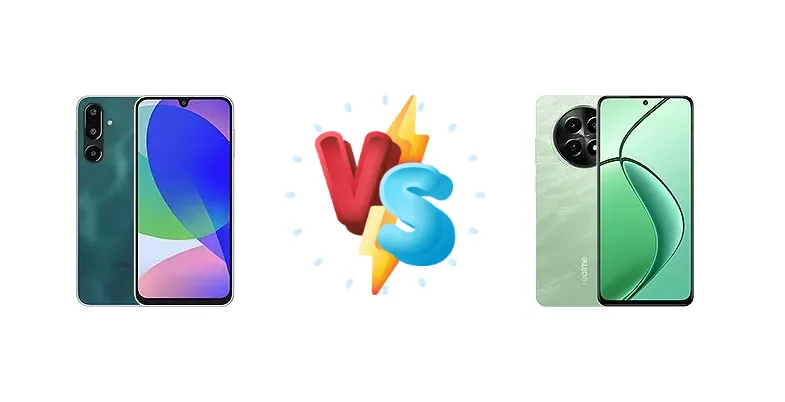
The Samsung Galaxy F16 and Realme C65 5G represent a growing trend: affordable 5G smartphones powered by capable chipsets. Both devices utilize the Mediatek Dimensity 6300, creating a fascinating head-to-head. This comparison dives deep into the nuances beyond the chipset, focusing on charging speeds, potential software experiences, and overall value to help you choose the right phone.
🏆 Quick Verdict
For the average user prioritizing quick top-ups and potentially longer software support, the Samsung Galaxy F16 emerges as the slightly better choice. Its 25W charging significantly outperforms the Realme C65 5G’s 15W, reducing downtime. However, the C65 5G remains a compelling option for those seeking maximum value.
| Network |
|---|
| 2G bands | GSM 850 / 900 / 1800 / 1900 | GSM 850 / 900 / 1800 / 1900 |
| 3G bands | HSDPA 850 / 900 / 1700(AWS) / 1900 / 2100 | HSDPA 850 / 900 / 2100 |
| 4G bands | 1, 2, 3, 4, 5, 7, 8, 12, 17, 20, 26, 28, 38, 40, 41, 66 | 1, 3, 5, 8, 28, 40, 41 |
| 5G bands | 1, 3, 5, 7, 8, 28, 40, 41, 66, 77, 78 SA/NSA/Sub6 | 1, 3, 5, 8, 28, 40, 41, 77, 78 SA/NSA |
| Speed | HSPA, LTE, 5G | HSPA, LTE, 5G |
| Technology | GSM / HSPA / LTE / 5G | GSM / HSPA / LTE / 5G |
| Launch |
|---|
| Announced | 2025, March 11 | 2024, April 26 |
| Status | Available. Released 2025, March 13 | Available. Released 2024, April 26 |
| Body |
|---|
| Build | Glass front, plastic back, plastic frame | - |
| Dimensions | 164.4 x 77.9 x 7.9 mm (6.47 x 3.07 x 0.31 in) | 165.6 x 76.1 x 7.9 mm (6.52 x 3.00 x 0.31 in) |
| SIM | Nano-SIM + Nano-SIM | Nano-SIM + Nano-SIM |
| Weight | 191 g (6.74 oz) | 190 g (6.70 oz) |
| Display |
|---|
| Resolution | 1080 x 2340 pixels, 19.5:9 ratio (~385 ppi density) | 720 x 1604 pixels, 20:9 ratio (~264 ppi density) |
| Size | 6.7 inches, 110.2 cm2 (~86.0% screen-to-body ratio) | 6.67 inches, 107.2 cm2 (~85.1% screen-to-body ratio) |
| Type | Super AMOLED, 90Hz, 800 nits (HBM) | IPS LCD, 120Hz, 500 nits (typ), 625 nits (HBM) |
| Platform |
|---|
| CPU | Octa-core (2x2.4 GHz Cortex-A76 & 6x2.0 GHz Cortex-A55) | Octa-core (2x2.4 GHz Cortex-A76 & 6x2.0 GHz Cortex-A55) |
| Chipset | Mediatek Dimensity 6300 (6 nm) | Mediatek Dimensity 6300 (6 nm) |
| GPU | Mali-G57 MC2 | Mali-G57 MC2 |
| OS | Android 15, up to 6 major Android upgrades, One UI 7 | Android 14, Realme UI 5.0 |
| Memory |
|---|
| Card slot | microSDXC (uses shared SIM slot) | microSDXC (uses shared SIM slot) |
| Internal | 128GB 4GB RAM, 128GB 6GB RAM, 128GB 8GB RAM | 64GB 4GB RAM, 128GB 4GB RAM, 128GB 6GB RAM, 128GB 8GB RAM |
| Main Camera |
|---|
| Features | LED flash, panorama, HDR | LED flash, HDR, panorama |
| Single | - | 50 MP, f/1.8, (wide), PDAF
Auxiliary lens/sensor |
| Triple | 50 MP, f/1.8, (wide), 1/2.76", 0.64µm, AF
5 MP, f/2.2, (ultrawide), 1/5.0", 1.12µm
2 MP (macro) | - |
| Video | 1080p@30fps, gyro-EIS | 1080p@30fps |
| Selfie camera |
|---|
| Features | - | Panorama |
| Single | 13 MP, f/2.0, (wide), 1/3.1", 1.12µm | 8 MP, f/2.0, (wide) |
| Video | 1080p@30fps | 1080p@30fps |
| Sound |
|---|
| 35mm jack | No | Yes |
| Loudspeaker | Yes | Yes |
| Comms |
|---|
| Bluetooth | 5.3, A2DP, LE | 5.3, A2DP, LE |
| NFC | Yes | No |
| Positioning | GPS, GALILEO, GLONASS, BDS, QZSS | GPS, GALILEO, GLONASS, QZSS, BDS |
| Radio | No | Unspecified |
| USB | USB Type-C 2.0 | USB Type-C 2.0 |
| WLAN | Wi-Fi 802.11 a/b/g/n/ac, dual-band, Wi-Fi Direct | Wi-Fi 802.11 a/b/g/n/ac, dual-band |
| Features |
|---|
| Sensors | Fingerprint (side-mounted), accelerometer, gyro, proximity, compass | Fingerprint (side-mounted), accelerometer, gyro, proximity, compass |
| Battery |
|---|
| Charging | 25W wired | 15W wired |
| Type | 5000 mAh | 5000 mAh |
| Misc |
|---|
| Colors | Bling Black, Vibing Blue, Glam Green | Feather Green, Glowing Black |
| Models | SM-E166P, SM-E166P/DS | - |
| Price | ₹ 13,300 | ₹ 11,890 |
| SAR | 1.08 W/kg (head) | - |
| SAR EU | 0.99 W/kg (head) 1.19 W/kg (body) | - |
Samsung Galaxy F16
- Faster 25W charging for quicker top-ups
- Potential for longer software support from Samsung
- Likely more refined software experience
- Potentially higher price point
- May have less aggressive pricing compared to Realme
Realme C65 5G
- More affordable price point
- Aggressive pricing strategy from Realme
- Potentially lighter and more compact design
- Slower 15W charging
- Shorter software support lifecycle expected
- Software experience may be less polished
Display Comparison
While both phones likely feature LCD panels given their price points, specific details like resolution and peak brightness are missing. The absence of LTPO technology suggests neither will offer adaptive refresh rates for power saving. Bezels are expected to be comparable, typical of this segment. Color accuracy will likely be decent, but not flagship-level, requiring calibration for professional use.
Camera Comparison
Camera details beyond the main sensor are sparse. Both phones will likely feature multiple rear cameras, but the inclusion of low-resolution 2MP macro or depth sensors is probable and offers limited real-world benefit. Image processing will differentiate the experience; Samsung typically leans towards vibrant, saturated colors, while Realme often aims for a more natural look. Without knowing sensor sizes or aperture values, it’s difficult to definitively declare a winner, but larger sensors generally perform better in low light.
Performance
Both the Samsung Galaxy F16 and Realme C65 5G are powered by the Mediatek Dimensity 6300 (6nm). This chipset features an octa-core configuration with 2x2.4 GHz Cortex-A76 and 6x2.0 GHz Cortex-A55 cores, promising similar CPU performance. The 6nm process node offers a good balance of power efficiency and performance. However, thermal management will be crucial; sustained loads could lead to throttling, and the larger chassis of the F16 *might* offer slightly better heat dissipation. RAM configurations are unknown, but LPDDR4X is the likely standard, impacting multitasking speeds.
Battery Life
Battery capacity is currently unknown for both devices. However, the critical difference lies in charging speed. The Samsung Galaxy F16 supports 25W wired charging, while the Realme C65 5G is limited to 15W. This translates to significantly faster top-up times for the F16. A full 0-100% charge on the F16 could take around 80-90 minutes, while the C65 5G could require over two hours. This difference is substantial for users who prioritize convenience.
Buying Guide
Buy the Samsung Galaxy F16 if you need faster charging speeds and value a brand with a longer track record of software updates. This phone is ideal for users who frequently find themselves needing to quickly replenish their battery throughout the day. Buy the Realme C65 5G if you prioritize getting the most performance for your money and are comfortable with a potentially shorter software support lifecycle. It’s a strong contender for budget-conscious users who don’t mind slower charging.
Frequently Asked Questions
❓ Will the Dimensity 6300 in the Realme C65 5G struggle with demanding games like PUBG Mobile?
The Dimensity 6300 is a capable chipset for its price range, and should handle PUBG Mobile at medium settings with reasonable frame rates. However, expect some frame drops during intense firefights, and don't anticipate consistently hitting high frame rate settings. Thermal throttling could also become a factor during extended gaming sessions.
❓ How long can I realistically expect software updates for the Samsung Galaxy F16?
Samsung typically provides at least two major Android updates and four years of security patches for its Galaxy F series devices. While not as extensive as their flagship support, this is significantly better than what Realme generally offers, potentially extending the usable life of the F16.
❓ Is the 15W charging on the Realme C65 5G a dealbreaker for users who frequently use their phone throughout the day?
Yes, the 15W charging is a significant drawback for power users. A full charge will take considerably longer than with the Samsung Galaxy F16’s 25W charging, making it less convenient for those who need to quickly top up their battery.