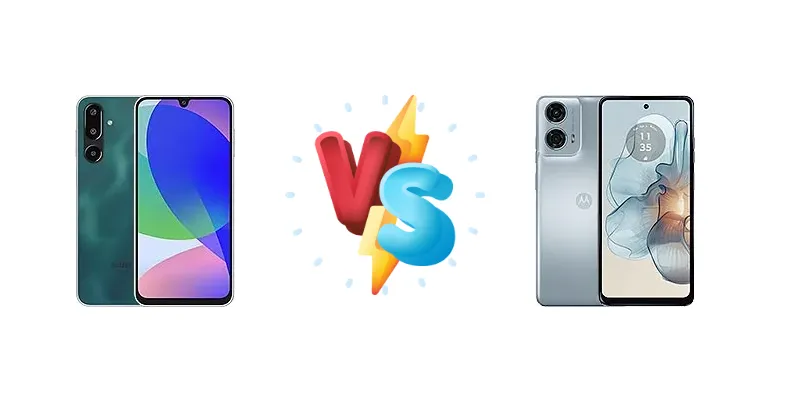
The Samsung Galaxy F16 and Motorola Moto G24 Power represent two compelling options in the increasingly competitive budget smartphone space. While both aim to deliver essential features at an accessible price, they take different approaches to achieving this. The F16 leverages a newer, more efficient chipset, while the G24 Power prioritizes faster charging. This comparison will dissect their key differences to determine which device offers the best value.
🏆 Quick Verdict
For the average user prioritizing sustained performance and future-proofing, the Samsung Galaxy F16 emerges as the stronger choice. Its Mediatek Dimensity 6300 chipset, built on a 6nm process, offers a noticeable advantage in CPU and GPU performance over the Motorola Moto G24 Power’s 12nm Helio G85, despite the latter’s faster charging.
| Network |
|---|
| 2G bands | GSM 850 / 900 / 1800 / 1900 | GSM 850 / 900 / 1800 / 1900 |
| 3G bands | HSDPA 850 / 900 / 1700(AWS) / 1900 / 2100 | HSDPA 850 / 900 / 1900 / 2100 |
| 4G bands | 1, 2, 3, 4, 5, 7, 8, 12, 17, 20, 26, 28, 38, 40, 41, 66 | 1, 2, 3, 5, 7, 8, 20, 28, 38, 40, 41 |
| 5G bands | 1, 3, 5, 7, 8, 28, 40, 41, 66, 77, 78 SA/NSA/Sub6 | - |
| Speed | HSPA, LTE, 5G | HSPA, LTE |
| Technology | GSM / HSPA / LTE / 5G | GSM / HSPA / LTE |
| Launch |
|---|
| Announced | 2025, March 11 | 2024, January 30 |
| Status | Available. Released 2025, March 13 | Available. Released 2024, February 07 |
| Body |
|---|
| Build | Glass front, plastic back, plastic frame | Glass front, plastic back, plastic frame |
| Dimensions | 164.4 x 77.9 x 7.9 mm (6.47 x 3.07 x 0.31 in) | 163.5 x 74.5 x 9 mm (6.44 x 2.93 x 0.35 in) |
| SIM | Nano-SIM + Nano-SIM | Nano-SIM + Nano-SIM |
| Weight | 191 g (6.74 oz) | 197 g (6.95 oz) |
| Display |
|---|
| Resolution | 1080 x 2340 pixels, 19.5:9 ratio (~385 ppi density) | 720 x 1612 pixels, 20:9 ratio (~269 ppi density) |
| Size | 6.7 inches, 110.2 cm2 (~86.0% screen-to-body ratio) | 6.56 inches, 103.4 cm2 (~84.9% screen-to-body ratio) |
| Type | Super AMOLED, 90Hz, 800 nits (HBM) | IPS LCD, 90Hz, 537 nits (peak) |
| Platform |
|---|
| CPU | Octa-core (2x2.4 GHz Cortex-A76 & 6x2.0 GHz Cortex-A55) | Octa-core (2x2.0 GHz Cortex-A75 & 6x1.7 GHz Cortex-A55) |
| Chipset | Mediatek Dimensity 6300 (6 nm) | Mediatek MT6769Z Helio G85 (12 nm) |
| GPU | Mali-G57 MC2 | Mali-G52 MC2 |
| OS | Android 15, up to 6 major Android upgrades, One UI 7 | Android 14 |
| Memory |
|---|
| Card slot | microSDXC (uses shared SIM slot) | microSDXC (dedicated slot) |
| Internal | 128GB 4GB RAM, 128GB 6GB RAM, 128GB 8GB RAM | 128GB 4GB RAM, 128GB 8GB RAM, 256GB 4GB RAM, 256GB 8GB RAM |
| Main Camera |
|---|
| Dual | - | 50 MP, f/1.8 (wide), 0.64µm, PDAF
2 MP (macro) |
| Features | LED flash, panorama, HDR | LED flash, HDR, panorama |
| Triple | 50 MP, f/1.8, (wide), 1/2.76", 0.64µm, AF
5 MP, f/2.2, (ultrawide), 1/5.0", 1.12µm
2 MP (macro) | - |
| Video | 1080p@30fps, gyro-EIS | 1080p@30fps |
| Selfie camera |
|---|
| Single | 13 MP, f/2.0, (wide), 1/3.1", 1.12µm | 8 MP, f/2.0, (wide), 1.12µm - International version
16 MP, f/2.5, (wide), 1.0µm - India version |
| Video | 1080p@30fps | 1080p@30fps |
| Sound |
|---|
| 35mm jack | No | Yes |
| Loudspeaker | Yes | Yes, with stereo speakers |
| Comms |
|---|
| Bluetooth | 5.3, A2DP, LE | 5.0, A2DP, LE |
| NFC | Yes | Yes (market/region dependent) |
| Positioning | GPS, GALILEO, GLONASS, BDS, QZSS | GPS, GALILEO, GLONASS |
| Radio | No | FM radio (market/region dependent) |
| USB | USB Type-C 2.0 | USB Type-C 2.0 |
| WLAN | Wi-Fi 802.11 a/b/g/n/ac, dual-band, Wi-Fi Direct | Wi-Fi 802.11 a/b/g/n/ac, dual-band |
| Features |
|---|
| Sensors | Fingerprint (side-mounted), accelerometer, gyro, proximity, compass | Fingerprint (side-mounted), accelerometer, gyro, proximity, compass |
| Battery |
|---|
| Charging | 25W wired | 30W wired |
| Type | 5000 mAh | 6000 mAh |
| Misc |
|---|
| Colors | Bling Black, Vibing Blue, Glam Green | Glacier Blue, Ink Blue |
| Models | SM-E166P, SM-E166P/DS | - |
| Price | ₹ 13,300 | € 132.29 |
| SAR | 1.08 W/kg (head) | - |
| SAR EU | 0.99 W/kg (head) 1.19 W/kg (body) | - |
Samsung Galaxy F16
- More powerful and efficient Dimensity 6300 chipset
- Potentially better image processing capabilities
- Improved long-term performance due to modern architecture
- Slower 25W charging compared to the Moto G24 Power
- Battery capacity not specified, potential for smaller battery
Motorola Moto G24 Power
- Faster 30W wired charging for quicker top-ups
- Potentially optimized for battery efficiency
- Competitive price point
- Less powerful and older Helio G85 chipset
- 12nm process may lead to more thermal throttling
- Potentially inferior image processing
Display Comparison
Neither device’s display specifications are provided, so a direct comparison is limited. However, given the market segment, both likely utilize LCD panels. The F16’s newer chipset *could* suggest a more advanced display controller, potentially enabling features like higher refresh rates, though this is speculative. The G24 Power’s focus on power suggests a display tuned for efficiency, potentially at the expense of peak brightness. Bezels are likely comparable, given the price point.
Camera Comparison
Without sensor details, a detailed camera comparison is impossible. However, the market positioning suggests both phones will feature a multi-camera setup with a primary sensor and supporting lenses (likely including a depth or macro sensor). The image signal processor (ISP) within the Dimensity 6300 is likely more advanced, potentially leading to better image processing, especially in low-light conditions. The G85’s ISP is adequate for basic photography, but will likely struggle to match the F16’s capabilities in challenging scenarios. The absence of OIS on either device suggests reliance on software stabilization.
Performance
The core difference lies in the chipsets. The Samsung Galaxy F16’s Mediatek Dimensity 6300 (6nm) boasts a more modern architecture than the Motorola Moto G24 Power’s Helio G85 (12nm). The Dimensity 6300’s Cortex-A76 cores, clocked at 2.4 GHz, offer a significant performance uplift over the G85’s 2.0 GHz Cortex-A75 cores. The 6nm fabrication process also translates to improved power efficiency, meaning less thermal throttling during sustained workloads. This benefits gamers and users running demanding applications. While both are octa-core CPUs, the architectural advantages of the Dimensity 6300 are substantial.
Battery Life
The Motorola Moto G24 Power’s 30W wired charging is a clear advantage over the Samsung Galaxy F16’s 25W charging. This translates to a faster 0-100% charge time, a crucial benefit for users who prioritize minimizing downtime. However, battery capacity isn’t specified. The Dimensity 6300’s superior power efficiency *could* offset a potentially smaller battery in the F16, resulting in comparable real-world battery life. The G24 Power’s faster charging is more impactful for quick top-ups, while the F16’s efficiency may lead to longer overall usage between charges.
Buying Guide
Buy the Samsung Galaxy F16 if you need a phone capable of handling demanding apps and multitasking with greater ease, and if you value a more modern chipset architecture for potential software updates and longevity. Buy the Motorola Moto G24 Power if you prioritize minimizing charging downtime and frequently find yourself away from power outlets, as its 30W charging offers a quicker top-up, even if the overall performance is less robust.
Frequently Asked Questions
❓ Will the Mediatek Dimensity 6300 in the Galaxy F16 handle demanding games like PUBG Mobile smoothly?
The Dimensity 6300 is a significant step up from the Helio G85. While it won't deliver flagship-level gaming performance, it should comfortably handle PUBG Mobile at medium settings with stable frame rates. The 6nm process also helps mitigate thermal throttling, ensuring sustained performance during longer gaming sessions.
❓ How long will it take to fully charge the Motorola Moto G24 Power from 0% with the 30W charger?
While a precise time isn't available without testing, the 30W charging should fully charge the Moto G24 Power in approximately 1 hour 30 minutes to 2 hours, depending on battery capacity. This is considerably faster than the Samsung Galaxy F16’s 25W charging.
❓ Does the Samsung Galaxy F16 support software updates for longer than the Motorola Moto G24 Power?
Samsung generally provides longer software support for its devices compared to Motorola. The newer Dimensity 6300 chipset in the F16 also suggests a greater likelihood of receiving future Android updates and security patches, extending the phone’s usable lifespan.
❓ Is the 2MP macro camera on either phone worth using?
Generally, 2MP macro cameras on budget phones offer limited utility. Image quality is often poor, and the fixed focus distance makes it difficult to capture truly detailed macro shots. They are primarily included for marketing purposes and are unlikely to significantly enhance your photography experience.