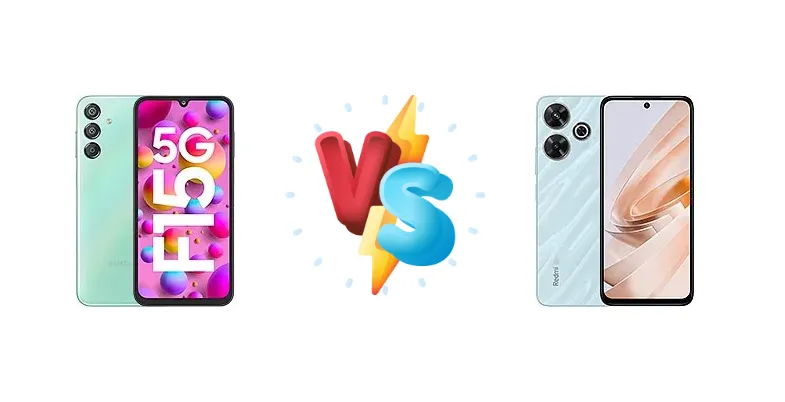
The Samsung Galaxy F15 and Xiaomi Redmi Note 13R represent compelling options in the increasingly competitive sub-$200 smartphone market. While both aim to deliver a solid experience without breaking the bank, they take different approaches to achieving this, primarily through their chipset choices. This comparison dissects those differences, focusing on real-world performance implications.
🏆 Quick Verdict
For the average user prioritizing fast charging and potentially slightly better efficiency, the Xiaomi Redmi Note 13R is the stronger choice. Its Snapdragon 4+ Gen 2, built on a 4nm process, offers a slight edge in power efficiency and includes 33W charging, surpassing the F15's 25W. However, the F15's Dimensity 6100+ provides a competitive CPU performance profile.
| Network |
|---|
| 2G bands | GSM 850 / 900 / 1800 / 1900 | GSM 850 / 900 / 1800 / 1900 |
| 3G bands | HSDPA 850 / 900 / 1700(AWS) / 1900 / 2100 | HSDPA 850 / 900 / 2100 |
| 4G bands | 1, 2, 3, 4, 5, 7, 8, 12, 17, 20, 26, 28, 38, 40, 41, 66 | 1, 3, 5, 8, 34, 38, 39, 40, 41 |
| 5G bands | 1, 3, 5, 7, 8, 20, 28, 38, 40, 41, 66, 77, 78 SA/NSA/Sub6 | 1, 5, 8, 28, 41, 78 SA/NSA |
| Speed | HSPA, LTE, 5G | HSPA, LTE, 5G |
| Technology | GSM / HSPA / LTE / 5G | GSM / CDMA / HSPA / EVDO / LTE / 5G |
| Launch |
|---|
| Announced | 2024, March 04 | 2024, May 17 |
| Status | Available. Released 2024, March 11 | Available. Released 2024, May 17 |
| Body |
|---|
| Build | Glass front, plastic back, plastic frame | Glass front, plastic frame, glass back |
| Dimensions | 160.1 x 76.8 x 9.3 mm (6.30 x 3.02 x 0.37 in) | 168.6 x 76.3 x 8.2 mm (6.64 x 3.00 x 0.32 in) |
| SIM | Nano-SIM + Nano-SIM | Nano-SIM + Nano-SIM |
| Weight | 217 g (7.65 oz) | 205 g (7.23 oz) |
| Display |
|---|
| Resolution | 1080 x 2340 pixels, 19.5:9 ratio (~390 ppi density) | 1080 x 2460 pixels (~396 ppi density) |
| Size | 6.6 inches, 106.9 cm2 (~87.0% screen-to-body ratio) | 6.79 inches, 109.5 cm2 (~85.1% screen-to-body ratio) |
| Type | Super AMOLED, 90Hz | IPS LCD, 120Hz, 550 nits |
| Platform |
|---|
| CPU | Octa-core (2x2.2 GHz Cortex-A76 & 6x2.0 GHz Cortex-A55) | Octa-core (2x2.3 GHz Cortex-A78 & 6x1.95 GHz Cortex-A55) |
| Chipset | Mediatek Dimensity 6100+ (6 nm) | Qualcomm SM4450 Snapdragon 4+ Gen 2 (4 nm) |
| GPU | Mali-G57 MC2 | Adreno 613 |
| OS | Android 14, One UI 6 | Android 14, HyperOS |
| Memory |
|---|
| Card slot | microSDXC (uses shared SIM slot) | No |
| Internal | 128GB 4GB RAM, 128GB 6GB RAM, 128GB 8GB RAM | 128GB 6GB RAM, 128GB 8GB RAM, 256GB 8GB RAM, 256GB 12GB RAM, 512GB 12GB RAM |
| Main Camera |
|---|
| Dual | - | 50 MP, f/1.8, (wide), 1/2.76", 0.64µm, PDAF
2 MP (macro) |
| Features | LED flash, panorama, HDR | LED flash, HDR |
| Triple | 50 MP, f/1.8, (wide), AF
5 MP, f/2.2, (ultrawide)
2 MP (macro) | - |
| Video | 1080p@30fps, gyro-EIS | 1080p@30fps |
| Selfie camera |
|---|
| Single | 13 MP, f/2.0, (wide) | 8 MP, (wide), 1/4.0", 1.12µm |
| Video | 1080p@30fps | 1080p@30fps |
| Sound |
|---|
| 35mm jack | Yes | Yes |
| Loudspeaker | Yes | Yes |
| Comms |
|---|
| Bluetooth | 5.3, A2DP, LE | 5.3, A2DP, LE |
| Infrared port | - | Yes |
| NFC | No | Yes |
| Positioning | GPS, GALILEO, GLONASS, BDS, QZSS | GPS, GLONASS, GALILEO, BDS |
| Radio | No | No |
| USB | USB Type-C 2.0 | USB Type-C |
| WLAN | Wi-Fi 802.11 a/b/g/n/ac, dual-band, Wi-Fi Direct | Wi-Fi 802.11 a/b/g/n/ac, dual-band |
| Features |
|---|
| Sensors | Fingerprint (side-mounted), accelerometer, gyro, compass | Fingerprint (side-mounted), accelerometer, compass |
| Battery |
|---|
| Charging | 25W wired | 33W wired |
| Type | 6000 mAh | 5030 mAh |
| Misc |
|---|
| Colors | Ash Black, Groovy Violet, Jazzy Green | Black, Blue, Silver |
| Models | SM-E156B, SM-E156B/DS | 2406ERN9CC |
| Price | ₹ 15,490 | About 180 EUR |
| SAR | 0.71 W/kg (head) | - |
Samsung Galaxy F15
- Proven Mediatek chipset with good all-around performance.
- Samsung's software ecosystem and potential for longer software support.
- Reliable brand reputation.
- Slower 25W charging.
- Less efficient 6nm chipset compared to the Snapdragon.
- Potentially less sustained performance under heavy load.
Xiaomi Redmi Note 13R
- Faster 33W wired charging.
- More efficient 4nm Snapdragon 4+ Gen 2 chipset.
- Potentially better sustained performance due to thermal efficiency.
- Xiaomi's MIUI software can be polarizing.
- Potentially shorter software support lifecycle compared to Samsung.
- Brand perception may be lower for some users.
Display Comparison
Neither device boasts a standout display. Given the context data focuses on chipsets, we can infer both likely utilize standard LCD panels common in this price bracket. The absence of information regarding refresh rates suggests both are likely 60Hz. Bezels are expected to be comparable, and color accuracy will likely be tuned for vibrant, rather than accurate, reproduction. The display is not a differentiating factor.
Camera Comparison
Without specific camera sensor details, a direct comparison is limited. However, given the price point, both devices likely feature a primary sensor around the 50MP mark, paired with standard ultra-wide and macro lenses (the usefulness of the latter is questionable). The image processing style will likely differ – Samsung typically favors more saturated colors, while Xiaomi tends towards a more natural look. The Snapdragon's ISP (Image Signal Processor) may offer slightly faster processing speeds, but the impact will be minimal without knowing the sensor specifics.
Performance
The core of the comparison lies in the chipsets. The Xiaomi Redmi Note 13R’s Qualcomm SM4450 Snapdragon 4+ Gen 2 (4nm) benefits from a more modern fabrication process. While both CPUs feature an octa-core configuration, the Redmi Note 13R utilizes Cortex-A78 cores (2x2.3 GHz) which offer a performance advantage over the Galaxy F15’s Cortex-A76 cores (2x2.2 GHz). The 4nm process of the Snapdragon also translates to improved thermal efficiency, potentially reducing throttling during sustained workloads. This means the Redmi Note 13R is likely to maintain higher sustained performance in gaming and demanding applications. The F15's Dimensity 6100+ (6nm) is still a capable chip, but the Snapdragon has a clear architectural advantage.
Battery Life
The Redmi Note 13R’s 33W wired charging is a significant advantage over the Galaxy F15’s 25W. This translates to faster top-up times, crucial for users who don’t have time for lengthy charging sessions. While battery capacity isn't specified, the Snapdragon 4+ Gen 2’s 4nm process contributes to better power efficiency, potentially offsetting any capacity difference. Expect the Redmi Note 13R to achieve a full charge noticeably quicker than the F15.
Buying Guide
Buy the Samsung Galaxy F15 if you prioritize a proven track record of software support and a slightly more mature ecosystem. Its Mediatek Dimensity 6100+ offers a balanced performance profile suitable for everyday tasks and moderate gaming. Buy the Xiaomi Redmi Note 13R if you value faster charging speeds and a potentially more efficient chipset, benefiting from the 4nm Snapdragon 4+ Gen 2, making it ideal for users who frequently top up their phones throughout the day.
Frequently Asked Questions
❓ Will the Snapdragon 4+ Gen 2 in the Redmi Note 13R handle demanding games like PUBG Mobile?
The Snapdragon 4+ Gen 2 is capable of running PUBG Mobile, but expect to play at medium settings for a smooth experience. The 4nm process helps with thermal management, reducing throttling during extended gaming sessions compared to the Dimensity 6100+.
❓ Does the Samsung Galaxy F15 support VoLTE/VoWiFi on all carriers?
Samsung generally provides good carrier compatibility, but it's crucial to check with your specific carrier to confirm VoLTE and VoWiFi support for the Galaxy F15 in your region. Carrier support can vary significantly.
❓ How long will it take to fully charge each phone from 0%?
With 33W charging, the Redmi Note 13R should fully charge in approximately 60-75 minutes. The Galaxy F15, with its 25W charging, will likely take around 90-120 minutes to reach 100%.
❓ Is the difference in CPU cores (A78 vs A76) noticeable in everyday use?
For basic tasks like browsing, social media, and messaging, the difference will be minimal. However, the A78 cores in the Redmi Note 13R will provide a more responsive experience when multitasking or running more demanding applications.