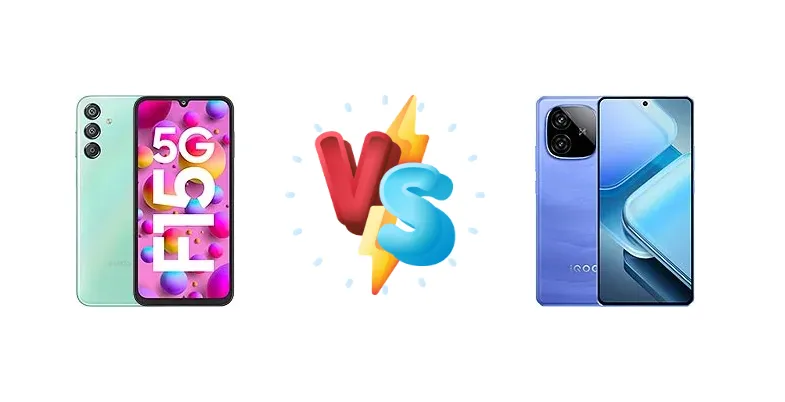
The Samsung Galaxy F15 and vivo iQOO Z9 Turbo Endurance represent distinct approaches to the mid-range smartphone market. The F15 aims for a well-rounded experience, while the iQOO Z9 Turbo Endurance aggressively prioritizes performance and charging speed, particularly targeting gamers and power users. This comparison dissects their key differences to determine which device best suits your needs.
🏆 Quick Verdict
For the average user prioritizing a balanced experience, the Samsung Galaxy F15 offers a solid all-around package. However, the iQOO Z9 Turbo Endurance is the clear winner for gamers and those who demand the fastest possible charging and a significant performance boost, thanks to its Snapdragon 8s Gen 3 chipset.
| Network |
|---|
| 2G bands | GSM 850 / 900 / 1800 / 1900 | GSM 850 / 900 / 1800 / 1900 |
| 3G bands | HSDPA 850 / 900 / 1700(AWS) / 1900 / 2100 | HSDPA 850 / 900 / 2100 |
| 4G bands | 1, 2, 3, 4, 5, 7, 8, 12, 17, 20, 26, 28, 38, 40, 41, 66 | 1, 3, 5, 8, 28, 34, 38, 39, 40, 41 |
| 5G bands | 1, 3, 5, 7, 8, 20, 28, 38, 40, 41, 66, 77, 78 SA/NSA/Sub6 | 1, 5, 8, 28, 41, 77, 78 SA/NSA |
| Speed | HSPA, LTE, 5G | HSPA, LTE, 5G |
| Technology | GSM / HSPA / LTE / 5G | GSM / CDMA / HSPA / LTE / 5G |
| Launch |
|---|
| Announced | 2024, March 04 | 2025, January 03 |
| Status | Available. Released 2024, March 11 | Available. Released 2025, January 03 |
| Body |
|---|
| Build | Glass front, plastic back, plastic frame | Glass front, plastic back, plastic frame |
| Dimensions | 160.1 x 76.8 x 9.3 mm (6.30 x 3.02 x 0.37 in) | 163.7 x 75.9 x 8 mm (6.44 x 2.99 x 0.31 in) |
| SIM | Nano-SIM + Nano-SIM | Nano-SIM + Nano-SIM |
| Weight | 217 g (7.65 oz) | 196 g (6.91 oz) |
| Display |
|---|
| Resolution | 1080 x 2340 pixels, 19.5:9 ratio (~390 ppi density) | 1260 x 2800 pixels, 20:9 ratio (~453 ppi density) |
| Size | 6.6 inches, 106.9 cm2 (~87.0% screen-to-body ratio) | 6.78 inches, 111.0 cm2 (~89.3% screen-to-body ratio) |
| Type | Super AMOLED, 90Hz | AMOLED, 1B colors, 144Hz, HDR |
| Platform |
|---|
| CPU | Octa-core (2x2.2 GHz Cortex-A76 & 6x2.0 GHz Cortex-A55) | Octa-core (1x3.0 GHz Cortex-X4 & 4x2.8 GHz Cortex-A720 & 3x2.0 GHz Cortex-A520) |
| Chipset | Mediatek Dimensity 6100+ (6 nm) | Qualcomm SM8635 Snapdragon 8s Gen 3 (4 nm) |
| GPU | Mali-G57 MC2 | Adreno 735 |
| OS | Android 14, One UI 6 | Android 14, OriginOS 4 |
| Memory |
|---|
| Card slot | microSDXC (uses shared SIM slot) | No |
| Internal | 128GB 4GB RAM, 128GB 6GB RAM, 128GB 8GB RAM | 256GB 12GB RAM, 256GB 16GB RAM, 512GB 12GB RAM, 512GB 16GB RAM |
| Main Camera |
|---|
| Dual | - | 50 MP, f/1.8, (wide), 1/1.95", 0.8µm, PDAF, OIS
8 MP, f/2.2, (ultrawide) |
| Features | LED flash, panorama, HDR | LED flash, panorama, HDR |
| Triple | 50 MP, f/1.8, (wide), AF
5 MP, f/2.2, (ultrawide)
2 MP (macro) | - |
| Video | 1080p@30fps, gyro-EIS | 4K@30/60fps, 1080p, gyro-EIS, OIS |
| Selfie camera |
|---|
| Single | 13 MP, f/2.0, (wide) | 16 MP, f/2.5, (wide), 1/3.0", 1.0µm |
| Video | 1080p@30fps | 1080p@30fps |
| Sound |
|---|
| 35mm jack | Yes | No |
| Loudspeaker | Yes | Yes, with stereo speakers |
| Comms |
|---|
| Bluetooth | 5.3, A2DP, LE | 5.4, A2DP, LE, aptX HD, aptX Adaptive, aptX Lossless |
| Infrared port | - | Yes |
| NFC | No | Yes |
| Positioning | GPS, GALILEO, GLONASS, BDS, QZSS | GPS (L1+L5), GLONASS (G1), BDS (B1I+B1c+B2a), GALILEO (E1+E5a), QZSS (L1+L5) |
| Radio | No | No |
| USB | USB Type-C 2.0 | USB Type-C 2.0, OTG |
| WLAN | Wi-Fi 802.11 a/b/g/n/ac, dual-band, Wi-Fi Direct | Wi-Fi 802.11 a/b/g/n/ac/6, dual-band |
| Features |
|---|
| Sensors | Fingerprint (side-mounted), accelerometer, gyro, compass | Fingerprint (under display, optical), accelerometer, gyro, proximity, compass |
| Battery |
|---|
| Charging | 25W wired | 80W wired
7.5W reverse wired |
| Type | 6000 mAh | Si/C Li-Ion 6400 mAh |
| Misc |
|---|
| Colors | Ash Black, Groovy Violet, Jazzy Green | Black, White, Blue |
| Models | SM-E156B, SM-E156B/DS | V2352GA |
| Price | ₹ 15,490 | About 250 EUR |
| SAR | 0.71 W/kg (head) | - |
Samsung Galaxy F15
- Potentially more balanced overall experience
- Familiar Samsung One UI software
- Likely longer software support
- Significantly slower charging speed
- Less powerful processor for gaming and demanding tasks
- Potentially lower-quality display
vivo iQOO Z9 Turbo Endurance
- Blazing-fast 80W charging
- Superior performance with Snapdragon 8s Gen 3
- Potential for a higher-quality AMOLED display
- Potentially shorter battery life due to performance demands
- Less established brand reputation than Samsung
- Software experience may not appeal to all users
Display Comparison
Neither device's display specifications are provided, so a direct comparison is limited. However, given the F15's positioning, it likely features a standard 60Hz or 90Hz LCD panel. The iQOO Z9 Turbo Endurance, being performance-focused, *may* include a higher refresh rate AMOLED panel, offering superior color accuracy and viewing angles. Bezels are likely comparable in this price segment, but the iQOO's potential AMOLED advantage would be a key differentiator for media consumption.
Camera Comparison
Without detailed camera specs, analysis is limited. However, the iQOO Z9 Turbo Endurance, positioned as a performance device, *may* feature a more advanced camera system with a larger sensor and improved image processing. The F15 likely focuses on providing a functional camera experience for social media and casual photography. The presence or absence of Optical Image Stabilization (OIS) on the iQOO would be a significant advantage, particularly in low-light conditions. We can assume both devices will include standard wide and ultrawide lenses, but the iQOO is more likely to prioritize image quality.
Performance
The core difference lies in the chipsets. The iQOO Z9 Turbo Endurance’s Qualcomm Snapdragon 8s Gen 3 (4nm) is a substantial upgrade over the Samsung Galaxy F15’s MediaTek Dimensity 6100+ (6nm). The 8s Gen 3 features a Cortex-X4 prime core clocked at 3.0 GHz, alongside Cortex-A720 performance cores, offering significantly higher CPU and GPU performance. The 4nm process node also translates to improved thermal efficiency, reducing throttling during sustained workloads like gaming. The Dimensity 6100+ is a capable chip for everyday tasks, but will struggle to match the iQOO’s performance in demanding applications. The iQOO's likely use of faster LPDDR5x RAM further enhances its performance advantage.
Battery Life
The iQOO Z9 Turbo Endurance’s 80W wired charging is a game-changer, allowing for a full charge in under 40 minutes. The Samsung Galaxy F15’s 25W charging is considerably slower, requiring significantly longer to reach 100%. While the F15 may have a slightly larger battery capacity (spec not provided), the iQOO’s faster charging mitigates the impact of a potentially smaller battery. The iQOO also offers 7.5W reverse wired charging, a feature absent on the F15, allowing it to top up other devices.
Buying Guide
Buy the Samsung Galaxy F15 if you need a reliable daily driver with decent performance for everyday tasks, a long-lasting battery, and a familiar Samsung user experience. Buy the vivo iQOO Z9 Turbo Endurance if you prioritize gaming performance, require incredibly fast 80W charging, and are willing to trade some battery capacity for a more powerful processor.
Frequently Asked Questions
❓ Will the Dimensity 6100+ in the Galaxy F15 struggle with graphically intensive games like Genshin Impact?
Yes, the Dimensity 6100+ is a mid-range chip and will likely require significant graphics settings reductions to achieve playable frame rates in demanding titles like Genshin Impact. The Snapdragon 8s Gen 3 in the iQOO Z9 Turbo Endurance is far better equipped to handle these games at higher settings.
❓ How long does it realistically take to fully charge the iQOO Z9 Turbo Endurance with the 80W charger?
The iQOO Z9 Turbo Endurance can charge from 0% to 100% in approximately 35-45 minutes with the included 80W charger. This is a substantial time saving compared to the Samsung Galaxy F15's 25W charging, which will likely take over 1.5 hours for a full charge.
❓ Does the iQOO Z9 Turbo Endurance get excessively hot during prolonged gaming sessions?
The Snapdragon 8s Gen 3 is a relatively efficient chip, and the iQOO Z9 Turbo Endurance likely incorporates thermal management features to mitigate heat. While some warming is expected during extended gaming, it shouldn't reach uncomfortable levels, and the 4nm process helps reduce throttling compared to the 6nm Dimensity 6100+.
❓ Is the reverse wired charging on the iQOO Z9 Turbo Endurance useful for topping up accessories like earbuds?
Yes, the 7.5W reverse wired charging is convenient for slowly topping up accessories like wireless earbuds or smartwatches. It's not a fast charging solution, but it can provide a useful boost when you're away from a power outlet.