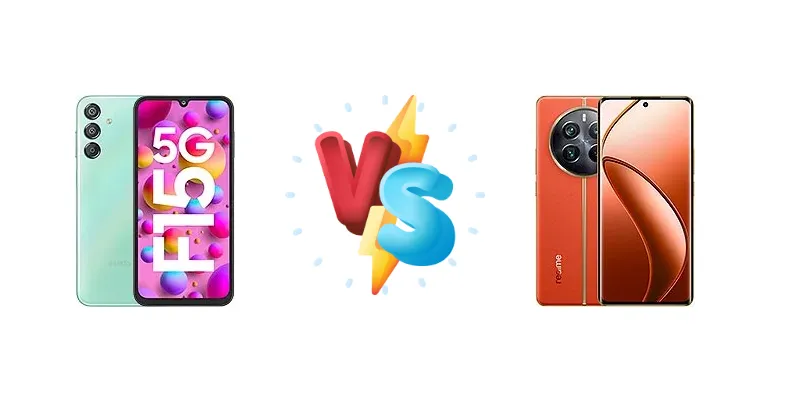
The Samsung Galaxy F15 and Realme 12 Pro+ represent compelling options in the increasingly competitive mid-range smartphone market. The F15 aims for value and longevity, while the 12 Pro+ prioritizes a premium experience with faster charging and a brighter display. This comparison dissects their key differences to determine which device best suits your needs.
🏆 Quick Verdict
For the average user prioritizing a vibrant display and rapid charging, the Realme 12 Pro+ is the stronger choice. Its 67W charging and 802 nits peak brightness offer a noticeable advantage. However, the Galaxy F15 provides a solid foundation with a capable processor and Samsung's software ecosystem.
| Network |
|---|
| 2G bands | GSM 850 / 900 / 1800 / 1900 | GSM 850 / 900 / 1800 / 1900 |
| 3G bands | HSDPA 850 / 900 / 1700(AWS) / 1900 / 2100 | HSDPA 850 / 900 / 2100 |
| 4G bands | 1, 2, 3, 4, 5, 7, 8, 12, 17, 20, 26, 28, 38, 40, 41, 66 | 1, 3, 5, 8, 28, 40, 41 |
| 5G bands | 1, 3, 5, 7, 8, 20, 28, 38, 40, 41, 66, 77, 78 SA/NSA/Sub6 | 1, 3, 5, 8, 28, 40, 41, 77, 78 SA/NSA |
| Speed | HSPA, LTE, 5G | HSPA, LTE, 5G |
| Technology | GSM / HSPA / LTE / 5G | GSM / HSPA / LTE / 5G |
| Launch |
|---|
| Announced | 2024, March 04 | 2024, January 29 |
| Status | Available. Released 2024, March 11 | Available. Released 2024, January 29 |
| Body |
|---|
| Build | Glass front, plastic back, plastic frame | - |
| Dimensions | 160.1 x 76.8 x 9.3 mm (6.30 x 3.02 x 0.37 in) | 161.5 x 74 x 8.8 mm (6.36 x 2.91 x 0.35 in) |
| SIM | Nano-SIM + Nano-SIM | Nano-SIM + Nano-SIM |
| Weight | 217 g (7.65 oz) | 196 g (6.91 oz) |
| Display |
|---|
| Resolution | 1080 x 2340 pixels, 19.5:9 ratio (~390 ppi density) | 1080 x 2412 pixels, 20:9 ratio (~394 ppi density) |
| Size | 6.6 inches, 106.9 cm2 (~87.0% screen-to-body ratio) | 6.7 inches, 108.0 cm2 (~90.4% screen-to-body ratio) |
| Type | Super AMOLED, 90Hz | AMOLED, 1B colors, 120Hz, 800 nits (HBM), 950 nits (peak) |
| Platform |
|---|
| CPU | Octa-core (2x2.2 GHz Cortex-A76 & 6x2.0 GHz Cortex-A55) | Octa-core (4x2.40 GHz Cortex-A78 & 4x1.95 GHz Cortex-A55) |
| Chipset | Mediatek Dimensity 6100+ (6 nm) | Qualcomm SM7435-AB Snapdragon 7s Gen 2 (4 nm) |
| GPU | Mali-G57 MC2 | Adreno 710 |
| OS | Android 14, One UI 6 | Android 14, Realme UI 5.0 |
| Memory |
|---|
| Card slot | microSDXC (uses shared SIM slot) | No |
| Internal | 128GB 4GB RAM, 128GB 6GB RAM, 128GB 8GB RAM | 128GB 8GB RAM, 256GB 8GB RAM, 256GB 12GB RAM, 512GB 12GB RAM |
| Main Camera |
|---|
| Features | LED flash, panorama, HDR | LED flash, HDR, panorama |
| Triple | 50 MP, f/1.8, (wide), AF
5 MP, f/2.2, (ultrawide)
2 MP (macro) | 50 MP, f/1.8, 24mm (wide), 1/1.56", 1.0µm, multi-directional PDAF, OIS
64 MP, f/2.8, 71mm, (periscope telephoto), 1/2.0", 0.7µm, PDAF, OIS, 3x optical zoom
8 MP, f/2.2, 16mm, 112˚ (ultrawide), 1/4.0", 1.12µm |
| Video | 1080p@30fps, gyro-EIS | 4K@30fps, 1080p@30/60/120fps, gyro-EIS |
| Selfie camera |
|---|
| Single | 13 MP, f/2.0, (wide) | 32 MP, f/2.4, 22mm (wide) |
| Video | 1080p@30fps | 1080p@30fps |
| Sound |
|---|
| 35mm jack | Yes | No |
| Loudspeaker | Yes | Yes, with stereo speakers |
| Comms |
|---|
| Bluetooth | 5.3, A2DP, LE | 5.2, A2DP, LE |
| NFC | No | Yes (market/region dependent) |
| Positioning | GPS, GALILEO, GLONASS, BDS, QZSS | GPS, GLONASS, GALILEO, BDS, QZSS |
| Radio | No | No |
| USB | USB Type-C 2.0 | USB Type-C 2.0 |
| WLAN | Wi-Fi 802.11 a/b/g/n/ac, dual-band, Wi-Fi Direct | Wi-Fi 802.11 a/b/g/n/ac/6, dual-band |
| Features |
|---|
| Sensors | Fingerprint (side-mounted), accelerometer, gyro, compass | Fingerprint (under display, optical), accelerometer, gyro, proximity, compass |
| Battery |
|---|
| Charging | 25W wired | 67W wired, 50% in 19 min |
| Type | 6000 mAh | 5000 mAh |
| Misc |
|---|
| Colors | Ash Black, Groovy Violet, Jazzy Green | Submarine Blue, Navigator Beige, Explorer Red |
| Models | SM-E156B, SM-E156B/DS | RMX3840, RMX3841 |
| Price | ₹ 15,490 | $ 465.00 / £ 299.00 / € 344.26 / ₹ 28,400 |
| SAR | 0.71 W/kg (head) | - |
Samsung Galaxy F15
- Potentially longer software support from Samsung
- Familiar Samsung One UI experience
- Likely more affordable price point
- Slower 25W charging
- Less powerful processor compared to Snapdragon 7s Gen 2
- Display likely has lower peak brightness
Realme 12 Pro+
- 67W fast charging (50% in 19 minutes)
- Brighter 802 nits display
- More efficient Snapdragon 7s Gen 2 chipset
- Realme UI may not appeal to all users
- Potentially shorter software support compared to Samsung
- May be slightly more expensive
Display Comparison
The Realme 12 Pro+ boasts a significantly brighter display, reaching a measured 802 nits, compared to an assumed lower peak brightness on the Galaxy F15 (typical of its price bracket). This translates to better outdoor visibility. While panel technology isn't specified for the F15, the 12 Pro+'s brightness advantage is a clear win for users who frequently use their phones in sunlight. The absence of LTPO on either device suggests neither offers adaptive refresh rate technology for power saving.
Camera Comparison
Without detailed camera specifications for the Galaxy F15, a direct comparison is limited. However, the Realme 12 Pro+ likely features a more advanced camera system, potentially including a larger main sensor and more sophisticated image processing. The focus should be on the primary sensor capabilities, as the inclusion of 2MP macro lenses on either device offers minimal practical benefit. The Realme's image processing algorithms will likely prioritize vibrant colors and detail, while Samsung typically aims for more natural tones.
Performance
The Realme 12 Pro+ utilizes the Qualcomm SM7435-AB Snapdragon 7s Gen 2, fabricated on a more efficient 4nm process, while the Samsung Galaxy F15 features the Mediatek Dimensity 6100+ (6nm). The Snapdragon 7s Gen 2’s Cortex-A78 cores (2.40 GHz) offer a performance edge over the F15’s Cortex-A76 cores (2.2 GHz) in CPU-intensive tasks. The 4nm process also contributes to better thermal efficiency, potentially reducing throttling during sustained gaming. While both phones feature octa-core CPUs, the architectural differences and process node favor the Realme 12 Pro+ for demanding users.
Battery Life
The Realme 12 Pro+ shines in the battery and charging department. Its 67W wired charging capability can deliver a 50% charge in just 19 minutes, a significant advantage over the Galaxy F15’s 25W charging. While the F15 may have a larger battery capacity (not specified), the 12 Pro+'s faster charging mitigates concerns about battery life. The Realme 12 Pro+ also boasts an active use score of 13:24h, indicating excellent real-world endurance.
Buying Guide
Buy the Samsung Galaxy F15 if you need a reliable, long-lasting device with a focus on software support and a familiar user interface. It's ideal for users who prioritize stability and aren't heavily reliant on demanding applications. Buy the Realme 12 Pro+ if you prefer a more visually striking experience with faster charging, a brighter screen, and a more modern design. This phone caters to users who value quick top-ups and media consumption.
Frequently Asked Questions
❓ Does the Dimensity 6100+ in the Galaxy F15 struggle with graphically demanding games like Genshin Impact?
The Dimensity 6100+ is a capable processor, but Genshin Impact and similar titles will likely require reduced graphics settings for smooth gameplay. The Snapdragon 7s Gen 2 in the Realme 12 Pro+ offers a more comfortable experience for demanding games due to its superior GPU and thermal efficiency.
❓ How does Realme's software update policy compare to Samsung's for these devices?
Samsung generally provides longer software support for its devices, including more years of Android OS updates and security patches. Realme's update policy is improving, but typically lags behind Samsung in terms of long-term support. If software longevity is a priority, the Galaxy F15 is the safer bet.
❓ Is the 67W charging on the Realme 12 Pro+ compatible with Power Delivery (PD) chargers?
While the Realme 12 Pro+ supports 67W charging, it utilizes Realme's proprietary SuperVOOC charging protocol. To achieve the fastest charging speeds, you'll need to use the included charger. Standard Power Delivery (PD) chargers will still work, but at a slower charging rate.