
Samsung Galaxy F15 vs OnePlus Nord CE 3 Lite: A Deep Dive into Budget 5G Contenders
| Phones Images | |||||
|---|---|---|---|---|---|
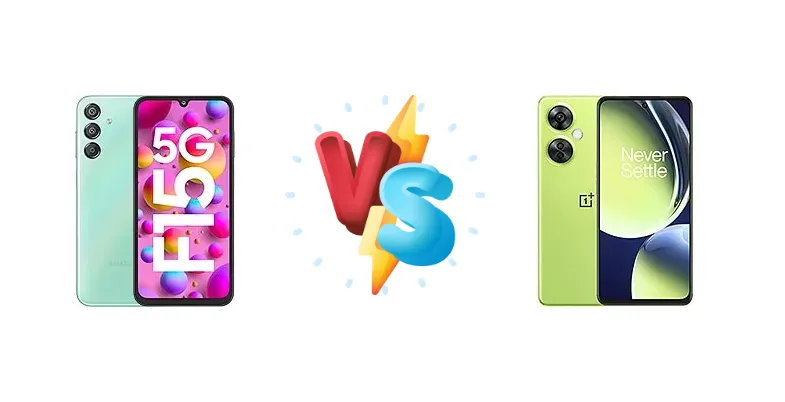
|
🏆 Quick Verdict
For the average user prioritizing fast charging and a generally smoother software experience, the OnePlus Nord CE 3 Lite emerges as the winner. Its 67W charging significantly reduces downtime, and while the Snapdragon 695 isn't a performance king, it's adequate for daily tasks and light gaming. However, the Galaxy F15 offers a potentially more efficient chipset.
| PHONES | ||
|---|---|---|
| Phone Names | Samsung Galaxy F15 | OnePlus Nord CE 3 Lite |
| Network | ||
|---|---|---|
| 2G bands | GSM 850 / 900 / 1800 / 1900 | GSM 850 / 900 / 1800 / 1900 |
| 3G bands | HSDPA 850 / 900 / 1700(AWS) / 1900 / 2100 | HSDPA 800 / 850 / 900 / 1700(AWS) / 1900 / 2100 - International |
| 4G bands | 1, 2, 3, 4, 5, 7, 8, 12, 17, 20, 26, 28, 38, 40, 41, 66 | 1, 2, 3, 4, 5, 7, 8, 12, 13, 17, 18, 19, 20, 26, 28, 32, 38, 39, 40, 41, 66 - International |
| 5G bands | 1, 3, 5, 7, 8, 20, 28, 38, 40, 41, 66, 77, 78 SA/NSA/Sub6 | 1, 3, 5, 7, 8, 20, 28, 38, 40, 41, 66, 77, 78 SA/NSA - International |
| Speed | HSPA, LTE, 5G | HSPA, LTE, 5G |
| Technology | GSM / HSPA / LTE / 5G | GSM / HSPA / LTE / 5G |
| - | 1, 3, 5, 8, 28, 40, 41, 77, 78 SA/NSA - India | |
| Launch | ||
|---|---|---|
| Announced | 2024, March 04 | 2023, April 04 |
| Status | Available. Released 2024, March 11 | Available. Released 2023, April 11 |
| Body | ||
|---|---|---|
| Build | Glass front, plastic back, plastic frame | Glass front, plastic frame, plastic back |
| Dimensions | 160.1 x 76.8 x 9.3 mm (6.30 x 3.02 x 0.37 in) | 165.5 x 76 x 8.3 mm (6.52 x 2.99 x 0.33 in) |
| SIM | Nano-SIM + Nano-SIM | Nano-SIM + Nano-SIM |
| Weight | 217 g (7.65 oz) | 195 g (6.88 oz) |
| Display | ||
|---|---|---|
| Protection | - | Corning Gorilla Glass |
| Resolution | 1080 x 2340 pixels, 19.5:9 ratio (~390 ppi density) | 1080 x 2400 pixels, 20:9 ratio (~391 ppi density) |
| Size | 6.6 inches, 106.9 cm2 (~87.0% screen-to-body ratio) | 6.72 inches, 109.6 cm2 (~87.1% screen-to-body ratio) |
| Type | Super AMOLED, 90Hz | IPS LCD, 120Hz, 550 nits (typ), 680 nits (peak) |
| Platform | ||
|---|---|---|
| CPU | Octa-core (2x2.2 GHz Cortex-A76 & 6x2.0 GHz Cortex-A55) | Octa-core (2x2.2 GHz Kryo 660 Gold & 6x1.7 GHz Kryo 660 Silver) |
| Chipset | Mediatek Dimensity 6100+ (6 nm) | Qualcomm SM6375 Snapdragon 695 5G (6 nm) |
| GPU | Mali-G57 MC2 | Adreno 619 |
| OS | Android 14, One UI 6 | Android 13, OxygenOS 13.1 |
| Memory | ||
|---|---|---|
| Card slot | microSDXC (uses shared SIM slot) | microSDXC (uses shared SIM slot) |
| Internal | 128GB 4GB RAM, 128GB 6GB RAM, 128GB 8GB RAM | 128GB 8GB RAM, 256GB 8GB RAM |
| - | UFS 2.2 | |
| Main Camera | ||
|---|---|---|
| Features | LED flash, panorama, HDR | LED flash, HDR, panorama |
| Triple | 50 MP, f/1.8, (wide), AF 5 MP, f/2.2, (ultrawide) 2 MP (macro) | 108 MP, f/1.8, (wide), 1/1.67", 0.64µm, PDAF 2 MP (macro) Auxiliary lens |
| Video | 1080p@30fps, gyro-EIS | 1080p@30fps |
| Selfie camera | ||
|---|---|---|
| Features | - | HDR, panorama |
| Single | 13 MP, f/2.0, (wide) | 16 MP, f/2.4, (wide), 1.0µm |
| Video | 1080p@30fps | 1080p@30fps |
| Sound | ||
|---|---|---|
| 3.5mm jack | - | Yes |
| 35mm jack | Yes | Yes |
| Loudspeaker | Yes | Yes, with stereo speakers |
| Comms | ||
|---|---|---|
| Bluetooth | 5.3, A2DP, LE | 5.1, A2DP, LE, aptX HD |
| NFC | No | Yes (market/region dependent) |
| Positioning | GPS, GALILEO, GLONASS, BDS, QZSS | GPS, GALILEO, GLONASS, BDS, QZSS |
| Radio | No | No |
| USB | USB Type-C 2.0 | USB Type-C 2.0, OTG |
| WLAN | Wi-Fi 802.11 a/b/g/n/ac, dual-band, Wi-Fi Direct | Wi-Fi 802.11 a/b/g/n/ac, dual-band |
| Features | ||
|---|---|---|
| Sensors | Fingerprint (side-mounted), accelerometer, gyro, compass | Fingerprint (side-mounted), accelerometer, gyro, proximity, compass |
| Battery | ||
|---|---|---|
| Charging | 25W wired | 67W wired, 80% in 30 min |
| Type | 6000 mAh | Li-Po 5000 mAh |
| Misc | ||
|---|---|---|
| Colors | Ash Black, Groovy Violet, Jazzy Green | Pastel Lime, Chromatic Gray |
| Models | SM-E156B, SM-E156B/DS | CPH2467, CPH2465 |
| Price | ₹ 15,490 | £ 169.98 / € 209.99 |
| SAR | 0.71 W/kg (head) | 1.17 W/kg (head) 0.70 W/kg (body) |
| Tests | ||
|---|---|---|
| Performance | - | AnTuTu: 412006 (v9) GeekBench: 2052 (v5) GFXBench: 17fps (ES 3.1 onscreen) |
Samsung Galaxy F15
- Potentially more efficient Dimensity 6100+ chipset
- Samsung's One UI software features
- Likely larger battery capacity (estimated)
- Slower 25W charging
- Potentially less optimized software experience compared to OnePlus
- May not match Nord CE 3 Lite's GPU performance
OnePlus Nord CE 3 Lite
- Ultra-fast 67W charging (80% in 30 minutes)
- Cleaner OxygenOS software experience
- Qualcomm's optimized software and potential GPU advantage
- Snapdragon 695 may be less CPU-efficient than Dimensity 6100+
- Potentially smaller battery capacity
- Samsung's One UI offers more features
Display Comparison
Neither device boasts a standout display. Both likely utilize LCD panels, a common cost-saving measure in this segment. While specific details like peak brightness and color accuracy are unavailable, the focus here is on functionality rather than visual fidelity. Bezels are expected to be moderate on both, and neither is likely to feature high refresh rate technology. The display experience will likely be similar on both devices, prioritizing visibility over immersive quality.
Camera Comparison
Camera performance is difficult to assess without detailed sensor information. Both phones likely feature a primary camera accompanied by depth and macro sensors (the latter often being of limited utility). The key differentiator will be the main sensor's size and aperture. Larger sensors capture more light, resulting in better low-light performance. Image processing algorithms also play a significant role; Samsung typically leans towards vibrant, saturated colors, while OnePlus often aims for a more natural look. Without specific details, it's reasonable to assume both will deliver acceptable results in good lighting conditions, but the F15 might have a slight edge in low-light scenarios if it utilizes a larger sensor.
Performance
The core difference lies in the chipsets. The Samsung Galaxy F15’s MediaTek Dimensity 6100+ (6nm) features an octa-core configuration with 2x2.2 GHz Cortex-A76 and 6x2.0 GHz Cortex-A55 cores. The OnePlus Nord CE 3 Lite uses the Qualcomm Snapdragon 695 5G (6nm) with 2x2.2 GHz Kryo 660 Gold and 6x1.7 GHz Kryo 660 Silver cores. While clock speeds are similar, the Cortex-A76 cores in the Dimensity 6100+ generally offer a slight performance advantage in CPU-intensive tasks. However, the Snapdragon 695 often benefits from Qualcomm’s optimized software and potentially better GPU performance for gaming. Thermal management will be crucial; the 6nm process on both should help, but sustained loads could reveal differences in efficiency. The F15 may exhibit better sustained performance due to the Dimensity's architecture.
Battery Life
The OnePlus Nord CE 3 Lite’s 67W wired charging is a game-changer. The claim of 80% charge in 30 minutes significantly reduces downtime compared to the Samsung Galaxy F15’s 25W charging. While the F15 may have a slightly larger battery capacity (spec not provided, but likely around 5000mAh based on the F series), the Nord CE 3 Lite’s faster charging effectively mitigates any capacity difference. Users who frequently need to quickly top up their phones will overwhelmingly prefer the Nord CE 3 Lite.
Buying Guide
Buy the Samsung Galaxy F15 if you prioritize potentially longer battery life due to the more efficient Dimensity 6100+ and prefer Samsung's One UI software ecosystem. Buy the OnePlus Nord CE 3 Lite if you value incredibly fast 67W charging, a cleaner software experience with OxygenOS, and a slightly more responsive user interface for everyday tasks. The Nord CE 3 Lite is the better choice for users who frequently find themselves needing to top up their phone quickly.