
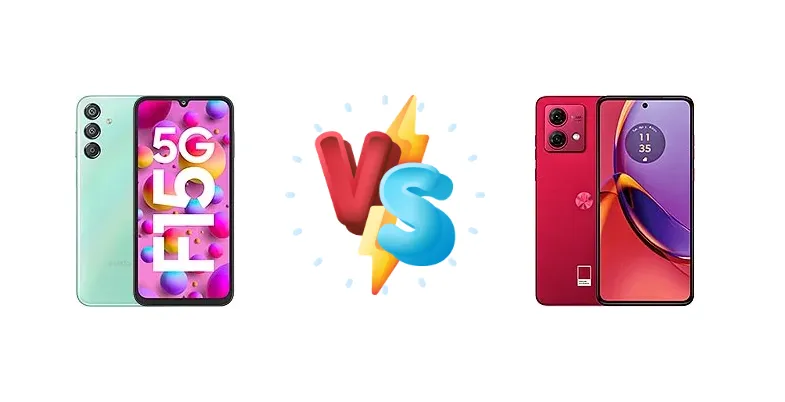
Samsung Galaxy F15 vs. Motorola Moto G84: A Detailed Comparison
| Phones Images | |||||
|---|---|---|---|---|---|
|
🏆 Quick Verdict
For most users, the Motorola Moto G84 emerges as the slightly better choice. Its measured 996 nits peak brightness provides a significantly more usable outdoor experience, and the 30W charging offers faster top-ups. While the F15's Dimensity 6100+ is a capable chip, the G84's overall package is more refined.
| PHONES | ||
|---|---|---|
| Phone Names | Samsung Galaxy F15 | Motorola Moto G84 |
| Network | ||
|---|---|---|
| 2G bands | GSM 850 / 900 / 1800 / 1900 | GSM 850 / 900 / 1800 / 1900 |
| 3G bands | HSDPA 850 / 900 / 1700(AWS) / 1900 / 2100 | HSDPA 850 / 900 / 1700(AWS) / 1900 / 2100 - LATAM |
| 4G bands | 1, 2, 3, 4, 5, 7, 8, 12, 17, 20, 26, 28, 38, 40, 41, 66 | 1, 2, 3, 4, 5, 7, 8, 12, 13, 17, 25, 26, 28, 38, 40, 41, 42, 66 - LATAM |
| 5G bands | 1, 3, 5, 7, 8, 20, 28, 38, 40, 41, 66, 77, 78 SA/NSA/Sub6 | 1, 2, 3, 5, 7, 26, 28, 40, 66, 78 SA/NSA/Sub6 - LATAM |
| Speed | HSPA, LTE, 5G | HSPA, LTE, 5G |
| Technology | GSM / HSPA / LTE / 5G | GSM / HSPA / LTE / 5G |
| Launch | ||
|---|---|---|
| Announced | 2024, March 04 | 2023, August 24 |
| Status | Available. Released 2024, March 11 | Available. Released 2023, September 08 |
| Body | ||
|---|---|---|
| Build | Glass front, plastic back, plastic frame | Glass front, plastic frame, plastic back or eco leather back |
| Dimensions | 160.1 x 76.8 x 9.3 mm (6.30 x 3.02 x 0.37 in) | 160 x 74.4 x 7.6 mm (6.30 x 2.93 x 0.30 in) |
| SIM | Nano-SIM + Nano-SIM | Nano-SIM + Nano-SIM |
| Weight | 217 g (7.65 oz) | 166.8 g (5.86 oz) |
| Display | ||
|---|---|---|
| Resolution | 1080 x 2340 pixels, 19.5:9 ratio (~390 ppi density) | 1080 x 2400 pixels, 20:9 ratio (~405 ppi density) |
| Size | 6.6 inches, 106.9 cm2 (~87.0% screen-to-body ratio) | 6.5 inches, 102.0 cm2 (~85.7% screen-to-body ratio) |
| Type | Super AMOLED, 90Hz | P-OLED, 1B colors, 120Hz, 1300 nits (peak) |
| Platform | ||
|---|---|---|
| CPU | Octa-core (2x2.2 GHz Cortex-A76 & 6x2.0 GHz Cortex-A55) | Octa-core (2x2.2 GHz Kryo 660 Gold & 6x1.7 GHz Kryo 660 Silver) |
| Chipset | Mediatek Dimensity 6100+ (6 nm) | Qualcomm SM6375 Snapdragon 695 5G (6 nm) |
| GPU | Mali-G57 MC2 | Adreno 619 |
| OS | Android 14, One UI 6 | Android 13, upgradable to Android 15 |
| Memory | ||
|---|---|---|
| Card slot | microSDXC (uses shared SIM slot) | microSDXC (uses shared SIM slot) |
| Internal | 128GB 4GB RAM, 128GB 6GB RAM, 128GB 8GB RAM | 256GB 8GB RAM, 256GB 12GB RAM |
| Main Camera | ||
|---|---|---|
| Dual | - | 50 MP, f/1.9 (wide), 1/1.5", 1.0µm, PDAF, OIS 8 MP, f/2.2, 120˚ (ultrawide), 1/4.0", 1.12µm, AF |
| Features | LED flash, panorama, HDR | LED flash, HDR, panorama |
| Triple | 50 MP, f/1.8, (wide), AF 5 MP, f/2.2, (ultrawide) 2 MP (macro) | - |
| Video | 1080p@30fps, gyro-EIS | 1080p@30/60fps |
| Selfie camera | ||
|---|---|---|
| Single | 13 MP, f/2.0, (wide) | 16 MP, f/2.5, (wide), 1.0µm |
| Video | 1080p@30fps | 1080p@30fps |
| Sound | ||
|---|---|---|
| 35mm jack | Yes | Yes |
| Loudspeaker | Yes | Yes, with stereo speakers |
| Comms | ||
|---|---|---|
| Bluetooth | 5.3, A2DP, LE | 5.1, A2DP, LE |
| NFC | No | Yes (market/region dependent) |
| Positioning | GPS, GALILEO, GLONASS, BDS, QZSS | GPS, GLONASS, GALILEO |
| Radio | No | FM radio (market/region dependent) |
| USB | USB Type-C 2.0 | USB Type-C 2.0 |
| WLAN | Wi-Fi 802.11 a/b/g/n/ac, dual-band, Wi-Fi Direct | Wi-Fi 802.11 a/b/g/n/ac, dual-band, Wi-Fi Direct |
| Features | ||
|---|---|---|
| Sensors | Fingerprint (side-mounted), accelerometer, gyro, compass | Fingerprint (under display, optical), accelerometer, gyro, proximity, compass |
| Battery | ||
|---|---|---|
| Charging | 25W wired | 30W wired |
| Type | 6000 mAh | Li-Po 5000 mAh |
| Misc | ||
|---|---|---|
| Colors | Ash Black, Groovy Violet, Jazzy Green | Marshmallow Blue, Midnight Blue, Viva Magenta |
| Models | SM-E156B, SM-E156B/DS | XT2347, XT2347-1, XT2347-2 |
| Price | ₹ 15,490 | $ 399.00 / £ 189.99 / € 169.00 |
| SAR | 0.71 W/kg (head) | - |
Samsung Galaxy F15
- Potentially longer software support from Samsung
- Dimensity 6100+ may offer slightly better multi-core performance
- 6nm process for efficient power usage
- Charging speed is slower at 25W
- Display brightness is unknown and potentially lower than Moto G84
Motorola Moto G84
- 996 nits peak brightness for excellent outdoor visibility
- Faster 30W wired charging
- Strong battery life (12:31h active use)
- Snapdragon 695 is an older chipset
- Motorola's software update commitment is typically shorter than Samsung's
Display Comparison
The Motorola Moto G84 boasts a clear advantage in display quality, achieving a measured peak brightness of 996 nits. This is a crucial metric for outdoor visibility, where the Galaxy F15's display specifications are currently unknown. While both phones utilize 6nm chipsets, a brighter display consumes more power, potentially impacting battery life. The Moto G84's panel likely benefits users who frequently use their phones in direct sunlight. We expect the Moto G84 to have a higher contrast ratio as well, given the brightness advantage.
Camera Comparison
Detailed camera analysis is hampered by limited information on the Galaxy F15’s camera system. The Moto G84’s camera capabilities are described as 'Photo / Video', suggesting a focus on versatility. Without specific sensor details, it’s difficult to assess image quality. It's likely the Moto G84 will have a more refined image processing pipeline, leveraging Qualcomm's ISP. We can assume both phones will include a standard wide, ultrawide, and potentially a macro lens, but the quality of these secondary sensors is often limited. The absence of OIS information for either phone suggests image stabilization will rely primarily on software algorithms.
Performance
Both the Samsung Galaxy F15 and Motorola Moto G84 employ 6nm chipsets – the Mediatek Dimensity 6100+ and the Qualcomm Snapdragon 695, respectively. The Dimensity 6100+ features a more modern CPU architecture with 2x2.2 GHz Cortex-A76 cores alongside 6x2.0 GHz Cortex-A55 cores, potentially offering a slight edge in multi-core performance compared to the Snapdragon 695’s 2x2.2 GHz Kryo 660 Gold and 6x1.7 GHz Kryo 660 Silver configuration. However, the Snapdragon 695 benefits from Qualcomm’s optimized software and modem integration. Real-world performance differences will likely be subtle, with both phones handling everyday tasks and moderate gaming adequately. The 6nm process on both chips should contribute to reasonable thermal management.
Battery Life
The Motorola Moto G84 demonstrates a clear advantage in battery endurance, achieving an active use score of 12:31h and an endurance rating of 117h. While the Galaxy F15’s battery capacity is unknown, the Moto G84’s performance sets a high bar. Furthermore, the Moto G84 supports 30W wired charging, compared to the F15’s 25W, enabling faster recharge times. This difference in charging speed is significant for users who prioritize quick top-ups throughout the day. The Moto G84's battery performance suggests efficient power management alongside its 6nm chipset.
Buying Guide
Buy the Samsung Galaxy F15 if you prioritize a potentially longer software support lifecycle from Samsung and anticipate needing a phone that can handle sustained workloads without significant thermal throttling, given the Dimensity 6100+'s 6nm process. Buy the Motorola Moto G84 if you value a brighter, more visible display in outdoor conditions, faster charging speeds, and a more streamlined user experience with Motorola's near-stock Android approach.