
Samsung Galaxy F15 vs. Infinix Note 40 Pro: A Deep Dive into Mid-Range Power and Charging
| Phones Images | |||||
|---|---|---|---|---|---|
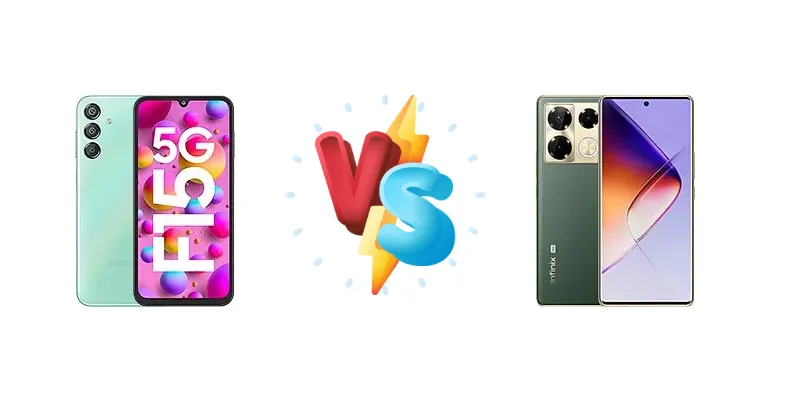
|
🏆 Quick Verdict
For the average user prioritizing fast charging and a slightly more powerful processor, the Infinix Note 40 Pro emerges as the winner. Its 45W wired and 20W MagCharge wireless capabilities significantly outperform the Galaxy F15’s 25W charging. However, Samsung’s brand recognition and software experience remain strong considerations.
| PHONES | ||
|---|---|---|
| Phone Names | Samsung Galaxy F15 | Infinix Note 40 Pro |
| Network | ||
|---|---|---|
| 2G bands | GSM 850 / 900 / 1800 / 1900 | GSM 850 / 900 / 1800 / 1900 |
| 3G bands | HSDPA 850 / 900 / 1700(AWS) / 1900 / 2100 | HSDPA 850 / 900 / 1700(AWS) / 1900 / 2100 |
| 4G bands | 1, 2, 3, 4, 5, 7, 8, 12, 17, 20, 26, 28, 38, 40, 41, 66 | 1, 2, 3, 4, 5, 7, 8, 12, 17, 20, 28, 38, 40, 41, 42, 66 |
| 5G bands | 1, 3, 5, 7, 8, 20, 28, 38, 40, 41, 66, 77, 78 SA/NSA/Sub6 | 1, 3, 5, 7, 8, 12, 20, 28, 38, 40, 41, 66, 77, 78 SA/NSA |
| Speed | HSPA, LTE, 5G | HSPA, LTE, 5G |
| Technology | GSM / HSPA / LTE / 5G | GSM / HSPA / LTE / 5G |
| Launch | ||
|---|---|---|
| Announced | 2024, March 04 | 2024, March 18 |
| Status | Available. Released 2024, March 11 | Available. Released 2024, March 19 |
| Body | ||
|---|---|---|
| Build | Glass front, plastic back, plastic frame | - |
| Dimensions | 160.1 x 76.8 x 9.3 mm (6.30 x 3.02 x 0.37 in) | 164.3 x 74.5 x 8.1 mm (6.47 x 2.93 x 0.32 in) |
| SIM | Nano-SIM + Nano-SIM | Nano-SIM + Nano-SIM |
| Weight | 217 g (7.65 oz) | 190 g or 196 g (6.70 oz) |
| Display | ||
|---|---|---|
| Protection | - | Corning Gorilla Glass |
| Resolution | 1080 x 2340 pixels, 19.5:9 ratio (~390 ppi density) | 1080 x 2436 pixels (~393 ppi density) |
| Size | 6.6 inches, 106.9 cm2 (~87.0% screen-to-body ratio) | 6.78 inches, 109.9 cm2 (~89.8% screen-to-body ratio) |
| Type | Super AMOLED, 90Hz | AMOLED, 1B colors, 120Hz, 2160Hz PWM, 1300 nits (peak) |
| Platform | ||
|---|---|---|
| CPU | Octa-core (2x2.2 GHz Cortex-A76 & 6x2.0 GHz Cortex-A55) | Octa-core (2x2.2 GHz Cortex-A78 & 6x2.0 GHz Cortex-A55) |
| Chipset | Mediatek Dimensity 6100+ (6 nm) | Mediatek Dimensity 7020 (6 nm) |
| GPU | Mali-G57 MC2 | IMG BXM-8-256 |
| OS | Android 14, One UI 6 | Android 14, XOS 14 |
| Memory | ||
|---|---|---|
| Card slot | microSDXC (uses shared SIM slot) | Unspecified |
| Internal | 128GB 4GB RAM, 128GB 6GB RAM, 128GB 8GB RAM | 256GB 8GB RAM |
| Main Camera | ||
|---|---|---|
| Features | LED flash, panorama, HDR | Dual-LED flash, HDR, panorama |
| Triple | 50 MP, f/1.8, (wide), AF 5 MP, f/2.2, (ultrawide) 2 MP (macro) | 108 MP, f/1.8, (wide), PDAF, OIS 2 MP, f/2.4 2 MP, f/2.4 |
| Video | 1080p@30fps, gyro-EIS | 1440p@30fps, 1080p@30/60fps |
| Selfie camera | ||
|---|---|---|
| Features | - | Dual-LED flash |
| Single | 13 MP, f/2.0, (wide) | 32 MP, f/2.2, (wide), 1/3.1" |
| Video | 1080p@30fps | 1080p@30fps |
| Sound | ||
|---|---|---|
| 35mm jack | Yes | No |
| Loudspeaker | Yes | Yes, with stereo speakers |
| Comms | ||
|---|---|---|
| Bluetooth | 5.3, A2DP, LE | Yes |
| Infrared port | - | Yes |
| NFC | No | Yes (market/region dependent) |
| Positioning | GPS, GALILEO, GLONASS, BDS, QZSS | GPS |
| Radio | No | FM radio |
| USB | USB Type-C 2.0 | USB Type-C 2.0, OTG |
| WLAN | Wi-Fi 802.11 a/b/g/n/ac, dual-band, Wi-Fi Direct | Wi-Fi 802.11 a/b/g/n/ac, dual-band |
| Features | ||
|---|---|---|
| Sensors | Fingerprint (side-mounted), accelerometer, gyro, compass | Fingerprint (under display, optical), accelerometer, gyro, proximity, compass |
| Battery | ||
|---|---|---|
| Charging | 25W wired | 45W wired, 50% in 26 min 20W wireless MagCharge Reverse wired Reverse wireless |
| Type | 6000 mAh | 5000 mAh |
| Misc | ||
|---|---|---|
| Colors | Ash Black, Groovy Violet, Jazzy Green | Vintage Green, Titan Gold, Racing Edition |
| Models | SM-E156B, SM-E156B/DS | X6851 |
| Price | ₹ 15,490 | About 280 EUR |
| SAR | 0.71 W/kg (head) | - |
Samsung Galaxy F15
- Established Brand Reputation
- Predictable Software Experience (One UI)
- Potentially Better Software Updates
- Slower Charging Speed (25W)
- Less Powerful Processor (Dimensity 6100+)
- Lacks Wireless Charging
Infinix Note 40 Pro
- Faster Charging (45W Wired, 20W Wireless)
- More Powerful Processor (Dimensity 7020)
- Reverse Charging Capabilities
- Less Established Brand
- Potentially Less Refined Software
- Long-term Software Support Unknown
Display Comparison
Neither device boasts a flagship-level display, but details are limited. Both utilize 6nm chipsets, suggesting a focus on efficiency over pushing display resolutions to the max. We anticipate both phones will feature FHD+ displays, but without specific nit brightness or panel type (LTPO vs. standard OLED) data, it’s difficult to declare a clear winner. Bezels are likely comparable, typical of this price segment. Color accuracy will likely be tuned for vibrant visuals, a common trend in this market.
Camera Comparison
Without detailed camera specs, a direct comparison is challenging. However, the market segment suggests both phones will feature a multi-camera setup with a primary sensor, ultrawide, and potentially a depth or macro lens. The absence of sensor size information is a key omission. Image processing will likely differ; Samsung typically aims for vibrant, saturated colors, while Infinix may lean towards a more natural look. The usefulness of a 2MP macro camera on either device is questionable, serving primarily as a marketing feature. OIS (Optical Image Stabilization) is unlikely on either model, given the price point.
Performance
The core difference lies in the chipsets. The Infinix Note 40 Pro’s Dimensity 7020, featuring Cortex-A78 cores, offers a demonstrable architectural advantage over the Galaxy F15’s Dimensity 6100+ and its Cortex-A76 cores. While both are octa-core CPUs with the same Cortex-A55 efficiency cores, the A78 provides a performance boost in single-core tasks and sustained workloads. This translates to snappier app launches and smoother multitasking on the Infinix. Both phones likely pair their chipsets with 8GB of RAM, but the RAM type (LPDDR4x vs LPDDR5x) is unknown; LPDDR5x would further benefit the Note 40 Pro. Thermal management will be crucial; the more powerful Dimensity 7020 will require effective cooling to avoid throttling during extended gaming sessions.
Battery Life
The Infinix Note 40 Pro’s charging capabilities are its standout feature. 45W wired charging, capable of reaching 50% in 26 minutes, is significantly faster than the Galaxy F15’s 25W charging. Furthermore, the inclusion of 20W wireless MagCharge and reverse wired/wireless charging adds considerable versatility. While battery capacity isn’t specified, the faster charging speeds on the Note 40 Pro mitigate the impact of a potentially smaller battery. The Galaxy F15 will likely offer a full charge in around 1.5-2 hours, while the Note 40 Pro aims for under an hour.
Buying Guide
Buy the Samsung Galaxy F15 if you prioritize a well-established brand with a predictable software experience and are less concerned with blazing-fast charging. Buy the Infinix Note 40 Pro if you value rapid charging – both wired and wireless – and want a processor with a slight edge in performance for multitasking and gaming, even if it means navigating a less-familiar UI.