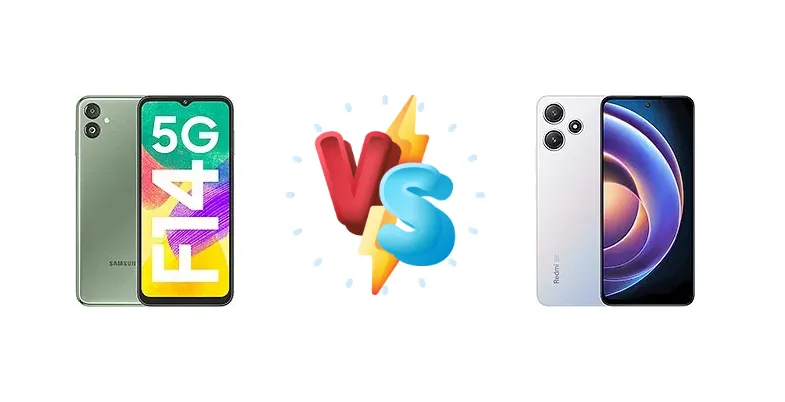
The Samsung Galaxy F14 and Xiaomi Redmi Note 12R represent compelling options in the increasingly competitive sub-$200 smartphone market. While both aim to deliver a solid experience without breaking the bank, they take different approaches to achieving this goal, primarily through their chipset choices. This comparison dissects the key differences between the Exynos 1330-powered F14 and the Snapdragon 4 Gen 2-equipped Note 12R, helping you determine which device best suits your needs.
🏆 Quick Verdict
For the average user prioritizing sustained performance and a potentially smoother software experience, the Samsung Galaxy F14 edges out the Redmi Note 12R. The Exynos 1330, despite being built on a 5nm process, offers a slight performance advantage in CPU-intensive tasks, and Samsung's software optimization often translates to better long-term stability.
| Network |
|---|
| 2G bands | GSM 850 / 900 / 1800 / 1900 | GSM 850 / 900 / 1800 / 1900 |
| 3G bands | HSDPA 850 / 900 / 1700(AWS) / 1900 / 2100 | HSDPA 850 / 900 / 2100 |
| 4G bands | 1, 2, 3, 4, 5, 7, 8, 12, 17, 20, 26, 28, 38, 40, 41, 66 | 1, 3, 5, 8, 34, 38, 39, 40, 41 |
| 5G bands | 1, 3, 5, 7, 8, 20, 28, 38, 40, 41, 66, 77, 78 SA/NSA/Sub6 | 1, 5, 8, 28, 41, 78 SA/NSA |
| Speed | HSPA, LTE-А, 5G | HSPA, LTE, 5G |
| Technology | GSM / HSPA / LTE / 5G | GSM / CDMA / HSPA / EVDO / LTE / 5G |
| Launch |
|---|
| Announced | 2023, March 24 | 2023, June 28 |
| Status | Available. Released 2023, March 30 | Available. Released 2023, June 28 |
| Body |
|---|
| Build | Glass front (Gorilla Glass 5), plastic back, plastic frame | Glass front, plastic frame, glass back |
| Dimensions | 166.8 x 77.2 x 9.4 mm (6.57 x 3.04 x 0.37 in) | 168.6 x 76.3 x 8.2 mm (6.64 x 3.00 x 0.32 in) |
| SIM | Nano-SIM + Nano-SIM | Nano-SIM + Nano-SIM |
| Weight | 206 g (7.27 oz) | 199 g (7.02 oz) |
| Display |
|---|
| Protection | Corning Gorilla Glass 5 | - |
| Resolution | 1080 x 2408 pixels, 20:9 ratio (~400 ppi density) | 1080 x 2460 pixels (~396 ppi density) |
| Size | 6.6 inches, 104.9 cm2 (~81.5% screen-to-body ratio) | 6.79 inches, 109.5 cm2 (~85.1% screen-to-body ratio) |
| Type | PLS LCD, 90Hz | IPS LCD, 90Hz, 550 nits |
| Platform |
|---|
| CPU | Octa-core (2x2.4 GHz Cortex-A78 & 6x2.0 GHz Cortex-A55) | Octa-core (2x2.2 GHz Cortex-A78 & 6x1.95 GHz Cortex-A55) |
| Chipset | Exynos 1330 (5 nm) | Qualcomm SM4450 Snapdragon 4 Gen 2 (4 nm) |
| GPU | Mali-G68 MP2 | Adreno 613 |
| OS | Android 13, One UI Core 5.1 | Android 13, MIUI 14 |
| Memory |
|---|
| Card slot | microSDXC (dedicated slot) | microSDXC (uses shared SIM slot) |
| Internal | 64GB 4GB RAM, 128GB 4GB RAM, 128GB 6GB RAM | 128GB 4GB RAM, 128GB 6GB RAM, 128GB 8GB RAM, 256GB 8GB RAM |
| Main Camera |
|---|
| Dual | 50 MP, f/1.8, (wide), PDAF
2 MP (macro) | 50 MP, f/1.8, (wide), PDAF
2 MP (macro) |
| Features | LED flash, panorama, HDR | LED flash, HDR |
| Video | 1080p@30fps | 1080p@30fps |
| Selfie camera |
|---|
| Features | - | HDR |
| Single | 13 MP, f/2.0, (wide) | 5 MP, f/2.2, (wide), 1/5.0", 1.12µm |
| Video | 1080p@30fps | 1080p@30fps |
| Sound |
|---|
| 3.5mm jack | Yes | - |
| 35mm jack | Yes | Yes |
| Loudspeaker | Yes | Yes |
| Comms |
|---|
| Bluetooth | 5.2, A2DP, LE | 5.3, A2DP, LE |
| Infrared port | - | Yes |
| NFC | No | Yes (market/region dependent) |
| Positioning | GPS, GLONASS, GALILEO, BDS, QZSS, NavIC | GPS, GLONASS, GALILEO, BDS |
| Radio | FM radio, recording | No |
| USB | USB Type-C 2.0 | USB Type-C |
| WLAN | Wi-Fi 802.11 a/b/g/n/ac, dual-band, Wi-Fi Direct | Wi-Fi 802.11 a/b/g/n/ac, dual-band |
| Features |
|---|
| Sensors | Fingerprint (side-mounted), accelerometer, gyro, proximity, compass | Fingerprint (side-mounted), accelerometer, compass |
| Battery |
|---|
| Charging | 25W wired | 18W wired, PD |
| Type | Li-Po 6000 mAh | Li-Po 5000 mAh |
| Misc |
|---|
| Colors | Black, Green, Purple | Black, Blue, Silver |
| Models | SM-E146B, SM-E146B/DS | 23076RA4BC |
| Price | About 150 EUR | About 150 EUR |
| SAR | 0.69 W/kg (head) | - |
Samsung Galaxy F14
- Potentially higher CPU performance for short bursts.
- Samsung’s One UI offers a feature-rich software experience.
- Faster 25W charging.
- 5nm process may lead to more thermal throttling under sustained load.
- Samsung’s software can be resource-intensive.
Xiaomi Redmi Note 12R
- More power-efficient Snapdragon 4 Gen 2 chipset.
- 4nm process minimizes thermal throttling.
- Power Delivery (PD) charging support.
- Slightly lower CPU clock speeds.
- Xiaomi’s MIUI can be polarizing.
Display Comparison
Neither Samsung nor Xiaomi provided display specs in the context data. However, given the price point, both likely feature 6.6-6.7 inch LCD panels with FHD+ resolution. The absence of LTPO technology suggests standard 60Hz refresh rates. The real difference will likely lie in color calibration and peak brightness, where Samsung historically excels. Bezels are expected to be similar, with plastic construction dominating at this price.
Camera Comparison
Without detailed camera specifications, a direct comparison is difficult. However, both phones likely feature a primary camera around 50MP. The Redmi Note 12R’s Snapdragon ISP is generally known for its efficient image processing, potentially leading to better dynamic range in challenging lighting conditions. The Exynos 1330’s ISP is capable, but Samsung’s tendency towards saturated colors might result in a different aesthetic. The inclusion of a 2MP macro camera on both devices is largely a marketing gimmick and offers minimal practical benefit.
Performance
The core of the difference lies in the chipsets. The Samsung Galaxy F14’s Exynos 1330 (5nm) features a 2x2.4 GHz Cortex-A78 and 6x2.0 GHz Cortex-A55 configuration, while the Xiaomi Redmi Note 12R utilizes the Qualcomm SM4450 Snapdragon 4 Gen 2 (4nm) with a 2x2.2 GHz Cortex-A78 and 6x1.95 GHz Cortex-A55 setup. While clock speeds are close, the Snapdragon 4 Gen 2’s 4nm process offers superior transistor density and, crucially, better thermal efficiency. This means the Note 12R is less likely to throttle under sustained load. However, the Exynos 1330’s slightly higher CPU clock speeds and potentially more aggressive core scheduling could provide a marginal edge in burst performance. Both phones likely utilize LPDDR4X RAM, limiting memory bandwidth.
Battery Life
Battery capacity is not specified, but both phones likely house around 5000mAh cells. The key differentiator is charging speed: the Galaxy F14 supports 25W wired charging, while the Redmi Note 12R offers 18W charging with Power Delivery (PD). While 25W is faster, the Snapdragon 4 Gen 2’s efficiency means the Note 12R will likely require less frequent charging. PD support on the Note 12R also allows for compatibility with a wider range of chargers.
Buying Guide
Buy the Samsung Galaxy F14 if you need a phone capable of handling moderate gaming and multitasking without significant slowdowns, and if you value Samsung’s One UI software experience. Buy the Xiaomi Redmi Note 12R if you prioritize power efficiency and fast charging, and if you prefer a cleaner, more stock-Android-like interface. The Note 12R is also a better choice for users who frequently rely on power-saving features.
Frequently Asked Questions
❓ Does the Exynos 1330 in the Galaxy F14 overheat during prolonged gaming sessions?
The Exynos 1330, built on a 5nm process, is susceptible to thermal throttling under sustained load. While it offers good peak performance, expect frame rate drops and reduced performance after 30-45 minutes of demanding games. The Redmi Note 12R’s Snapdragon 4 Gen 2, with its 4nm process, will likely maintain more consistent performance over longer periods.
❓ Is the 18W charging on the Redmi Note 12R significantly slower than the 25W charging on the Galaxy F14?
While 25W is numerically faster, the Redmi Note 12R’s more efficient chipset means it requires less energy to charge. The difference in 0-100% charge times will likely be less dramatic than the wattage difference suggests. Furthermore, the Note 12R’s PD support offers greater charger compatibility.
❓ Which phone is better for running multiple apps simultaneously?
The Samsung Galaxy F14, with its Exynos 1330, has a slight edge in multi-tasking due to its potentially more aggressive core scheduling. However, both phones with their likely 4GB or 6GB of LPDDR4X RAM will handle typical multitasking scenarios adequately.