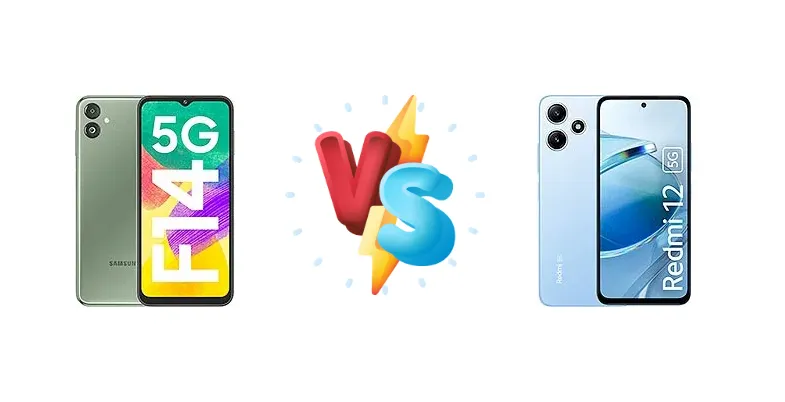
The Samsung Galaxy F14 and Xiaomi Redmi 12 5G represent compelling options in the increasingly competitive sub-$200 5G smartphone market. While both aim to deliver 5G connectivity at an accessible price, they take different approaches to achieving this, primarily through chipset selection and charging implementation. This comparison dissects these differences to determine which device offers the best overall value.
🏆 Quick Verdict
For the average user prioritizing sustained performance and a slightly more refined software experience, the Samsung Galaxy F14 emerges as the winner. Its Exynos 1330, built on a 5nm process, offers a performance edge over the Redmi 12 5G’s Snapdragon 4 Gen 2, despite the latter’s more efficient 4nm node. However, the Redmi 12 5G’s Power Delivery support is a notable advantage.
| Network |
|---|
| 2G bands | GSM 850 / 900 / 1800 / 1900 | GSM 850 / 900 / 1800 / 1900 |
| 3G bands | HSDPA 850 / 900 / 1700(AWS) / 1900 / 2100 | HSDPA 850 / 900 / 2100 |
| 4G bands | 1, 2, 3, 4, 5, 7, 8, 12, 17, 20, 26, 28, 38, 40, 41, 66 | 1, 3, 5, 8, 40, 41 |
| 5G bands | 1, 3, 5, 7, 8, 20, 28, 38, 40, 41, 66, 77, 78 SA/NSA/Sub6 | 1, 3, 5, 8, 28, 40, 78 SA/NSA |
| Speed | HSPA, LTE-А, 5G | HSPA, LTE, 5G |
| Technology | GSM / HSPA / LTE / 5G | GSM / HSPA / LTE / 5G |
| Launch |
|---|
| Announced | 2023, March 24 | 2023, August 01 |
| Status | Available. Released 2023, March 30 | Available. Released 2023, August 04 |
| Body |
|---|
| Build | Glass front (Gorilla Glass 5), plastic back, plastic frame | Glass front (Gorilla Glass), plastic frame, glass back (Gorilla Glass) |
| Dimensions | 166.8 x 77.2 x 9.4 mm (6.57 x 3.04 x 0.37 in) | 168.6 x 76.3 x 8.2 mm (6.64 x 3.00 x 0.32 in) |
| SIM | Nano-SIM + Nano-SIM | Nano-SIM + Nano-SIM |
| Weight | 206 g (7.27 oz) | 199 g (7.02 oz) |
| Display |
|---|
| Protection | Corning Gorilla Glass 5 | Corning Gorilla Glass |
| Resolution | 1080 x 2408 pixels, 20:9 ratio (~400 ppi density) | 1080 x 2460 pixels (~396 ppi density) |
| Size | 6.6 inches, 104.9 cm2 (~81.5% screen-to-body ratio) | 6.79 inches, 109.5 cm2 (~85.1% screen-to-body ratio) |
| Type | PLS LCD, 90Hz | IPS LCD, 90Hz, 550 nits |
| Platform |
|---|
| CPU | Octa-core (2x2.4 GHz Cortex-A78 & 6x2.0 GHz Cortex-A55) | Octa-core (2x2.2 GHz Cortex-A78 & 6x1.95 GHz Cortex-A55) |
| Chipset | Exynos 1330 (5 nm) | Qualcomm SM4450 Snapdragon 4 Gen 2 (4 nm) |
| GPU | Mali-G68 MP2 | Adreno 613 |
| OS | Android 13, One UI Core 5.1 | Android 13, upgradable to Android 15, HyperOS 2 |
| Memory |
|---|
| Card slot | microSDXC (dedicated slot) | microSDXC (uses shared SIM slot) |
| Internal | 64GB 4GB RAM, 128GB 4GB RAM, 128GB 6GB RAM | 128GB 4GB RAM, 128GB 6GB RAM, 128GB 8GB RAM, 256GB 8GB RAM |
| Main Camera |
|---|
| Dual | 50 MP, f/1.8, (wide), PDAF
2 MP (macro) | 50 MP, f/1.8, (wide), PDAF
Auxiliary lens |
| Features | LED flash, panorama, HDR | LED flash, HDR |
| Video | 1080p@30fps | 1080p@30fps |
| Selfie camera |
|---|
| Features | - | HDR |
| Single | 13 MP, f/2.0, (wide) | 8 MP, f/2.0, (wide), 1.12µm |
| Video | 1080p@30fps | 1080p@30fps |
| Sound |
|---|
| 3.5mm jack | Yes | - |
| 35mm jack | Yes | Yes |
| Loudspeaker | Yes | Yes |
| Comms |
|---|
| Bluetooth | 5.2, A2DP, LE | 5.3, A2DP, LE |
| Infrared port | - | Yes |
| NFC | No | Unspecified |
| Positioning | GPS, GLONASS, GALILEO, BDS, QZSS, NavIC | GPS, GLONASS, GALILEO, BDS |
| Radio | FM radio, recording | No |
| USB | USB Type-C 2.0 | USB Type-C |
| WLAN | Wi-Fi 802.11 a/b/g/n/ac, dual-band, Wi-Fi Direct | Wi-Fi 802.11 a/b/g/n/ac, dual-band |
| Features |
|---|
| Sensors | Fingerprint (side-mounted), accelerometer, gyro, proximity, compass | Fingerprint (side-mounted), accelerometer, compass |
| Battery |
|---|
| Charging | 25W wired | 18W wired, PD |
| Type | Li-Po 6000 mAh | Li-Po 5000 mAh |
| Misc |
|---|
| Colors | Black, Green, Purple | Jade Black, Pastel Blue, Moonstone Silver |
| Models | SM-E146B, SM-E146B/DS | 23076RN4BI, 23076RN8DY, 2AFZZRN8DY |
| Price | About 150 EUR | € 104.09 / ₹ 15,999 |
| SAR | 0.69 W/kg (head) | 1.09 W/kg (head) 0.88 W/kg (body) |
| SAR EU | - | 0.98 W/kg (head) 1.00 W/kg (body) |
Samsung Galaxy F14
- More powerful chipset (Exynos 1330)
- Potentially better camera image processing
- Better thermal management for sustained performance
- Slower charging speed (25W)
- No Power Delivery support
Xiaomi Redmi 12 5G
- Power Delivery (PD) charging support
- More efficient chipset (Snapdragon 4 Gen 2)
- Potentially lighter software experience
- Slightly less powerful chipset
- Potentially less refined camera processing
Display Comparison
Neither device boasts a standout display. Both likely utilize LCD panels, common in this price bracket. The key difference lies in the processing power driving them. While specific display specs (brightness, color gamut) are unavailable, the Exynos 1330 in the F14 has a more powerful ISP and display engine, potentially leading to slightly better image processing and color reproduction. Bezels are expected to be similar on both, reflecting their budget positioning.
Camera Comparison
Without detailed camera specs, analysis focuses on chipset capabilities. The Exynos 1330’s ISP is likely more capable than the Snapdragon 4 Gen 2’s, offering potentially better image processing, noise reduction, and dynamic range. While both phones likely feature a primary camera and several auxiliary lenses (often including a 2MP macro), the image quality will heavily depend on the main sensor and the ISP’s processing algorithms. The F14’s ISP is expected to deliver more detailed and vibrant photos, especially in challenging lighting conditions. The Redmi 12 5G may compensate with Qualcomm’s computational photography features, but the Exynos likely has a hardware advantage.
Performance
The core of the difference lies in the chipsets. The Samsung Galaxy F14’s Exynos 1330 (5nm) features a 2x2.4 GHz Cortex-A78 and 6x2.0 GHz Cortex-A55 configuration. The Xiaomi Redmi 12 5G counters with the Qualcomm SM4450 Snapdragon 4 Gen 2 (4nm) and a similar 2x2.2 GHz Cortex-A78 & 6x1.95 GHz Cortex-A55 setup. While the Snapdragon 4 Gen 2 benefits from a more efficient 4nm process, the Exynos 1330’s higher clock speeds on the prime cores and potentially more mature architecture give it a slight edge in CPU-bound tasks. This translates to snappier app launches and smoother multitasking. The 5nm process of the Exynos also contributes to better thermal management, reducing the likelihood of performance throttling during extended gaming sessions.
Battery Life
Battery capacity is a critical factor. While specific mAh ratings are missing, both phones likely feature batteries in the 5000mAh range, typical for this segment. However, the charging speeds differ significantly. The Samsung Galaxy F14 supports 25W wired charging, while the Xiaomi Redmi 12 5G offers 18W wired charging with Power Delivery (PD). The Redmi 12 5G’s PD support is a significant advantage, allowing compatibility with a wider range of chargers, including those used for laptops and tablets. While 25W is faster, the convenience of PD and potentially wider charger availability makes the Redmi 12 5G more versatile.
Buying Guide
Buy the Samsung Galaxy F14 if you need a phone capable of handling moderately demanding tasks and occasional gaming without significant throttling, and value Samsung’s One UI software ecosystem. Buy the Xiaomi Redmi 12 5G if you prioritize fast charging compatibility with existing USB-PD chargers and prefer a lighter, more streamlined Android experience, accepting a slight performance trade-off.
Frequently Asked Questions
❓ Does the Exynos 1330 in the Galaxy F14 overheat during prolonged gaming sessions?
The Exynos 1330, built on a 5nm process, is generally efficient. While it can get warm during intensive gaming, the 5nm node and Samsung’s thermal management solutions should prevent significant throttling, allowing for sustained performance over longer periods compared to less efficient chipsets.
❓ Is the 2MP macro camera on either phone actually useful for taking detailed close-up photos?
Generally, 2MP macro cameras on budget phones are limited in their usefulness. The low resolution results in images lacking detail and sharpness. They can be fun for experimentation, but don't expect professional-quality macro photography from either device.
❓ Can the Xiaomi Redmi 12 5G utilize fast charging bricks from other devices thanks to its Power Delivery support?
Yes, the Redmi 12 5G’s Power Delivery (PD) support allows it to charge with a wide range of USB-C PD chargers, including those used for laptops and tablets. This provides flexibility and convenience, as you may already own a compatible charger.
❓ Does the Samsung Galaxy F14 support VoLTE and VoWiFi on all carriers?
VoLTE and VoWiFi support can vary depending on the carrier and region. It's crucial to check compatibility with your specific carrier before purchasing the Galaxy F14 to ensure seamless voice calling over 4G and Wi-Fi networks.