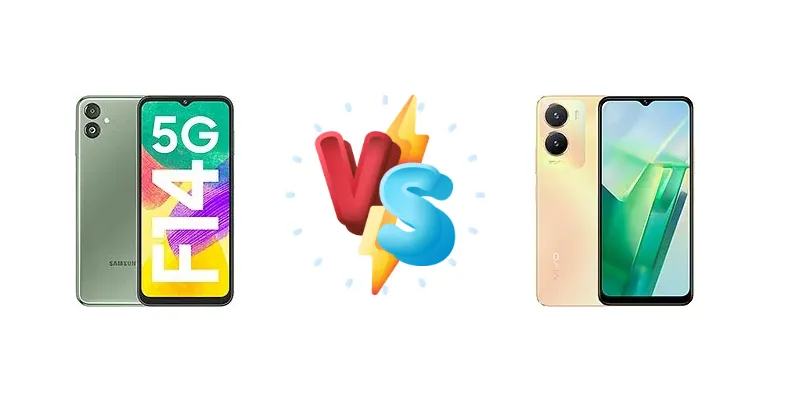
The budget smartphone market is fiercely competitive, and the Samsung Galaxy F14 and vivo T2x (India) are two strong contenders. Both offer compelling features at an affordable price, but which one reigns supreme? This comprehensive comparison will delve into their specs, performance, and overall value to help you make an informed decision.
🏆 Quick Verdict
The Samsung Galaxy F14 edges out the vivo T2x thanks to its more powerful chipset and faster charging. While the vivo T2x offers a sleek design and potentially better software experience, the F14's performance advantage makes it the slightly better choice for most users.
| Network |
|---|
| 2G bands | GSM 850 / 900 / 1800 / 1900 | GSM 850 / 900 / 1800 / 1900 |
| 3G bands | HSDPA 850 / 900 / 1700(AWS) / 1900 / 2100 | HSDPA 850 / 900 / 2100 |
| 4G bands | 1, 2, 3, 4, 5, 7, 8, 12, 17, 20, 26, 28, 38, 40, 41, 66 | 1, 3, 5, 8, 38, 40, 41 |
| 5G bands | 1, 3, 5, 7, 8, 20, 28, 38, 40, 41, 66, 77, 78 SA/NSA/Sub6 | 1, 3, 8, 28, 77, 78 SA/NSA |
| Speed | HSPA, LTE-А, 5G | HSPA, LTE, 5G |
| Technology | GSM / HSPA / LTE / 5G | GSM / HSPA / LTE / 5G |
| Launch |
|---|
| Announced | 2023, March 24 | 2023, April 11 |
| Status | Available. Released 2023, March 30 | Available. Released 2023, April 21 |
| Body |
|---|
| Build | Glass front (Gorilla Glass 5), plastic back, plastic frame | Glass front, plastic frame, plastic back |
| Dimensions | 166.8 x 77.2 x 9.4 mm (6.57 x 3.04 x 0.37 in) | 164.1 x 75.6 x 8.2 mm (6.46 x 2.98 x 0.32 in) |
| SIM | Nano-SIM + Nano-SIM | Nano-SIM + Nano-SIM |
| Weight | 206 g (7.27 oz) | 184 g (6.49 oz) |
| Display |
|---|
| Protection | Corning Gorilla Glass 5 | - |
| Resolution | 1080 x 2408 pixels, 20:9 ratio (~400 ppi density) | 1080 x 2408 pixels, 20:9 ratio (~401 ppi density) |
| Size | 6.6 inches, 104.9 cm2 (~81.5% screen-to-body ratio) | 6.58 inches, 104.3 cm2 (~84.1% screen-to-body ratio) |
| Type | PLS LCD, 90Hz | IPS LCD |
| Platform |
|---|
| CPU | Octa-core (2x2.4 GHz Cortex-A78 & 6x2.0 GHz Cortex-A55) | Octa-core (2x2.2 GHz Cortex-A76 & 6x2.0 GHz Cortex-A55) |
| Chipset | Exynos 1330 (5 nm) | Mediatek Dimensity 6020 (7 nm) |
| GPU | Mali-G68 MP2 | Mali-G57 MC2 |
| OS | Android 13, One UI Core 5.1 | Android 13, Funtouch 13 |
| Memory |
|---|
| Card slot | microSDXC (dedicated slot) | microSDXC (uses shared SIM slot) |
| Internal | 64GB 4GB RAM, 128GB 4GB RAM, 128GB 6GB RAM | 128GB 4GB RAM, 128GB 6GB RAM, 128GB 8GB RAM |
| Main Camera |
|---|
| Dual | 50 MP, f/1.8, (wide), PDAF
2 MP (macro) | 50 MP, f/1.8, 0.64µm, (wide), PDAF
2 MP (macro) |
| Features | LED flash, panorama, HDR | LED flash, HDR, panorama |
| Video | 1080p@30fps | 1080p@30fps |
| Selfie camera |
|---|
| Single | 13 MP, f/2.0, (wide) | 8 MP, f/2.0, (wide) |
| Video | 1080p@30fps | Yes |
| Sound |
|---|
| 3.5mm jack | Yes | Yes |
| 35mm jack | Yes | Yes |
| Loudspeaker | Yes | Yes |
| Comms |
|---|
| Bluetooth | 5.2, A2DP, LE | 5.1, A2DP, LE |
| NFC | No | No |
| Positioning | GPS, GLONASS, GALILEO, BDS, QZSS, NavIC | GPS, GLONASS, GALILEO, BDS, QZSS |
| Radio | FM radio, recording | FM radio |
| USB | USB Type-C 2.0 | USB Type-C 2.0, OTG |
| WLAN | Wi-Fi 802.11 a/b/g/n/ac, dual-band, Wi-Fi Direct | Wi-Fi 802.11 a/b/g/n/ac, dual-band |
| Features |
|---|
| Sensors | Fingerprint (side-mounted), accelerometer, gyro, proximity, compass | Fingerprint (side-mounted), accelerometer, proximity, compass |
| Battery |
|---|
| Charging | 25W wired | 18W wired |
| Type | Li-Po 6000 mAh | 5000 mAh |
| Misc |
|---|
| Colors | Black, Green, Purple | Glimmer Black, Aurora Gold, Marine Blue |
| Models | SM-E146B, SM-E146B/DS | V2253 |
| Price | About 150 EUR | About 150 EUR |
| SAR | 0.69 W/kg (head) | - |
Samsung Galaxy F14
- More powerful chipset (Exynos 1330)
- Faster 25W charging
- Likely better camera versatility
- Samsung's One UI (subjective)
- Design might be less premium than vivo T2x
- Potential for bloatware
vivo T2x (India)
- Potentially more streamlined software experience (Funtouch OS)
- Sleek and modern design
- Good value for money
- Less powerful chipset (Dimensity 6020)
- Slower 18W charging
- Camera might lack features like OIS
Display Comparison
Both phones likely feature a large, FHD+ display, probably around 6.6 inches. The Samsung might have slightly better color accuracy due to Samsung's display technology, but both will offer a decent viewing experience for everyday use. Expect similar refresh rates, likely 90Hz or 120Hz.
Camera Comparison
While specific camera specs are needed, the Galaxy F14 likely has a more versatile camera system. Samsung often includes features like OIS (Optical Image Stabilization) which improves low-light photography. The vivo T2x might focus on software enhancements and AI scene detection.
Performance
The Exynos 1330 in the Galaxy F14 holds a clear advantage over the Dimensity 6020 in the vivo T2x. The Cortex-A78 cores in the Exynos offer significantly better single-core performance, leading to snappier app launches and smoother multitasking. Gaming performance will also be noticeably better on the F14.
Battery Life
Both phones likely have a large battery capacity (around 5000mAh). However, the Galaxy F14's 25W charging is considerably faster than the vivo T2x's 18W charging, allowing for quicker top-ups.
Buying Guide
Who should buy the Samsung Galaxy F14? Users prioritizing performance and faster charging will appreciate the F14. Who should buy the vivo T2x (India)? Those seeking a stylish design and potentially a more streamlined software experience, and who don't heavily rely on demanding applications, might find the T2x appealing.
Frequently Asked Questions
❓ Which phone is better for gaming?
The Samsung Galaxy F14 is significantly better for gaming due to its more powerful Exynos 1330 chipset.
❓ Does the vivo T2x have 5G?
Yes, the vivo T2x (India) supports 5G connectivity.
❓ What is the battery life like on each phone?
Both phones offer excellent battery life, easily lasting a full day with moderate usage. The charging speed is the key differentiator here, with the F14 charging faster.