
Samsung Galaxy F14 vs Galaxy M33: A Detailed Comparison
| Phones Images | |||||
|---|---|---|---|---|---|
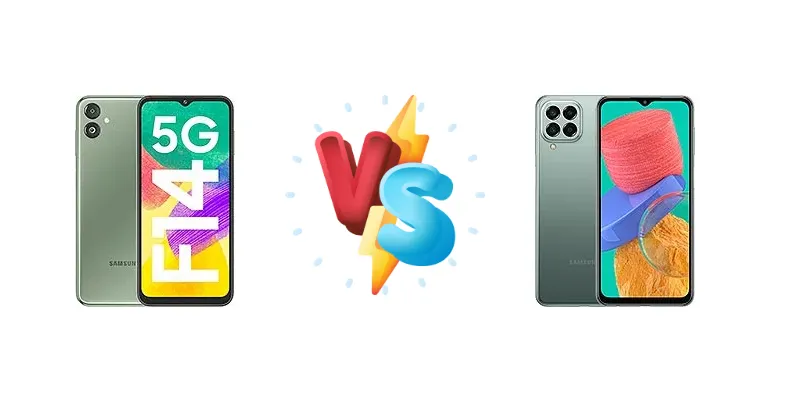
|
🏆 Quick Verdict
The Galaxy F14 edges out the M33 thanks to its slightly newer chipset and potentially improved efficiency. While the M33 boasts reverse charging, the F14's overall performance and modern design make it the better choice for most users seeking a reliable mid-range Samsung.
| PHONES | ||
|---|---|---|
| Phone Names | Samsung Galaxy F14 | Samsung Galaxy M33 |
| Network | ||
|---|---|---|
| 2G bands | GSM 850 / 900 / 1800 / 1900 | GSM 850 / 900 / 1800 / 1900 |
| 3G bands | HSDPA 850 / 900 / 1700(AWS) / 1900 / 2100 | HSDPA 850 / 900 / 1700(AWS) / 1900 / 2100 |
| 4G bands | 1, 2, 3, 4, 5, 7, 8, 12, 17, 20, 26, 28, 38, 40, 41, 66 | 1, 2, 3, 4, 5, 7, 8, 12, 17, 20, 26, 28, 38, 40, 41, 66 |
| 5G bands | 1, 3, 5, 7, 8, 20, 28, 38, 40, 41, 66, 77, 78 SA/NSA/Sub6 | 1, 3, 5, 7, 8, 20, 28, 38, 40, 41, 66, 78 SA/NSA |
| Speed | HSPA, LTE-А, 5G | HSPA, LTE, 5G |
| Technology | GSM / HSPA / LTE / 5G | GSM / HSPA / LTE / 5G |
| Launch | ||
|---|---|---|
| Announced | 2023, March 24 | 2022, March 04 |
| Status | Available. Released 2023, March 30 | Available. Released 2022, April 08 |
| Body | ||
|---|---|---|
| Build | Glass front (Gorilla Glass 5), plastic back, plastic frame | Glass front (Gorilla Glass 5), plastic frame, plastic back |
| Dimensions | 166.8 x 77.2 x 9.4 mm (6.57 x 3.04 x 0.37 in) | 165.4 x 76.9 x 9.4 mm (6.51 x 3.03 x 0.37 in) |
| SIM | Nano-SIM + Nano-SIM | · Nano-SIM· Nano-SIM + Nano-SIM |
| Weight | 206 g (7.27 oz) | 198 g (Global) / 215 g (India) (6.98 oz) |
| Display | ||
|---|---|---|
| Protection | Corning Gorilla Glass 5 | Corning Gorilla Glass 5 |
| Resolution | 1080 x 2408 pixels, 20:9 ratio (~400 ppi density) | 1080 x 2408 pixels, 20:9 ratio (~400 ppi density) |
| Size | 6.6 inches, 104.9 cm2 (~81.5% screen-to-body ratio) | 6.6 inches, 104.9 cm2 (~82.5% screen-to-body ratio) |
| Type | PLS LCD, 90Hz | TFT LCD, 120Hz |
| Platform | ||
|---|---|---|
| CPU | Octa-core (2x2.4 GHz Cortex-A78 & 6x2.0 GHz Cortex-A55) | Octa-core (2x2.4 GHz Cortex-A78 & 6x2.0 GHz Cortex-A55) |
| Chipset | Exynos 1330 (5 nm) | Exynos 1280 (5 nm) |
| GPU | Mali-G68 MP2 | Mali-G68 |
| OS | Android 13, One UI Core 5.1 | Android 12, upgradable to Android 16, One UI 8 |
| Memory | ||
|---|---|---|
| Card slot | microSDXC (dedicated slot) | microSDXC (dedicated slot) |
| Internal | 64GB 4GB RAM, 128GB 4GB RAM, 128GB 6GB RAM | 128GB 6GB RAM, 128GB 8GB RAM |
| - | UFS 2.2 | |
| Main Camera | ||
|---|---|---|
| Dual | 50 MP, f/1.8, (wide), PDAF 2 MP (macro) | - |
| Features | LED flash, panorama, HDR | LED flash, panorama, HDR |
| Quad | - | 50 MP, f/1.8, (wide), PDAF 5 MP, f/2.2, 123˚ (ultrawide) 2 MP (macro) Auxiliary lens |
| Single | - | 8 MP, f/2.2, (wide) |
| Video | 1080p@30fps | 4K@30fps, 1080p@30fps |
| Selfie camera | ||
|---|---|---|
| Single | 13 MP, f/2.0, (wide) | 8 MP, f/2.2, (wide) |
| Video | 1080p@30fps | 1080p@30fps |
| Sound | ||
|---|---|---|
| 3.5mm jack | Yes | Yes |
| 35mm jack | Yes | Yes |
| Loudspeaker | Yes | Yes |
| Comms | ||
|---|---|---|
| Bluetooth | 5.2, A2DP, LE | 5.1, A2DP, LE |
| NFC | No | Yes |
| Positioning | GPS, GLONASS, GALILEO, BDS, QZSS, NavIC | GPS, GLONASS, GALILEO, BDS, QZSS |
| Radio | FM radio, recording | Unspecified |
| USB | USB Type-C 2.0 | USB Type-C 2.0, OTG |
| WLAN | Wi-Fi 802.11 a/b/g/n/ac, dual-band, Wi-Fi Direct | Wi-Fi 802.11 a/b/g/n/ac, dual-band, Wi-Fi Direct |
| Features | ||
|---|---|---|
| Sensors | Fingerprint (side-mounted), accelerometer, gyro, proximity, compass | Fingerprint (side-mounted), accelerometer, gyro |
| - | Virtual Proximity Sensing | |
| Battery | ||
|---|---|---|
| Charging | 25W wired | 25W wired 4.5W reverse wired |
| Type | Li-Po 6000 mAh | Market-dependent versions:· Li-Ion 5000 mAh (Global)· Li-Ion 6000 mAh (India only) |
| Misc | ||
|---|---|---|
| Colors | Black, Green, Purple | Green, Blue, Brown |
| Models | SM-E146B, SM-E146B/DS | SM-M336B, SM-M336B/DS, SM-M336BU, SM-M336BU/DS, SM-M336K |
| Price | About 150 EUR | £ 299.00 |
| SAR | 0.69 W/kg (head) | - |
| SAR EU | - | 1.04 W/kg (head) 1.38 W/kg (body) |
Samsung Galaxy F14
- Newer Exynos 1330 chipset
- Modern design
- Excellent battery life
- Vibrant 120Hz display
- No reverse charging
- Camera might be slightly less impressive than M33 in low light
Samsung Galaxy M33
- Reverse wired charging
- Slightly larger display (potentially)
- Good value for money
- Reliable performance
- Older Exynos 1280 chipset
- Design may feel dated
- Slightly less efficient than F14
Display Comparison
Both phones feature a 6.6-inch FHD+ Super AMOLED display with a 120Hz refresh rate, offering vibrant colors and smooth scrolling. The M33 might have slightly better color accuracy due to its slightly older panel, but the difference is minimal. The F14's design might offer a more modern look.
Camera Comparison
The M33 typically features a 50MP main camera with OIS, an 8MP ultrawide, and a 2MP macro lens. The F14 also has a 50MP main camera, but details on other lenses may vary slightly. Image quality is generally good on both, with the M33 potentially having a slight edge in low-light conditions due to OIS. Video recording capabilities are comparable.
Performance
The Exynos 1330 in the F14 is a newer chipset built on a 5nm process, offering a slight performance advantage over the Exynos 1280 in the M33. Expect smoother multitasking and slightly faster app loading times on the F14. Both handle everyday tasks with ease.
Battery Life
Both phones pack a 6000mAh battery, promising all-day battery life. The F14's newer chipset might offer slightly better power efficiency. The M33 has a unique advantage with its 4.5W reverse wired charging, allowing you to charge other devices.
Buying Guide
The Samsung Galaxy F14 is ideal for users prioritizing performance and a modern design without breaking the bank. The Galaxy M33 is a good option for those who value reverse charging and a slightly larger display, and are comfortable with a slightly older chipset.