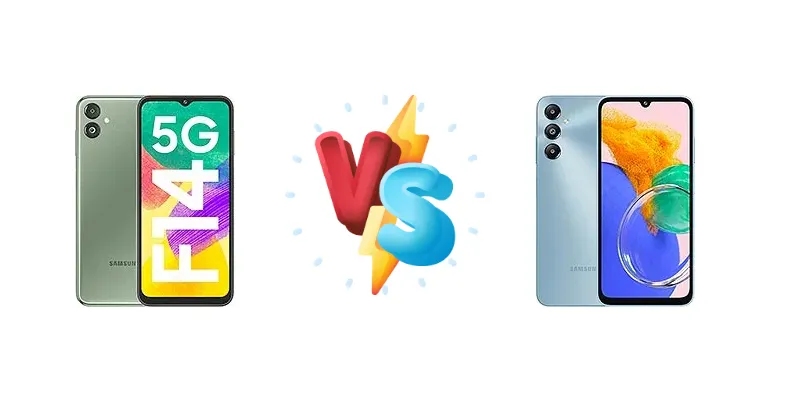
Samsung's F and M series consistently deliver compelling value in the budget smartphone space. The Galaxy F14 and M14 4G represent two distinct approaches to achieving affordability. While both share a similar price point, they diverge significantly in their core processing power, with the F14 utilizing Samsung’s in-house Exynos 1330 and the M14 4G opting for Qualcomm’s Snapdragon 680. This comparison will dissect these differences to determine which device best suits your needs.
🏆 Quick Verdict
For the average user prioritizing consistent performance and potential for future software support, the Samsung Galaxy F14 emerges as the stronger choice. Its Exynos 1330 chipset, built on a smaller 5nm process, offers a noticeable performance advantage over the Snapdragon 680 in the M14 4G, despite both having the same peak CPU clock speed.
| Network |
|---|
| 2G bands | GSM 850 / 900 / 1800 / 1900 | GSM 850 / 900 / 1800 / 1900 |
| 3G bands | HSDPA 850 / 900 / 1700(AWS) / 1900 / 2100 | HSDPA 850 / 900 / 2100 |
| 4G bands | 1, 2, 3, 4, 5, 7, 8, 12, 17, 20, 26, 28, 38, 40, 41, 66 | 1, 3, 5, 7, 8, 20, 28, 38, 40, 41 |
| 5G bands | 1, 3, 5, 7, 8, 20, 28, 38, 40, 41, 66, 77, 78 SA/NSA/Sub6 | - |
| Speed | HSPA, LTE-А, 5G | HSPA, LTE |
| Technology | GSM / HSPA / LTE / 5G | GSM / HSPA / LTE |
| Launch |
|---|
| Announced | 2023, March 24 | 2024, March 07 |
| Status | Available. Released 2023, March 30 | Available. Released 2024, March 07 |
| Body |
|---|
| Build | Glass front (Gorilla Glass 5), plastic back, plastic frame | - |
| Dimensions | 166.8 x 77.2 x 9.4 mm (6.57 x 3.04 x 0.37 in) | 168 x 77.8 x 8.8 mm (6.61 x 3.06 x 0.35 in) |
| SIM | Nano-SIM + Nano-SIM | Nano-SIM + Nano-SIM |
| Weight | 206 g (7.27 oz) | 194 g (6.84 oz) |
| Display |
|---|
| Protection | Corning Gorilla Glass 5 | - |
| Resolution | 1080 x 2408 pixels, 20:9 ratio (~400 ppi density) | 1080 x 2400 pixels, 20:9 ratio (~394 ppi density) |
| Size | 6.6 inches, 104.9 cm2 (~81.5% screen-to-body ratio) | 6.7 inches, 107.8 cm2 (~82.5% screen-to-body ratio) |
| Type | PLS LCD, 90Hz | PLS LCD, 90Hz |
| Platform |
|---|
| CPU | Octa-core (2x2.4 GHz Cortex-A78 & 6x2.0 GHz Cortex-A55) | Octa-core (4x2.4 GHz Kryo 265 Gold & 4x1.9 GHz Kryo 265 Silver) |
| Chipset | Exynos 1330 (5 nm) | Qualcomm SM6225 Snapdragon 680 4G (6 nm) |
| GPU | Mali-G68 MP2 | Adreno 610 |
| OS | Android 13, One UI Core 5.1 | Android 13, up to 2 major Android upgrades, One UI 5.1 |
| Memory |
|---|
| Card slot | microSDXC (dedicated slot) | microSDXC (dedicated slot) |
| Internal | 64GB 4GB RAM, 128GB 4GB RAM, 128GB 6GB RAM | 64GB 4GB RAM, 128GB 6GB RAM |
| Main Camera |
|---|
| Dual | 50 MP, f/1.8, (wide), PDAF
2 MP (macro) | - |
| Features | LED flash, panorama, HDR | LED flash, panorama, HDR |
| Triple | - | 50 MP, f/1.8, (wide), PDAF
2 MP (macro)
Auxiliary lens |
| Video | 1080p@30fps | 1080p@30/60fps |
| Selfie camera |
|---|
| Single | 13 MP, f/2.0, (wide) | 13 MP, f/2.0, (wide) |
| Video | 1080p@30fps | 1080p@30fps |
| Sound |
|---|
| 3.5mm jack | Yes | - |
| 35mm jack | Yes | Yes |
| Loudspeaker | Yes | Yes |
| Comms |
|---|
| Bluetooth | 5.2, A2DP, LE | 5.1, A2DP, LE |
| NFC | No | No |
| Positioning | GPS, GLONASS, GALILEO, BDS, QZSS, NavIC | GPS, GALILEO, GLONASS, BDS, QZSS |
| Radio | FM radio, recording | Unspecified |
| USB | USB Type-C 2.0 | USB Type-C 2.0 |
| WLAN | Wi-Fi 802.11 a/b/g/n/ac, dual-band, Wi-Fi Direct | Wi-Fi 802.11 a/b/g/n/ac, dual-band, Wi-Fi Direct |
| Features |
|---|
| Sensors | Fingerprint (side-mounted), accelerometer, gyro, proximity, compass | Fingerprint (side-mounted), accelerometer, proximity |
| Battery |
|---|
| Charging | 25W wired | 25W wired |
| Type | Li-Po 6000 mAh | Li-Ion 5000 mAh |
| Misc |
|---|
| Colors | Black, Green, Purple | Arctic Blue, Sapphire Blue |
| Models | SM-E146B, SM-E146B/DS | SM-M145F, SM-M145F/DS |
| Price | About 150 EUR | About 90 EUR |
| SAR | 0.69 W/kg (head) | 0.56 W/kg (head) |
Samsung Galaxy F14
- More powerful Exynos 1330 chipset for smoother performance.
- 5nm fabrication process for improved efficiency.
- Potentially better image processing thanks to a more advanced ISP.
- May experience slightly shorter battery life compared to the M14 4G.
- Potential for software bloat common in Samsung devices.
Samsung Galaxy M14 4G
- Snapdragon 680 is known for its stable and efficient performance.
- Potentially longer battery life due to chipset efficiency.
- Generally reliable software experience.
- Less powerful chipset compared to the Exynos 1330.
- 6nm process is less efficient than the F14's 5nm process.
Display Comparison
Both devices are expected to feature similar LCD panels, but detailed display specs (resolution, brightness, color gamut) are not provided. However, the chipset differences indirectly impact the display experience. The Exynos 1330’s more powerful GPU in the F14 can drive smoother animations and potentially handle higher refresh rates if Samsung were to implement them in future software updates. The lack of detailed display information makes a direct comparison difficult, but the F14’s processing power offers headroom for a potentially better visual experience.
Camera Comparison
Without detailed camera sensor information, a direct comparison is limited. However, Samsung’s image processing algorithms are known to vary between chipsets. The Exynos 1330 in the F14 likely benefits from a more advanced image signal processor (ISP), potentially resulting in better dynamic range, noise reduction, and overall image quality, especially in challenging lighting conditions. The presence of a more powerful ISP can also enable features like faster image processing and improved video stabilization. The 2MP macro cameras on both devices are likely to offer limited utility, serving primarily as a marketing feature.
Performance
The core difference lies in the chipsets. The Samsung Galaxy F14’s Exynos 1330 (5nm) boasts a more modern architecture than the Qualcomm Snapdragon 680 (6nm) in the M14 4G. While both CPUs feature octa-core configurations with a 2.4 GHz peak clock speed, the Exynos 1330 utilizes Cortex-A78 cores for its performance cluster, offering a significant architectural advantage over the Snapdragon 680’s Kryo 265 Gold cores. The 5nm fabrication process of the Exynos 1330 also contributes to improved power efficiency and thermal management, potentially reducing throttling during sustained workloads. This translates to a smoother experience in demanding apps and games for the F14.
Battery Life
Both phones feature 25W wired charging, suggesting similar charging speeds. While battery capacity isn't specified, the Snapdragon 680’s inherent power efficiency in the M14 4G could translate to slightly longer battery life during typical usage. However, the Exynos 1330’s 5nm process also contributes to efficiency, potentially offsetting this advantage. Real-world battery performance will depend heavily on usage patterns and software optimization. The 25W charging speed is adequate for the segment, but not particularly fast compared to some competitors.
Buying Guide
Buy the Samsung Galaxy F14 if you need a phone capable of handling moderately demanding tasks like multitasking, light gaming, and content creation without significant slowdowns. Its more efficient chipset also suggests better long-term performance. Buy the Samsung Galaxy M14 4G if you prioritize maximizing battery life and prefer a proven, stable chipset known for its efficiency, even if it means sacrificing some raw processing power. It's a solid choice for basic smartphone usage.
Frequently Asked Questions
❓ Does the Exynos 1330 in the Galaxy F14 overheat during prolonged gaming sessions?
The Exynos 1330’s 5nm fabrication process and Samsung’s thermal management solutions should mitigate overheating during gaming. While it may get warm, it’s unlikely to throttle significantly under normal gaming conditions, offering a more consistent experience than the Snapdragon 680 in the M14 4G under similar stress.
❓ Is the Snapdragon 680 in the Galaxy M14 4G sufficient for playing popular games like PUBG Mobile?
The Snapdragon 680 can run PUBG Mobile, but you’ll likely need to lower the graphics settings to achieve a smooth frame rate. It’s not ideal for demanding games at high settings, and you may experience occasional stuttering. The Exynos 1330 in the F14 offers a more comfortable gaming experience with higher settings.
❓ How does the 6nm vs 5nm process affect the long-term performance of these phones?
A smaller fabrication process (5nm vs 6nm) generally leads to better power efficiency and less heat generation. Over time, this can translate to less performance degradation due to thermal throttling and potentially a longer lifespan for the chipset. The F14's 5nm Exynos 1330 is therefore expected to maintain its performance better over the long run.