
Samsung Galaxy F14 vs Galaxy M13 5G: The Ultimate Budget Showdown
| Phones Images | |||||
|---|---|---|---|---|---|
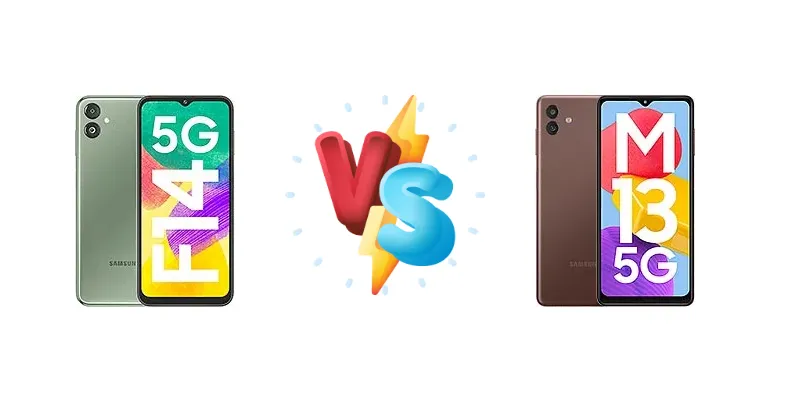
|
🏆 Quick Verdict
The Galaxy F14 edges out the M13 5G thanks to its significantly faster charging and a more powerful chipset. While the M13 5G offers 5G connectivity, the F14's overall performance and charging speed make it the better choice for most users.
| PHONES | ||
|---|---|---|
| Phone Names | Samsung Galaxy F14 | Samsung Galaxy M13 5G |
| Network | ||
|---|---|---|
| 2G bands | GSM 850 / 900 / 1800 / 1900 | GSM 850 / 900 / 1800 / 1900 |
| 3G bands | HSDPA 850 / 900 / 1700(AWS) / 1900 / 2100 | HSDPA 850 / 900 / 1900 / 2100 |
| 4G bands | 1, 2, 3, 4, 5, 7, 8, 12, 17, 20, 26, 28, 38, 40, 41, 66 | 1, 2, 3, 4, 5, 7, 8, 12, 17, 20, 26, 28, 38, 40, 41, 66 |
| 5G bands | 1, 3, 5, 7, 8, 20, 28, 38, 40, 41, 66, 77, 78 SA/NSA/Sub6 | 1, 3, 5, 7, 8, 20, 28, 38, 40, 41, 78 SA/NSA/Sub6 |
| Speed | HSPA, LTE-А, 5G | HSPA, LTE, 5G |
| Technology | GSM / HSPA / LTE / 5G | GSM / HSPA / LTE / 5G |
| Launch | ||
|---|---|---|
| Announced | 2023, March 24 | 2022, July 14 |
| Status | Available. Released 2023, March 30 | Available. Released 2022, July 23 |
| Body | ||
|---|---|---|
| Build | Glass front (Gorilla Glass 5), plastic back, plastic frame | Glass front (Gorilla Glass 3), plastic back, plastic frame |
| Dimensions | 166.8 x 77.2 x 9.4 mm (6.57 x 3.04 x 0.37 in) | 164.5 x 76.5 x 8.8 mm (6.48 x 3.01 x 0.35 in) |
| SIM | Nano-SIM + Nano-SIM | Nano-SIM + Nano-SIM |
| Weight | 206 g (7.27 oz) | 195 g (6.88 oz) |
| Display | ||
|---|---|---|
| Protection | Corning Gorilla Glass 5 | Corning Gorilla Glass 3 |
| Resolution | 1080 x 2408 pixels, 20:9 ratio (~400 ppi density) | 720 x 1600 pixels, 20:9 ratio (~270 ppi density) |
| Size | 6.6 inches, 104.9 cm2 (~81.5% screen-to-body ratio) | 6.5 inches, 102.0 cm2 (~81.1% screen-to-body ratio) |
| Type | PLS LCD, 90Hz | PLS LCD, 90Hz, 400 nits (typ) |
| Platform | ||
|---|---|---|
| CPU | Octa-core (2x2.4 GHz Cortex-A78 & 6x2.0 GHz Cortex-A55) | Octa-core (2x2.2 GHz Cortex-A76 & 6x2.0 GHz Cortex-A55) |
| Chipset | Exynos 1330 (5 nm) | Mediatek Dimensity 700 (7 nm) |
| GPU | Mali-G68 MP2 | Mali-G57 MC2 |
| OS | Android 13, One UI Core 5.1 | Android 12, One UI Core 4 |
| Memory | ||
|---|---|---|
| Card slot | microSDXC (dedicated slot) | microSDXC (dedicated slot) |
| Internal | 64GB 4GB RAM, 128GB 4GB RAM, 128GB 6GB RAM | 64GB 4GB RAM, 128GB 6GB RAM |
| Main Camera | ||
|---|---|---|
| Dual | 50 MP, f/1.8, (wide), PDAF 2 MP (macro) | 50 MP, f/1.8, (wide), PDAF Auxiliary lens |
| Features | LED flash, panorama, HDR | LED flash, panorama, HDR |
| Video | 1080p@30fps | 1080p@30fps |
| Selfie camera | ||
|---|---|---|
| Features | - | HDR |
| Single | 13 MP, f/2.0, (wide) | 5 MP, f/2.0, (wide) |
| Video | 1080p@30fps | - |
| Sound | ||
|---|---|---|
| 3.5mm jack | Yes | Yes |
| 35mm jack | Yes | Yes |
| Loudspeaker | Yes | Yes |
| Comms | ||
|---|---|---|
| Bluetooth | 5.2, A2DP, LE | 5.0, A2DP, LE |
| NFC | No | No |
| Positioning | GPS, GLONASS, GALILEO, BDS, QZSS, NavIC | GPS, GLONASS, BDS, GALILEO, QZSS |
| Radio | FM radio, recording | Unspecified |
| USB | USB Type-C 2.0 | USB Type-C 2.0 |
| WLAN | Wi-Fi 802.11 a/b/g/n/ac, dual-band, Wi-Fi Direct | Wi-Fi 802.11 a/b/g/n/ac, dual-band |
| Features | ||
|---|---|---|
| Sensors | Fingerprint (side-mounted), accelerometer, gyro, proximity, compass | Fingerprint (side-mounted), accelerometer, gyro, compass |
| - | Virtual proximity sensing | |
| Battery | ||
|---|---|---|
| Charging | 25W wired | 15W wired |
| Type | Li-Po 6000 mAh | Li-Po 5000 mAh |
| Misc | ||
|---|---|---|
| Colors | Black, Green, Purple | Midnight Blue, Aqua Green, Stardust Brown |
| Models | SM-E146B, SM-E146B/DS | SM-M136B, SM-M136B/DS |
| Price | About 150 EUR | About 180 EUR |
| SAR | 0.69 W/kg (head) | 0.73 W/kg (head) |
| SAR EU | - | 0.84 W/kg (head) 1.33 W/kg (body) |
Samsung Galaxy F14
- Faster Charging (25W)
- More Powerful Chipset (Exynos 1330)
- Potentially Better Camera
- Likely 90Hz Display
- May lack some carrier compatibility in certain regions
- Design might be less premium
Samsung Galaxy M13 5G
- 5G Connectivity
- Large 6000mAh Battery
- Affordable Price
- Slower Charging (15W)
- Less Powerful Chipset (Dimensity 700)
- Likely 60Hz Display
- Potentially Lower Camera Quality
Display Comparison
Both phones feature a 6.6-inch FHD+ display, likely with a 90Hz refresh rate on the F14 and a standard 60Hz on the M13 5G. The F14's display may offer slightly better color accuracy and brightness due to its more modern panel. However, both provide a decent viewing experience for media consumption.
Camera Comparison
The F14 is expected to have a slightly better camera system, potentially with a higher resolution main sensor and improved image processing. Both phones likely feature a similar ultrawide and macro lens setup. Expect the F14 to produce more detailed and vibrant photos in most lighting conditions.
Performance
The Exynos 1330 in the F14 holds a clear advantage over the Dimensity 700 in the M13 5G. The Cortex-A78 cores in the F14 offer significantly better single-core performance, resulting in smoother multitasking and app loading. While both have 6 Cortex-A55 cores, the F14's overall architecture is more efficient.
Battery Life
Both phones likely feature a 6000mAh battery, promising excellent battery life. However, the F14's 25W charging is a major advantage over the M13 5G's 15W charging, allowing for significantly faster top-ups.
Buying Guide
The Samsung Galaxy F14 is ideal for users prioritizing performance and faster charging. It's a great choice for everyday tasks, light gaming, and those who want a responsive experience. The Samsung Galaxy M13 5G is best suited for users who absolutely need 5G connectivity and are willing to compromise on charging speed and overall performance.