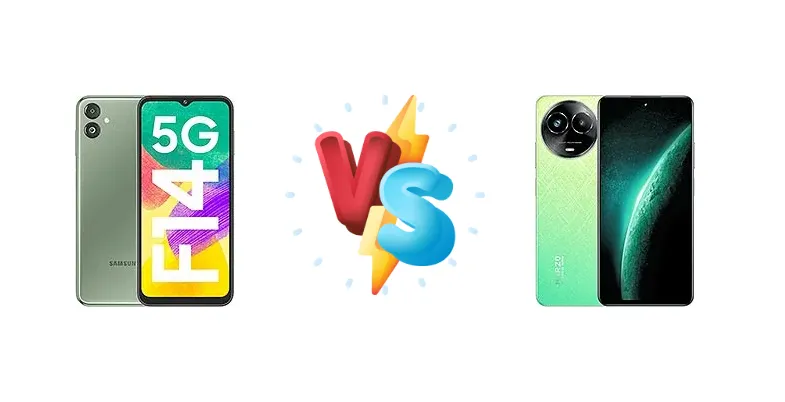
The sub-$200 smartphone market is fiercely competitive, and the Realme Narzo 60x and Samsung Galaxy F14 are two strong contenders. The Narzo 60x leverages MediaTek's latest Dimensity 6100+ chipset, while the Galaxy F14 relies on Samsung's in-house Exynos 1330. This comparison will dissect their strengths and weaknesses to determine which device delivers the best value for your money.
🏆 Quick Verdict
For most users, the Realme Narzo 60x emerges as the better choice. Its 33W charging significantly reduces downtime, and the Dimensity 6100+’s 6nm process offers a slight efficiency advantage over the Exynos 1330’s 5nm node, potentially leading to better sustained performance. While Samsung’s brand recognition is strong, Realme delivers more tangible benefits in this price bracket.
| Network |
|---|
| 2G bands | GSM 850 / 900 / 1800 / 1900 | GSM 850 / 900 / 1800 / 1900 |
| 3G bands | HSDPA 850 / 900 / 1700(AWS) / 1900 / 2100 | HSDPA 850 / 900 / 2100 |
| 4G bands | 1, 2, 3, 4, 5, 7, 8, 12, 17, 20, 26, 28, 38, 40, 41, 66 | 1, 3, 5, 8, 28, 40, 41 |
| 5G bands | 1, 3, 5, 7, 8, 20, 28, 38, 40, 41, 66, 77, 78 SA/NSA/Sub6 | 1, 3, 5, 8, 28, 40, 41, 77, 78 SA/NSA |
| Speed | HSPA, LTE-А, 5G | HSPA, LTE, 5G |
| Technology | GSM / HSPA / LTE / 5G | GSM / HSPA / LTE / 5G |
| Launch |
|---|
| Announced | 2023, March 24 | 2023, September 06 |
| Status | Available. Released 2023, March 30 | Available. Released 2023, September 12 |
| Body |
|---|
| Build | Glass front (Gorilla Glass 5), plastic back, plastic frame | - |
| Dimensions | 166.8 x 77.2 x 9.4 mm (6.57 x 3.04 x 0.37 in) | 165.7 x 76 x 7.9 mm (6.52 x 2.99 x 0.31 in) |
| SIM | Nano-SIM + Nano-SIM | Nano-SIM + Nano-SIM |
| Weight | 206 g (7.27 oz) | 190 g (6.70 oz) |
| Display |
|---|
| Protection | Corning Gorilla Glass 5 | - |
| Resolution | 1080 x 2408 pixels, 20:9 ratio (~400 ppi density) | 1080 x 2400 pixels, 20:9 ratio (~392 ppi density) |
| Size | 6.6 inches, 104.9 cm2 (~81.5% screen-to-body ratio) | 6.72 inches, 109.0 cm2 (~86.6% screen-to-body ratio) |
| Type | PLS LCD, 90Hz | IPS LCD, 120Hz, 550 nits (typ), 680 nits (HBM) |
| Platform |
|---|
| CPU | Octa-core (2x2.4 GHz Cortex-A78 & 6x2.0 GHz Cortex-A55) | Octa-core (2x2.2 GHz Cortex-A76 & 6x2.0 GHz Cortex-A55) |
| Chipset | Exynos 1330 (5 nm) | Mediatek Dimensity 6100+ (6 nm) |
| GPU | Mali-G68 MP2 | Mali-G57 MC2 |
| OS | Android 13, One UI Core 5.1 | Android 13, Realme UI 4.0 |
| Memory |
|---|
| Card slot | microSDXC (dedicated slot) | microSDXC (dedicated slot) |
| Internal | 64GB 4GB RAM, 128GB 4GB RAM, 128GB 6GB RAM | 128GB 4GB RAM, 128GB 6GB RAM |
| Main Camera |
|---|
| Dual | 50 MP, f/1.8, (wide), PDAF
2 MP (macro) | 50 MP, f/1.8, 27mm (wide), 0.64µm, PDAF
Auxiliary lens |
| Features | LED flash, panorama, HDR | LED flash, HDR, panorama |
| Video | 1080p@30fps | 1080p@30fps |
| Selfie camera |
|---|
| Features | - | Panorama |
| Single | 13 MP, f/2.0, (wide) | 8 MP, f2.1, 26mm (wide) |
| Video | 1080p@30fps | 1080p@30fps |
| Sound |
|---|
| 3.5mm jack | Yes | - |
| 35mm jack | Yes | Yes |
| Loudspeaker | Yes | Yes |
| Comms |
|---|
| Bluetooth | 5.2, A2DP, LE | 5.2, A2DP, LE |
| NFC | No | No |
| Positioning | GPS, GLONASS, GALILEO, BDS, QZSS, NavIC | GPS, GALILEO, GLONASS, BDS |
| Radio | FM radio, recording | Unspecified |
| USB | USB Type-C 2.0 | USB Type-C 2.0 |
| WLAN | Wi-Fi 802.11 a/b/g/n/ac, dual-band, Wi-Fi Direct | Wi-Fi 802.11 a/b/g/n/ac, dual-band, Wi-Fi Direct |
| Features |
|---|
| Sensors | Fingerprint (side-mounted), accelerometer, gyro, proximity, compass | Fingerprint (side-mounted), accelerometer, proximity, compass |
| Battery |
|---|
| Charging | 25W wired | 33W wired, 50% in 29 min |
| Type | Li-Po 6000 mAh | 5000 mAh |
| Misc |
|---|
| Colors | Black, Green, Purple | Stellar Green, Nebula Purple |
| Models | SM-E146B, SM-E146B/DS | RMX3782, RMX3710 |
| Price | About 150 EUR | About 150 EUR |
| SAR | 0.69 W/kg (head) | - |
Samsung Galaxy F14
- Strong brand recognition and software support from Samsung.
- Potentially more refined software experience.
- Slightly higher clocked primary CPU cores.
- Slower 25W charging.
- Exynos 1330’s 5nm process may result in slightly higher thermal throttling.
- Likely less efficient chipset compared to Dimensity 6100+
Realme Narzo 60x
- Faster 33W charging with quick top-up times.
- More efficient Dimensity 6100+ chipset (6nm).
- Competitive pricing for the features offered.
- Realme UI may not appeal to all users.
- Brand recognition is lower than Samsung.
- Potentially less consistent software updates.
Display Comparison
Neither device boasts a standout display. Both likely utilize LCD panels, a common cost-saving measure in this segment. While specific display specs (resolution, brightness) are missing, the focus here is on performance. The absence of high refresh rates on either device suggests a prioritization of battery life over visual fluidity. Bezels are likely comparable, typical of budget offerings.
Camera Comparison
Without detailed camera specs, a direct comparison is difficult. However, both phones likely feature a primary camera paired with auxiliary lenses of limited utility (e.g., 2MP macro). The larger sensor size, if present on either device, will be the primary determinant of image quality, particularly in low light. Image processing algorithms will also play a crucial role, with Samsung historically favoring vibrant, saturated colors, while Realme often aims for a more natural look. OIS (Optical Image Stabilization) is unlikely on either device at this price point.
Performance
The core difference lies in the chipsets. The Realme Narzo 60x’s MediaTek Dimensity 6100+ (6nm) and the Samsung Galaxy F14’s Exynos 1330 (5nm) represent different approaches. While the Exynos 1330 features slightly higher clocked Cortex-A78 cores (2.4 GHz vs 2.2 GHz), the Dimensity 6100+ benefits from a more modern architecture and a smaller process node. This 6nm process generally translates to improved power efficiency and potentially better sustained performance under load. Both CPUs share the same Cortex-A55 efficiency cores, meaning multi-tasking performance will be similar. The impact of RAM speed (likely LPDDR4X on both) is minimal in everyday tasks.
Battery Life
The Realme Narzo 60x’s 33W charging is a clear advantage over the Galaxy F14’s 25W charging. Realme claims a 50% charge in 29 minutes, a significant time saver. While battery capacity isn’t specified, the faster charging speed mitigates any potential disadvantage if the Galaxy F14 has a slightly larger battery. The Dimensity 6100+’s 6nm process also contributes to better power efficiency, potentially extending battery life during demanding tasks.
Buying Guide
Buy the Samsung Galaxy F14 if you prioritize brand familiarity and a potentially more refined software experience, even if it means sacrificing charging speed. Buy the Realme Narzo 60x if you value faster charging, a slightly more efficient chipset, and are comfortable with Realme UI, all while staying within a tight budget. The Narzo 60x is ideal for users who are constantly on the go and need quick top-ups.
Frequently Asked Questions
❓ Does the Exynos 1330 in the Galaxy F14 tend to overheat during prolonged gaming sessions?
The Exynos 1330, while capable, is built on a 5nm process. This means it may generate more heat under sustained load compared to the Narzo 60x’s Dimensity 6100+ (6nm). While not necessarily overheating, users might experience some thermal throttling, leading to a slight performance dip during extended gaming.
❓ Is the 2MP macro camera on either phone actually useful for taking detailed close-up photos?
Generally, 2MP macro cameras on budget smartphones are of limited utility. The low resolution results in images lacking detail and sharpness. They are often included for marketing purposes but rarely deliver satisfying results. Expect soft, grainy images when attempting macro photography with either device.
❓ Can the Realme Narzo 60x reliably maintain 60fps in popular games like PUBG Mobile?
The Dimensity 6100+ is capable of running PUBG Mobile at 60fps on medium settings. However, achieving consistently stable frame rates will depend on the specific device configuration and in-game settings. Expect some frame drops during intense action sequences, but overall, the gaming experience should be acceptable.
❓ How does Realme UI compare to Samsung's One UI in terms of bloatware and user experience?
Realme UI historically has included more pre-installed apps (bloatware) than Samsung's One UI, although Realme has been improving in this area. One UI is generally considered more polished and feature-rich, but Realme UI offers a degree of customization. User preference plays a significant role here.