
Samsung Galaxy F14 vs Motorola Moto G54: Which Budget Champion Reigns Supreme?
| Phones Images | |||||
|---|---|---|---|---|---|
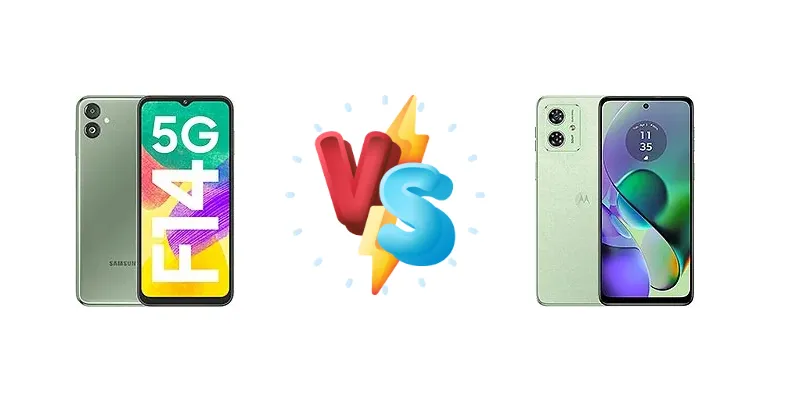
|
🏆 Quick Verdict
For the average user prioritizing sustained performance and a slightly more refined software experience, the Motorola Moto G54 emerges as the better choice. Its Mediatek Dimensity 7020, fabricated on a 6nm process, offers a tangible efficiency advantage over the Samsung Galaxy F14’s 5nm Exynos 1330, translating to potentially less thermal throttling during extended use.
| PHONES | ||
|---|---|---|
| Phone Names | Samsung Galaxy F14 | Motorola Moto G54 |
| Network | ||
|---|---|---|
| 2G bands | GSM 850 / 900 / 1800 / 1900 | GSM 850 / 900 / 1800 / 1900 |
| 3G bands | HSDPA 850 / 900 / 1700(AWS) / 1900 / 2100 | HSDPA 850 / 900 / 1900 / 2100 |
| 4G bands | 1, 2, 3, 4, 5, 7, 8, 12, 17, 20, 26, 28, 38, 40, 41, 66 | 1, 2, 3, 5, 7, 8, 20, 26, 28, 32, 38, 40, 41, 42 |
| 5G bands | 1, 3, 5, 7, 8, 20, 28, 38, 40, 41, 66, 77, 78 SA/NSA/Sub6 | 1, 3, 5, 7, 8, 20, 26, 28, 38, 40, 41, 77, 78 SA/NSA |
| Speed | HSPA, LTE-А, 5G | HSPA, LTE, 5G |
| Technology | GSM / HSPA / LTE / 5G | GSM / HSPA / LTE / 5G |
| Launch | ||
|---|---|---|
| Announced | 2023, March 24 | 2023, September 05 |
| Status | Available. Released 2023, March 30 | Available. Released 2023, September 05 |
| Body | ||
|---|---|---|
| Build | Glass front (Gorilla Glass 5), plastic back, plastic frame | Glass front, plastic back or silicone polymer back (eco leather), plastic frame |
| Dimensions | 166.8 x 77.2 x 9.4 mm (6.57 x 3.04 x 0.37 in) | 161.6 x 73.8 x 8 mm (6.36 x 2.91 x 0.31 in) |
| SIM | Nano-SIM + Nano-SIM | · Nano-SIM + eSIM· Nano-SIM + Nano-SIM |
| Weight | 206 g (7.27 oz) | 177 g (6.24 oz) |
| Display | ||
|---|---|---|
| Protection | Corning Gorilla Glass 5 | - |
| Resolution | 1080 x 2408 pixels, 20:9 ratio (~400 ppi density) | 1080 x 2400 pixels, 20:9 ratio (~405 ppi density) |
| Size | 6.6 inches, 104.9 cm2 (~81.5% screen-to-body ratio) | 6.5 inches, 102.0 cm2 (~85.5% screen-to-body ratio) |
| Type | PLS LCD, 90Hz | IPS LCD, 120Hz |
| Platform | ||
|---|---|---|
| CPU | Octa-core (2x2.4 GHz Cortex-A78 & 6x2.0 GHz Cortex-A55) | Octa-core (2x2.2 GHz Cortex-A78 & 6x2.0 GHz Cortex-A55) |
| Chipset | Exynos 1330 (5 nm) | Mediatek Dimensity 7020 (6 nm) |
| GPU | Mali-G68 MP2 | IMG BXM-8-256 |
| OS | Android 13, One UI Core 5.1 | Android 13, upgradable to Android 15 |
| Memory | ||
|---|---|---|
| Card slot | microSDXC (dedicated slot) | microSDXC (dedicated slot) - InternationalmicroSDXC (uses shared SIM slot) - China |
| Internal | 64GB 4GB RAM, 128GB 4GB RAM, 128GB 6GB RAM | 128GB 4GB RAM, 128GB 8GB RAM, 256GB 4GB RAM, 256GB 8GB RAM, 256GB 12GB RAM |
| Main Camera | ||
|---|---|---|
| Dual | 50 MP, f/1.8, (wide), PDAF 2 MP (macro) | 50 MP, f/1.8 (wide), 0.61µm, PDAF, OIS 2 MP (macro) |
| Features | LED flash, panorama, HDR | Dual-LED dual-tone flash, HDR, panorama |
| Video | 1080p@30fps | 1080p@30/60fps |
| Selfie camera | ||
|---|---|---|
| Features | - | HDR |
| Single | 13 MP, f/2.0, (wide) | 16 MP, f/2.4, (wide), 1.0µm |
| Video | 1080p@30fps | 1080p@30fps |
| Sound | ||
|---|---|---|
| 3.5mm jack | Yes | - |
| 35mm jack | Yes | Yes |
| Loudspeaker | Yes | Yes, with stereo speakers |
| Comms | ||
|---|---|---|
| Bluetooth | 5.2, A2DP, LE | 5.3, A2DP, LE |
| NFC | No | Yes |
| Positioning | GPS, GLONASS, GALILEO, BDS, QZSS, NavIC | GPS, GLONASS, GALILEO, BDS, QZSS |
| Radio | FM radio, recording | FM radio (market/region dependent) |
| USB | USB Type-C 2.0 | USB Type-C 2.0, OTG |
| WLAN | Wi-Fi 802.11 a/b/g/n/ac, dual-band, Wi-Fi Direct | Wi-Fi 802.11 a/b/g/n/ac, dual-band |
| Features | ||
|---|---|---|
| Sensors | Fingerprint (side-mounted), accelerometer, gyro, proximity, compass | Fingerprint (side-mounted), accelerometer, gyro, proximity, compass |
| Battery | ||
|---|---|---|
| Charging | 25W wired | 15W wired Reverse wired |
| Type | Li-Po 6000 mAh | Li-Po 5000 mAh |
| Misc | ||
|---|---|---|
| Colors | Black, Green, Purple | Midnight blue, Indigo blue, Glacier blue, Mint green |
| Models | SM-E146B, SM-E146B/DS | XT2343-1, XT2343-2 |
| Price | About 150 EUR | € 147.00 / $ 189.99 / £ 161.57 |
| SAR | 0.69 W/kg (head) | - |
Samsung Galaxy F14
- Faster 25W wired charging
- Samsung brand recognition and ecosystem
- Potentially wider accessory availability
- Exynos 1330 may throttle under sustained load
- No reverse wireless charging
Motorola Moto G54
- More efficient Dimensity 7020 chipset
- Reverse wired charging capability
- Potentially better sustained gaming performance
- Slower 15W wired charging
- Motorola’s software update track record is less consistent than Samsung’s
Display Comparison
Neither device boasts a standout display. While specific panel details (like peak brightness in nits or color gamut coverage) are absent, the focus here is on the underlying processors. Display quality is likely similar, leaning towards adequate for the price point. Bezels are expected to be comparable, and color accuracy will likely be tuned for vibrant, rather than color-accurate, visuals. The absence of high refresh rate panels on both devices suggests a focus on power efficiency.
Camera Comparison
Without detailed camera specs beyond the chipsets, a direct comparison is limited. However, the image signal processor (ISP) within the Dimensity 7020 is generally considered competitive in this price segment. The absence of optical image stabilization (OIS) on either device suggests reliance on software processing for image stabilization. The usefulness of a 2MP macro camera on either phone is questionable; these sensors typically deliver limited detail and are often better avoided. Image processing style will likely differ – Samsung tends towards more saturated colors, while Motorola often aims for a more natural look.
Performance
The core of the difference lies in the chipsets. The Motorola Moto G54’s Mediatek Dimensity 7020 (6nm) has a slight edge in CPU clock speed (2.2 GHz vs 2.4 GHz on the F14’s Exynos 1330), but the more significant factor is the fabrication process. 6nm generally offers better power efficiency than 5nm, meaning the Dimensity 7020 is likely to run cooler and sustain peak performance for longer periods. Both CPUs share the same core configuration (2x Cortex-A78 & 6x Cortex-A55), but the 6nm process gives the Dimensity 7020 a thermal advantage. The GPU performance will also likely favor the Moto G54, benefiting mobile gamers.
Battery Life
The battery capacity is not provided, but the charging wattage is a key differentiator. The Samsung Galaxy F14 supports 25W wired charging, while the Motorola Moto G54 is limited to 15W. This means the F14 will likely charge significantly faster, potentially reaching 100% in under 90 minutes, while the G54 could take over two hours. However, the Dimensity 7020’s superior efficiency could offset the slower charging speed, resulting in comparable real-world battery life despite a potentially smaller battery capacity. The Moto G54 also offers reverse wired charging, a feature absent on the F14, allowing it to act as a power bank for other devices.
Buying Guide
Buy the Samsung Galaxy F14 if you prioritize the Samsung brand ecosystem and a potentially wider availability of accessories. Its 25W charging is also a plus for those who frequently top up their phones. Buy the Motorola Moto G54 if you value raw performance per dollar, especially for gaming, and appreciate the added convenience of reverse wireless charging. The Dimensity 7020 provides a slight edge in CPU and GPU capabilities, making it a better fit for demanding tasks.