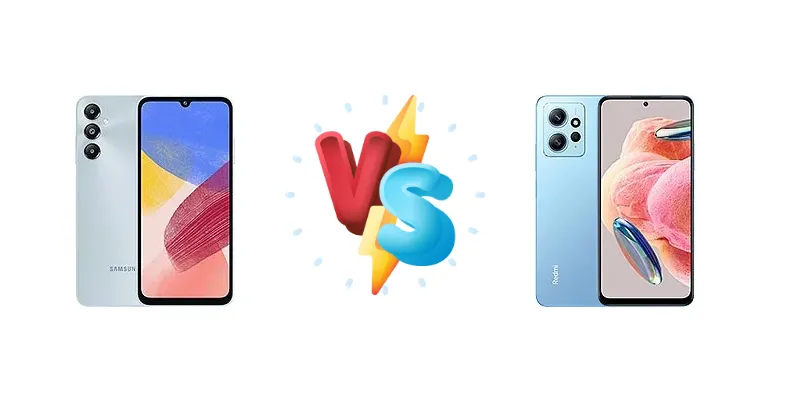
Both the Samsung Galaxy F14 4G and the Xiaomi Redmi Note 12 4G target the competitive budget smartphone market. While both rely on Qualcomm's Snapdragon 6-series for power, subtle differences in chipset, display technology, and charging capabilities create distinct user experiences. This comparison dives deep to reveal which device offers the best value.
🏆 Quick Verdict
For most users, the Xiaomi Redmi Note 12 4G is the better choice. Its slightly more powerful Snapdragon 685 chipset and significantly faster 33W charging outweigh the Galaxy F14's brand recognition. Both offer comparable battery life, but the Redmi Note 12’s charging speed is a clear advantage.
| Network |
|---|
| 2G bands | GSM 850 / 900 / 1800 / 1900 | GSM 850 / 900 / 1800 / 1900 |
| 3G bands | HSDPA 850 / 900 / 2100 | HSDPA 850 / 900 / 2100 |
| 4G bands | 1, 3, 5, 7, 8, 20, 28, 38, 40, 41 | 1, 3, 5, 7, 8, 20, 28, 38, 40, 41 |
| Speed | HSPA, LTE | HSPA, LTE, 5G |
| Technology | GSM / HSPA / LTE | GSM / HSPA / LTE |
| Launch |
|---|
| Announced | 2024, August 02 | 2023, March 23 |
| Status | Available. Released 2024, September 05 | Available. Released 2023, March 30 |
| Body |
|---|
| Build | Glass front, plastic back, plastic frame | Glass front (Gorilla Glass 3), plastic frame, plastic back |
| Dimensions | 168 x 77.8 x 8.8 mm (6.61 x 3.06 x 0.35 in) | 165.7 x 76 x 7.9 mm (6.52 x 2.99 x 0.31 in) |
| SIM | Nano-SIM + Nano-SIM | Nano-SIM + Nano-SIM |
| Weight | 194 g (6.84 oz) | 183.5 g (6.49 oz) |
| | - | IP53, dust and splash resistant |
| Display |
|---|
| Protection | - | Corning Gorilla Glass 3 |
| Resolution | 1080 x 2400 pixels, 20:9 ratio (~393 ppi density) | 1080 x 2400 pixels, 20:9 ratio (~395 ppi density) |
| Size | 6.7 inches, 108.4 cm2 (~82.9% screen-to-body ratio) | 6.67 inches, 107.4 cm2 (~85.3% screen-to-body ratio) |
| Type | PLS LCD, 90Hz | AMOLED, 120Hz, 450 nits (typ), 700 nits (HBM), 1200 nits (peak) |
| Platform |
|---|
| CPU | Octa-core (4x2.4 GHz Kryo 265 Gold & 4x1.9 GHz Kryo 265 Silver) | Octa-core (4x2.8 GHz Cortex-A73 & 4x1.9 GHz Cortex-A53) |
| Chipset | Qualcomm SM6225 Snapdragon 680 4G (6 nm) | Qualcomm SM6225 Snapdragon 685 (6 nm) |
| GPU | Adreno 610 | Adreno 610 |
| OS | Android 14, up to 2 major Android upgrades, One UI 6.1 | Android 13, upgradable to Android 14, HyperOS |
| Memory |
|---|
| Card slot | microSDXC (dedicated slot) | microSDXC (dedicated slot) |
| Internal | 64GB 4GB RAM | 64GB 4GB RAM, 64GB 6GB RAM, 128GB 4GB RAM, 128GB 6GB RAM, 128GB 8GB RAM, 256GB 8GB RAM |
| | - | UFS 2.2 |
| Main Camera |
|---|
| Features | LED flash, panorama, HDR | LED flash, HDR, panorama |
| Triple | 50 MP, f/1.8, (wide), PDAF
2 MP (macro)
Auxiliary lens | 50 MP, f/1.8, (wide), 1/2.76", 0.64µm, PDAF
8 MP, f/2.2, 120˚ (ultrawide), 1/4.0", 1.12µm
2 MP (macro) |
| Video | 1080p@30/60fps | 1080p@30fps |
| Selfie camera |
|---|
| Features | - | HDR |
| Single | 13 MP, f/2.0, (wide) | 13 MP, f/2.5, (wide), 1/3.0" |
| Video | 1080p@30fps | 1080p@30fps |
| Sound |
|---|
| 3.5mm jack | - | Yes |
| 35mm jack | Yes | Yes |
| Loudspeaker | Yes | Yes |
| Comms |
|---|
| Bluetooth | 5.1, A2DP, LE | 5.0, A2DP, LE |
| Infrared port | - | Yes |
| NFC | No | Yes (market/region dependent) |
| Positioning | GPS, GALILEO, GLONASS, BDS, QZSS | GPS, GLONASS, GALILEO |
| Radio | Unspecified | Unspecified |
| USB | USB Type-C 2.0 | USB Type-C 2.0, OTG |
| WLAN | Wi-Fi 802.11 a/b/g/n/ac, dual-band, Wi-Fi Direct | Wi-Fi 802.11 a/b/g/n/ac, dual-band |
| Features |
|---|
| Sensors | Fingerprint (side-mounted), accelerometer, proximity | Fingerprint (side-mounted), accelerometer, gyro, proximity, compass |
| Battery |
|---|
| Charging | 25W wired | 33W wired |
| Type | 5000 mAh | Li-Po 5000 mAh |
| Misc |
|---|
| Colors | Moonlight Silver, Peppermint Green | Onyx Gray, Mint Green, Ice Blue |
| Models | SM-E145F, SM-E145F/DS | 23021RAAEG, 23021RAA2Y, 23027RAD4I, 23028RA60L |
| Price | About 100 EUR | £ 189.99 / € 107.98 / ₹ 9,998 |
| SAR | 0.56 W/kg (head) | 1.09 W/kg (head) 0.89 W/kg (body) |
| SAR EU | - | 0.90 W/kg (head) 0.99 W/kg (body) |
| Tests |
|---|
| Battery life | - |
Endurance rating 117h
|
| Camera | - |
Photo / Video |
| Display | - |
Contrast ratio: Infinite (nominal) |
| Loudspeaker | - |
-27.9 LUFS (Good)
|
| Performance | - |
AnTuTu: 319219 (v9)
GeekBench: 1797 (v5.1), 1341 (v6)
GFXBench: 7.5fps (ES 3.1 onscreen) |
Samsung Galaxy F14 4G
- Samsung Brand Recognition
- Potentially more refined software experience
- Reliable build quality
- Slower charging speed (25W)
- Slightly less powerful processor
- Display brightness likely lower
Xiaomi Redmi Note 12 4G
- Faster charging (33W)
- More powerful Snapdragon 685 chipset
- Brighter display (744 nits)
- Xiaomi’s MIUI software can be polarizing
- Potential for more pre-installed bloatware
Display Comparison
The Xiaomi Redmi Note 12 4G boasts a brighter display, reaching a measured peak brightness of 744 nits, compared to an unspecified brightness for the Galaxy F14 4G. While both likely utilize IPS LCD panels, the Redmi Note 12’s higher brightness translates to better outdoor visibility. The Redmi Note 12 also claims an 'infinite' contrast ratio, typical of IPS displays, but the lack of detailed display specs for the F14 makes a direct comparison difficult. Bezels are likely similar on both devices, given their price point.
Camera Comparison
Both devices feature 'Photo / Video' capabilities, but detailed camera specifications are lacking. Without sensor size or aperture information, a direct comparison is challenging. However, the Redmi Note 12’s image processing algorithms are generally known for producing vibrant, if sometimes over-processed, images. The Galaxy F14 likely leans towards a more natural color profile, consistent with Samsung’s camera tuning. The presence of a 2MP macro camera on both devices is largely a marketing gimmick and should not be a deciding factor for serious photographers.
Performance
Both phones are powered by Qualcomm Snapdragon 6-series chipsets fabricated on a 6nm process, ensuring reasonable efficiency. However, the Redmi Note 12 4G features the Snapdragon 685, with a faster CPU configuration – 4x2.8 GHz Cortex-A73 cores versus the Galaxy F14’s 4x2.4 GHz Kryo 265 Gold cores. This translates to a noticeable performance edge for the Redmi Note 12 in CPU-intensive tasks. While both likely pair the chipset with similar RAM configurations, the Redmi Note 12’s CPU advantage will be more apparent in app loading times and multitasking. Thermal management is likely similar, given the comparable chipsets and target price points.
Battery Life
Both the Samsung Galaxy F14 4G and the Xiaomi Redmi Note 12 4G achieve an impressive endurance rating of 117 hours, indicating similar battery life under typical usage. However, the Redmi Note 12 4G significantly outperforms the Galaxy F14 in charging speed, supporting 33W wired charging compared to the F14’s 25W. This means the Redmi Note 12 can replenish its battery much faster, reducing downtime and offering greater convenience.
Buying Guide
Buy the Samsung Galaxy F14 4G if you prioritize the Samsung ecosystem and a generally reliable software experience, even if it means sacrificing some performance and charging speed. Buy the Xiaomi Redmi Note 12 4G if you prioritize a slightly more responsive processor for everyday tasks and significantly faster charging, making it ideal for users who are always on the go.
Frequently Asked Questions
❓ Does the Snapdragon 685 in the Redmi Note 12 4G offer a noticeable performance improvement over the Snapdragon 680 in the Galaxy F14 4G for gaming?
Yes, the Snapdragon 685’s faster CPU cores (Cortex-A73 vs Kryo 265 Gold) provide a tangible performance boost in gaming, resulting in smoother frame rates and reduced stuttering, particularly in less demanding titles. However, both chipsets are entry-level and won’t deliver a high-end gaming experience.
❓ How long does it realistically take to fully charge the Redmi Note 12 4G with the 33W charger compared to the Galaxy F14 4G’s 25W charger?
The Redmi Note 12 4G can charge from 0-100% in approximately 60-70 minutes with the included 33W charger. The Galaxy F14 4G, with its 25W charging, will likely take around 80-90 minutes for a full charge. This 20-30 minute difference can be significant for users who need a quick power boost.
❓ Is the software experience on the Xiaomi Redmi Note 12 4G significantly different from the Samsung Galaxy F14 4G, and which is generally considered more user-friendly?
Yes, the software experiences differ considerably. Samsung’s One UI is generally considered cleaner and more intuitive, while Xiaomi’s MIUI is more feature-rich but can be cluttered with pre-installed apps (bloatware). User preference plays a large role, but many find One UI easier to navigate and less intrusive.