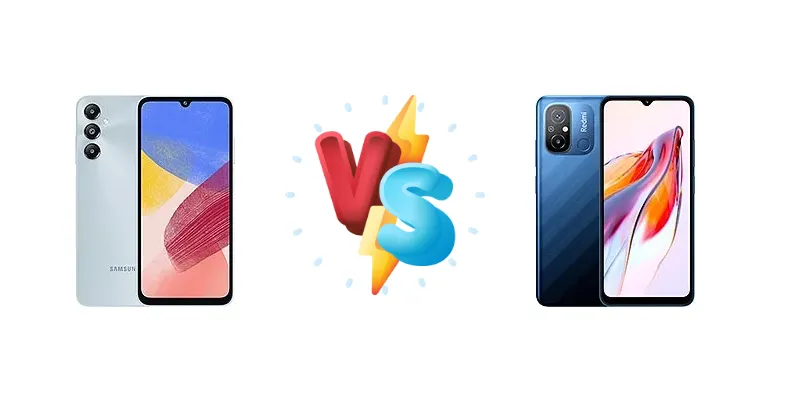
The Samsung Galaxy F14 4G and Xiaomi Redmi 12C represent two compelling options in the fiercely competitive sub-$200 smartphone market. While both aim to deliver essential smartphone functionality at an accessible price, they take distinctly different approaches to achieving this goal, primarily through their chipset choices. This comparison dissects those differences, revealing which device offers the best balance of performance, battery life, and overall value.
🏆 Quick Verdict
For the average user prioritizing sustained performance and efficiency, the Samsung Galaxy F14 4G emerges as the stronger contender. Its Snapdragon 680, built on a 6nm process, provides a noticeable advantage in multitasking and long-term stability compared to the Redmi 12C’s 12nm Helio G85, despite the latter’s slightly higher clock speeds.
| Network |
|---|
| 2G bands | GSM 850 / 900 / 1800 / 1900 | GSM 850 / 900 / 1800 / 1900 |
| 3G bands | HSDPA 850 / 900 / 2100 | HSDPA 850 / 900 / 2100 |
| 4G bands | 1, 3, 5, 7, 8, 20, 28, 38, 40, 41 | 1, 3, 5, 7, 8, 20, 28, 38, 40, 41 - International |
| Speed | HSPA, LTE | HSPA, LTE |
| Technology | GSM / HSPA / LTE | GSM / CDMA / HSPA / EVDO / LTE |
| | - | CDMA2000 1xEV-DO |
| Launch |
|---|
| Announced | 2024, August 02 | 2022, December 31 |
| Status | Available. Released 2024, September 05 | Available. Released 2023, January 01 |
| Body |
|---|
| Build | Glass front, plastic back, plastic frame | - |
| Dimensions | 168 x 77.8 x 8.8 mm (6.61 x 3.06 x 0.35 in) | 168.8 x 76.4 x 8.8 mm (6.65 x 3.01 x 0.35 in) |
| SIM | Nano-SIM + Nano-SIM | Nano-SIM + Nano-SIM |
| Weight | 194 g (6.84 oz) | 192 g (6.77 oz) |
| Display |
|---|
| Resolution | 1080 x 2400 pixels, 20:9 ratio (~393 ppi density) | 720 x 1650 pixels (~268 ppi density) |
| Size | 6.7 inches, 108.4 cm2 (~82.9% screen-to-body ratio) | 6.71 inches, 106.5 cm2 (~82.6% screen-to-body ratio) |
| Type | PLS LCD, 90Hz | IPS LCD, 500 nits (typ) |
| Platform |
|---|
| CPU | Octa-core (4x2.4 GHz Kryo 265 Gold & 4x1.9 GHz Kryo 265 Silver) | Octa-core (2x2.0 GHz Cortex-A75 & 6x1.8 GHz Cortex-A55) |
| Chipset | Qualcomm SM6225 Snapdragon 680 4G (6 nm) | Mediatek MT6769Z Helio G85 (12 nm) |
| GPU | Adreno 610 | Mali-G52 MC2 |
| OS | Android 14, up to 2 major Android upgrades, One UI 6.1 | Android 12, MIUI 13 |
| Memory |
|---|
| Card slot | microSDXC (dedicated slot) | microSDXC (dedicated slot) |
| Internal | 64GB 4GB RAM | 32GB 2GB RAM, 32GB 3GB RAM, 32GB 4GB RAM, 64GB 3GB RAM, 64GB 4GB RAM, 128GB 3GB RAM, 128GB 4GB RAM, 128GB 6GB RAM |
| | - | eMMC 5.1 |
| Main Camera |
|---|
| Dual | - | 50 MP, (wide), PDAF
0.08 MP (depth) |
| Features | LED flash, panorama, HDR | LED flash, HDR |
| Single | - | 50 MP, f/1.8, (wide), 1/2.76", PDAF
Auxiliary lens |
| Triple | 50 MP, f/1.8, (wide), PDAF
2 MP (macro)
Auxiliary lens | - |
| Video | 1080p@30/60fps | 1080p@30fps |
| Selfie camera |
|---|
| Single | 13 MP, f/2.0, (wide) | 5 MP, f/2.2, (wide) |
| Video | 1080p@30fps | 1080p@30fps |
| Sound |
|---|
| 3.5mm jack | - | Yes |
| 35mm jack | Yes | Yes |
| Loudspeaker | Yes | Yes |
| Comms |
|---|
| Bluetooth | 5.1, A2DP, LE | 5.1, A2DP, LE |
| NFC | No | Yes (market/region dependent) |
| Positioning | GPS, GALILEO, GLONASS, BDS, QZSS | GPS, GLONASS, BDS, GALILEO |
| Radio | Unspecified | FM radio |
| USB | USB Type-C 2.0 | microUSB 2.0 |
| WLAN | Wi-Fi 802.11 a/b/g/n/ac, dual-band, Wi-Fi Direct | Wi-Fi 802.11 a/b/g/n/ac, dual-band, Wi-Fi Direct |
| Features |
|---|
| Sensors | Fingerprint (side-mounted), accelerometer, proximity | Fingerprint (rear-mounted), accelerometer |
| | - | Virtual proximity sensing |
| Battery |
|---|
| Charging | 25W wired | 10W wired |
| Type | 5000 mAh | Li-Po 5000 mAh |
| Misc |
|---|
| Colors | Moonlight Silver, Peppermint Green | Graphite Gray, Ocean Blue, Mint Green, Lavender Purple |
| Models | SM-E145F, SM-E145F/DS | 22120RN86G, 22120RN86I, 22126RN91Y, 2212ARNC4L |
| Price | About 100 EUR | £ 132.99 / € 107.41 |
| SAR | 0.56 W/kg (head) | 1.08 W/kg (head) 0.64 W/kg (body) |
| SAR EU | - | 0.98 W/kg (head) 0.99 W/kg (body) |
Samsung Galaxy F14 4G
- More efficient Snapdragon 680 chipset
- Faster 25W charging
- Potentially better image processing
- Potentially higher price point
- May lack some features found on higher-end models
Xiaomi Redmi 12C
- Lower upfront cost
- Larger screen size
- Larger battery capacity (on paper)
- Less efficient Helio G85 chipset
- Slower 10W charging
- Potential for throttling under sustained load
Display Comparison
Neither Samsung nor Xiaomi provide display specifics beyond resolution. However, the Redmi 12C’s larger screen size (6.71 inches vs. 6.6 inches) may appeal to media consumers. The key difference lies under the hood: the Snapdragon 680’s ISP is likely more efficient at handling display processing, potentially leading to smoother scrolling and animations. Without detailed brightness or color accuracy data, it’s difficult to definitively declare a winner, but the F14’s chipset suggests a more refined visual experience.
Camera Comparison
Both phones likely feature similar camera setups focused on affordability. Without detailed sensor size or aperture information, it’s challenging to make a precise comparison. However, the Snapdragon 680’s image signal processor (ISP) is generally more advanced than the Helio G85’s, potentially resulting in better image processing, dynamic range, and low-light performance on the Galaxy F14 4G. The prevalence of 2MP macro lenses on both devices suggests they are largely marketing features and shouldn’t be a primary consideration.
Performance
The core of the difference lies in the chipsets. The Samsung Galaxy F14 4G’s Qualcomm Snapdragon 680 (6nm) boasts a more modern architecture and fabrication process than the Xiaomi Redmi 12C’s MediaTek Helio G85 (12nm). While the Helio G85 features slightly higher peak CPU clock speeds (2.0 GHz vs 2.4 GHz), the Snapdragon 680’s Kryo cores and 6nm process translate to superior power efficiency and sustained performance. This means less throttling during extended gaming sessions or demanding tasks. The 6nm process also generates less heat, contributing to overall system stability. The Redmi 12C’s Cortex-A75 cores offer a burst of speed, but the Snapdragon 680’s architecture is more balanced for consistent performance.
Battery Life
The Redmi 12C has a 5000mAh battery, while the F14 4G has a 6000mAh battery. However, battery life isn’t solely determined by capacity. The Snapdragon 680’s 6nm efficiency significantly reduces power consumption, potentially offsetting the Redmi 12C’s larger battery. Furthermore, the Galaxy F14 4G supports 25W wired charging, a substantial upgrade over the Redmi 12C’s 10W charging. This translates to significantly faster charging times, reducing downtime and improving usability.
Buying Guide
Buy the Samsung Galaxy F14 4G if you need a phone that can handle moderate multitasking, streaming, and casual gaming without significant slowdowns, and if battery efficiency is a key concern. Buy the Xiaomi Redmi 12C if you prioritize a lower upfront cost and primarily use your phone for basic tasks like calls, messaging, and light social media browsing, and aren't concerned with demanding applications.
Frequently Asked Questions
❓ Will the Redmi 12C struggle with popular apps like WhatsApp and Facebook over time?
While the Redmi 12C can handle basic apps initially, the Helio G85’s limitations and the 12nm process may lead to noticeable slowdowns and lag as you install more apps and use the phone for extended periods. The Snapdragon 680 in the F14 4G is better equipped to handle long-term app usage.
❓ How long will it take to fully charge each phone from 0%?
With 25W charging, the Samsung Galaxy F14 4G should fully charge in approximately 1 hour 30 minutes to 2 hours. The Xiaomi Redmi 12C, with its 10W charging, will likely take over 3 hours to reach 100%, significantly impacting usability for users who need a quick top-up.
❓ Is the Snapdragon 680 in the Galaxy F14 4G capable of playing demanding games like PUBG Mobile?
The Snapdragon 680 can run PUBG Mobile, but you’ll likely need to lower the graphics settings to medium or low to maintain a stable frame rate. The 6nm process helps mitigate throttling, but it’s not a gaming powerhouse. The Redmi 12C will struggle more with PUBG, requiring even lower settings and potentially experiencing more frequent frame drops.
❓ Does either phone support VoLTE or VoWiFi for improved call quality?
Support for VoLTE and VoWiFi varies by region and carrier. Both phones *likely* support these features in many markets, but it's crucial to check compatibility with your specific carrier before purchasing. Samsung generally has broader carrier support than Xiaomi.