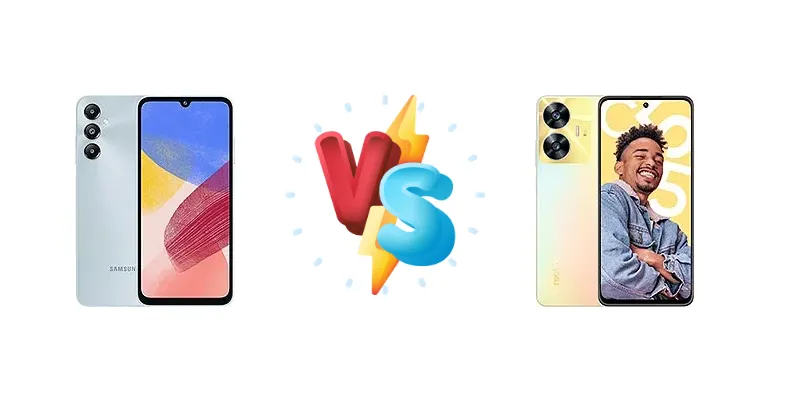
The Samsung Galaxy F14 4G and Realme C55 represent compelling options in the crowded sub-$200 smartphone market. While both aim to deliver essential features at an accessible price, they take different approaches to achieving this. The F14 prioritizes efficient processing with a Snapdragon chipset, while the C55 focuses on faster charging and a bright display. This comparison dissects their key differences to determine which device best suits your needs.
🏆 Quick Verdict
For the average user prioritizing sustained performance and a smoother overall experience, the Samsung Galaxy F14 4G emerges as the better choice. Its Snapdragon 680 chipset, built on a more efficient 6nm process, offers a noticeable advantage over the Realme C55’s Helio G88, despite the latter’s faster charging capabilities.
| Network |
|---|
| 2G bands | GSM 850 / 900 / 1800 / 1900 | GSM 850 / 900 / 1800 / 1900 |
| 3G bands | HSDPA 850 / 900 / 2100 | HSDPA 850 / 900 / 2100 |
| 4G bands | 1, 3, 5, 7, 8, 20, 28, 38, 40, 41 | 1, 3, 5, 8, 38, 40, 41 |
| Speed | HSPA, LTE | HSPA, LTE |
| Technology | GSM / HSPA / LTE | GSM / HSPA / LTE |
| Launch |
|---|
| Announced | 2024, August 02 | 2023, March 07 |
| Status | Available. Released 2024, September 05 | Available. Released 2023, March 08 |
| Body |
|---|
| Build | Glass front, plastic back, plastic frame | Glass front, plastic frame, plastic back |
| Dimensions | 168 x 77.8 x 8.8 mm (6.61 x 3.06 x 0.35 in) | 165.6 x 75.9 x 7.9 mm (6.52 x 2.99 x 0.31 in) |
| SIM | Nano-SIM + Nano-SIM | Nano-SIM + Nano-SIM |
| Weight | 194 g (6.84 oz) | 189.5 g (6.70 oz) |
| Display |
|---|
| Resolution | 1080 x 2400 pixels, 20:9 ratio (~393 ppi density) | 1080 x 2400 pixels, 20:9 ratio (~392 ppi density) |
| Size | 6.7 inches, 108.4 cm2 (~82.9% screen-to-body ratio) | 6.72 inches, 109.0 cm2 (~86.7% screen-to-body ratio) |
| Type | PLS LCD, 90Hz | IPS LCD, 90Hz, 680 nits (peak) |
| Platform |
|---|
| CPU | Octa-core (4x2.4 GHz Kryo 265 Gold & 4x1.9 GHz Kryo 265 Silver) | Octa-core (2x2.0 GHz Cortex-A75 & 6x1.8 GHz Cortex-A55) |
| Chipset | Qualcomm SM6225 Snapdragon 680 4G (6 nm) | Mediatek MT6769H Helio G88 (12 nm) |
| GPU | Adreno 610 | Mali-G52 MC2 |
| OS | Android 14, up to 2 major Android upgrades, One UI 6.1 | Android 13, Realme UI 4.0 |
| Memory |
|---|
| Card slot | microSDXC (dedicated slot) | microSDXC (dedicated slot) |
| Internal | 64GB 4GB RAM | 64GB 4GB RAM, 64GB 6GB RAM, 128GB 4GB RAM, 128GB 6GB RAM, 128GB 8GB RAM, 256GB 8GB RAM |
| Main Camera |
|---|
| Dual | - | 64 MP, (wide), 1/2.0", PDAF
Auxiliary lens |
| Features | LED flash, panorama, HDR | LED flash, HDR, panorama |
| Single | - | 8 MP, (wide) |
| Triple | 50 MP, f/1.8, (wide), PDAF
2 MP (macro)
Auxiliary lens | - |
| Video | 1080p@30/60fps | 1080p@30/60fps |
| Selfie camera |
|---|
| Features | - | HDR, panorama |
| Single | 13 MP, f/2.0, (wide) | 8 MP, (wide) |
| Video | 1080p@30fps | 1080p@30fps |
| Sound |
|---|
| 3.5mm jack | - | Yes |
| 35mm jack | Yes | Yes |
| Loudspeaker | Yes | Yes |
| Comms |
|---|
| Bluetooth | 5.1, A2DP, LE | 5.2, A2DP, LE |
| NFC | No | Yes, 360˚ (market/region dependent) |
| Positioning | GPS, GALILEO, GLONASS, BDS, QZSS | GPS, GLONASS, GALILEO, BDS |
| Radio | Unspecified | No |
| USB | USB Type-C 2.0 | USB Type-C 2.0 |
| WLAN | Wi-Fi 802.11 a/b/g/n/ac, dual-band, Wi-Fi Direct | Wi-Fi 802.11 a/b/g/n/ac, dual-band |
| Features |
|---|
| Sensors | Fingerprint (side-mounted), accelerometer, proximity | Fingerprint (side-mounted), accelerometer, proximity, compass |
| Battery |
|---|
| Charging | 25W wired | 33W wired, 50% in 29 min |
| Type | 5000 mAh | 5000 mAh |
| Misc |
|---|
| Colors | Moonlight Silver, Peppermint Green | Sun Shower, Rainy Night, Rainforest |
| Models | SM-E145F, SM-E145F/DS | RMX3710 |
| Price | About 100 EUR | ₹ 8,399 |
| SAR | 0.56 W/kg (head) | - |
| Tests |
|---|
| Battery life | - |
Endurance rating 123h
|
| Camera | - |
Photo / Video |
| Display | - |
Contrast ratio: 1264:1 (nominal) |
| Loudspeaker | - |
-31.8 LUFS (Below average)
|
| Performance | - |
AnTuTu: 257263 (v9)
GeekBench: 1452 (v5.1), 1413 (v6)
GFXBench: 9fps (ES 3.1 onscreen) |
Samsung Galaxy F14 4G
- More efficient Snapdragon 680 chipset
- Potentially better sustained performance
- Balanced CPU core configuration
- Slower 25W charging
- Lower peak display brightness
Realme C55
- Faster 33W charging with quick top-up times
- Brighter 659 nit display
- Competitive price point
- Less efficient Helio G88 chipset
- Potentially more thermal throttling
- Less balanced CPU core configuration
Display Comparison
Both the Samsung Galaxy F14 4G and Realme C55 feature displays with a 1264:1 contrast ratio, suggesting similar visual depth. However, the Realme C55 boasts a measured peak brightness of 659 nits, offering a brighter viewing experience, particularly outdoors. While both lack high refresh rates, the C55’s higher brightness is a tangible benefit for users who frequently consume media in well-lit environments. Details regarding panel technology (IPS vs. VA) are missing, but both likely utilize IPS for wider viewing angles, common in this price bracket.
Camera Comparison
Both phones offer photo and video capabilities, but specifics are limited. Without detailed sensor information, it’s difficult to make a definitive judgment. The presence of a 2MP macro camera on both devices is largely a marketing tactic, offering limited practical benefit due to the small sensor size and low resolution. Image processing algorithms will play a significant role in the final image quality, and brand-specific tuning will likely differentiate the results. We can assume both will perform adequately in good lighting conditions, but struggle in low-light scenarios.
Performance
The core difference lies in the chipsets. The Samsung Galaxy F14 4G utilizes the Qualcomm Snapdragon 680, fabricated on a 6nm process. This smaller node generally translates to improved power efficiency and reduced thermal throttling compared to the Realme C55’s MediaTek Helio G88, which is built on a 12nm process. The Snapdragon 680’s octa-core configuration (4x2.4 GHz Kryo 265 Gold & 4x1.9 GHz Kryo 265 Silver) is architecturally more balanced than the Helio G88’s (2x2.0 GHz Cortex-A75 & 6x1.8 GHz Cortex-A55), suggesting better multi-tasking capabilities. While the Helio G88’s Cortex-A75 cores offer higher peak performance, the Snapdragon 680’s efficiency will likely result in smoother sustained performance during extended gaming sessions.
Battery Life
Both devices achieve an endurance rating of 123 hours, indicating similar overall battery life under typical usage. However, the Realme C55 compensates for any potential efficiency differences with its 33W wired charging, capable of reaching 50% charge in just 29 minutes. The Samsung Galaxy F14 4G is limited to 25W charging, meaning a full charge will take considerably longer. This faster charging capability is a significant advantage for users who frequently need to quickly top up their battery.
Buying Guide
Buy the Samsung Galaxy F14 4G if you need a phone for consistent daily tasks, moderate gaming, and value long-term performance over ultra-fast charging. Its efficient processor will translate to better battery life during heavy use. Buy the Realme C55 if you prioritize quick top-ups with its 33W charging and enjoy a bright, vibrant display for media consumption, even if it means slightly less processing power.
Frequently Asked Questions
❓ Will the Helio G88 in the Realme C55 overheat during prolonged gaming sessions?
The MediaTek Helio G88, built on a 12nm process, is more prone to thermal throttling than the Snapdragon 680. While it can handle casual gaming, extended sessions with graphically demanding titles may lead to noticeable performance drops as the chip heats up. The Samsung Galaxy F14 4G, with its 6nm Snapdragon 680, is better equipped to maintain consistent performance over longer periods.
❓ Is the 33W charging on the Realme C55 a significant advantage over the Samsung Galaxy F14 4G's 25W?
Yes, the 33W charging on the Realme C55 is a substantial benefit. The ability to reach 50% charge in 29 minutes is considerably faster than the Samsung Galaxy F14 4G, making it ideal for users who need a quick power boost. While both phones have similar endurance ratings, the C55’s faster charging mitigates the inconvenience of a depleted battery.
❓ How does the Snapdragon 680's efficiency impact real-world battery life on the Samsung Galaxy F14 4G?
The Snapdragon 680's 6nm fabrication process is more power-efficient than the Helio G88's 12nm process. This translates to less energy consumption during everyday tasks and gaming, potentially extending the usable battery life of the Samsung Galaxy F14 4G, especially during intensive use. While both phones have a 123-hour endurance rating, the F14 is likely to maintain a higher percentage over a longer period under similar workloads.