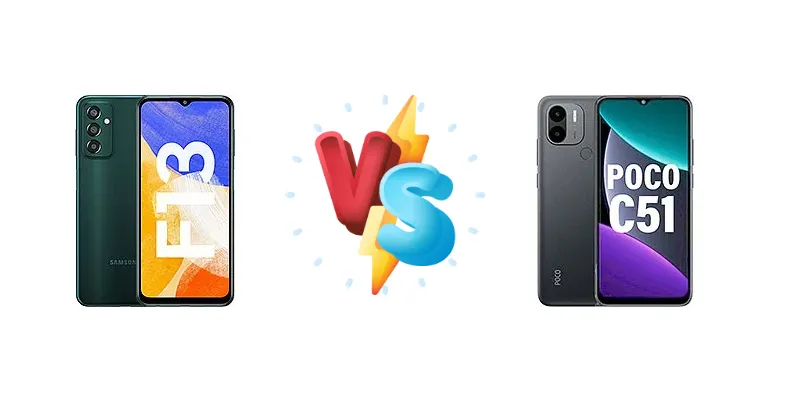
The Samsung Galaxy F13 and Xiaomi Poco C51 represent the fiercely competitive sub-$150 smartphone market. Both aim to deliver essential smartphone functionality at an accessible price, but they take different approaches to achieving this. The F13 leverages Samsung’s Exynos 850, while the Poco C51 opts for MediaTek’s Helio G36. This comparison dissects these choices, focusing on performance, efficiency, and overall user experience.
🏆 Quick Verdict
For the average user prioritizing sustained performance and a slightly more refined software experience, the Samsung Galaxy F13 is the better choice. Its 8nm Exynos 850 offers superior efficiency compared to the Poco C51’s 12nm Helio G36, translating to better thermal management and potentially longer gaming sessions, despite the slower charging.
| Network |
|---|
| 2G bands | GSM 850 / 900 / 1800 / 1900 | GSM 850 / 900 / 1800 / 1900 |
| 3G bands | HSDPA 850 / 900 / 2100 | HSDPA 850 / 900 / 2100 |
| 4G bands | 1, 3, 5, 7, 8, 20, 28, 38, 40, 41 | 1, 3, 5, 8, 40, 41 |
| Speed | HSPA, LTE | HSPA, LTE |
| Technology | GSM / HSPA / LTE | GSM / HSPA / LTE |
| Launch |
|---|
| Announced | 2022, June 22 | 2023, April 07 |
| Status | Available. Released 2022, June 29 | Available. Released 2023, April 13 |
| Body |
|---|
| Build | Glass front (Gorilla Glass 5), plastic back, plastic frame | - |
| Dimensions | 165.4 x 76.9 x 9.3 mm (6.51 x 3.03 x 0.37 in) | 164.9 x 76.8 x 9.1 mm (6.49 x 3.02 x 0.36 in) |
| SIM | Nano-SIM + Nano-SIM | Nano-SIM + Nano-SIM |
| Weight | 207 g (7.30 oz) | 192 g (6.77 oz) |
| Display |
|---|
| Protection | Corning Gorilla Glass 5 | - |
| Resolution | 1080 x 2408 pixels, 20:9 ratio (~400 ppi density) | 720 x 1600 pixels, 20:9 ratio (~269 ppi density) |
| Size | 6.6 inches, 104.9 cm2 (~82.5% screen-to-body ratio) | 6.52 inches, 102.6 cm2 (~81.0% screen-to-body ratio) |
| Type | PLS LCD | IPS LCD, 400 nits (typ) |
| Platform |
|---|
| CPU | Octa-core (4x2.0 GHz Cortex-A55 & 4x2.0 GHz Cortex-A55) | Octa-core (4x2.2 GHz Cortex-A53 & 4x1.7 GHz Cortex-A53) |
| Chipset | Exynos 850 (8 nm) | Mediatek Helio G36 (12 nm) |
| GPU | Mali-G52 | PowerVR GE8320 |
| OS | Android 12, upgradable to Android 13, One UI Core 5 | Android 13 (Go edition), MIUI |
| Memory |
|---|
| Card slot | microSDXC (dedicated slot) | microSDXC (dedicated slot) |
| Internal | 64GB 4GB RAM, 128GB 4GB RAM, 128GB 6GB RAM | 64GB 4GB RAM, 128GB 6GB RAM |
| | eMMC 5.1 | eMMC 5.1 |
| Main Camera |
|---|
| Dual | - | 8 MP, f/2.0, (wide)
0.08 MP (depth) |
| Features | LED flash, panorama, HDR | Dual-LED flash, HDR |
| Single | 8 MP, f/2.2, (wide) | 8 MP, f/2.0, (wide)
Auxiliary lens |
| Triple | 50 MP, f/1.8, (wide), PDAF
5 MP, f/2.2, 123˚ (ultrawide)
Auxiliary lens | - |
| Video | 1080p@30fps | 1080p@30fps |
| Selfie camera |
|---|
| Features | HDR | - |
| Single | 8 MP, f/2.2, (wide) | 5 MP, f/2.2 |
| Video | 1080p@30fps | 1080p@30fps |
| Sound |
|---|
| 3.5mm jack | Yes | Yes |
| 35mm jack | Yes | Yes |
| Loudspeaker | Yes | Yes |
| Comms |
|---|
| Bluetooth | 5.0, A2DP, LE | 5.0, A2DP, LE |
| NFC | Yes | No |
| Positioning | GPS, GLONASS, GALILEO, BDS | GPS, GLONASS, BDS |
| Radio | FM radio | FM radio, recording |
| USB | USB Type-C 2.0, OTG | microUSB 2.0, OTG |
| WLAN | Wi-Fi 802.11 a/b/g/n/ac, dual-band | Wi-Fi 802.11 b/g/n |
| Features |
|---|
| Sensors | Fingerprint (side-mounted), accelerometer, compass | Fingerprint (rear-mounted), accelerometer |
| | Virtual proximity sensing | - |
| Battery |
|---|
| Charging | 15W wired | 10W wired |
| Type | Li-Po 6000 mAh | Li-Po 5000 mAh |
| Misc |
|---|
| Colors | Waterfall Blue, Sunrise Copper, Nightsky Green | Power Black, Royal Blue |
| Models | SM-E135F, SM-E135F/DS | MZB0E6DIN, MZB0DXKIN, 2302EPCC4I, 2305EPCC4G, 2302EPCC4H |
| Price | About 150 EUR | About 100 EUR |
| SAR | 0.55 W/kg (head) | 0.97 W/kg (head) 0.87 W/kg (body) |
| SAR EU | 0.45 W/kg (head) 1.36 W/kg (body) | - |
Samsung Galaxy F13
- More efficient Exynos 850 chipset
- Faster 15W charging
- Potentially better image processing
- May be slightly more expensive
- Software updates may be less frequent than Xiaomi
Xiaomi Poco C51
- Lower price point
- Simple and straightforward software
- Potentially larger battery capacity (unconfirmed)
- Less efficient Helio G36 chipset
- Slower 10W charging
- Older CPU architecture
Display Comparison
Neither Samsung nor Xiaomi provide display specifications beyond the basic resolution. However, given the price point, both likely utilize LCD panels. The key difference lies in the underlying chipsets; the Exynos 850 in the F13 has a more capable ISP which *could* translate to slightly better image processing for display output. Bezels are expected to be substantial on both devices, and color accuracy will likely be standard for this segment.
Camera Comparison
Detailed camera specs are unavailable, but it’s safe to assume both phones feature basic camera setups geared towards casual photography. The focus should be on the primary sensor, as auxiliary lenses (often 2MP macro lenses) offer limited utility. The Exynos 850’s image signal processor (ISP) is likely more advanced than the Helio G36’s, potentially resulting in better image quality, particularly in low-light conditions. Expect similar front-facing camera performance on both devices.
Performance
The core of the difference lies in the chipsets. The Samsung Galaxy F13’s Exynos 850, built on an 8nm process, offers a more efficient architecture than the Poco C51’s MediaTek Helio G36 (12nm). While both are octa-core CPUs, the Helio G36 utilizes older Cortex-A53 cores clocked at 2.2 GHz and 1.7 GHz, while the Exynos 850 uses Cortex-A55 cores at 2.0 GHz. The 8nm process of the Exynos 850 allows for better thermal dissipation, meaning the F13 is less likely to throttle under sustained load. This benefits users who play mobile games or use demanding applications. The Poco C51’s Helio G36 will likely struggle with more than a few apps open simultaneously.
Battery Life
Battery capacity is not specified for either device. However, the Poco C51’s 10W charging is significantly slower than the Galaxy F13’s 15W charging. While a larger battery capacity on the Poco C51 could offset this, the less efficient Helio G36 will likely drain the battery faster during use. The F13’s more efficient chipset means it can deliver comparable battery life with a potentially smaller battery, and recharge faster when needed.
Buying Guide
Buy the Samsung Galaxy F13 if you need a phone that can handle moderate multitasking and occasional gaming without significant slowdowns, and if you value Samsung’s One UI software experience. Buy the Xiaomi Poco C51 if your primary needs are basic communication – calls, texts, and light social media – and you prioritize the absolute lowest price point, accepting compromises in performance and charging speed.
Frequently Asked Questions
❓ Does the Exynos 850 in the Galaxy F13 overheat during prolonged gaming sessions?
The Exynos 850’s 8nm process and efficient architecture are designed to minimize heat generation. While it won’t deliver flagship-level gaming performance, it’s unlikely to overheat significantly during moderate gaming sessions. Thermal throttling will occur, but it should be less pronounced than on the Poco C51.
❓ Is the 10W charging on the Poco C51 a significant drawback?
Yes, 10W charging is considerably slower than the 15W charging on the Galaxy F13. Expect a much longer time to fully charge the Poco C51, potentially taking over 3 hours for a full charge, depending on battery capacity. This is a significant inconvenience for users who rely on quick top-ups.
❓ Will the Poco C51 struggle with popular apps like Facebook and WhatsApp?
While the Poco C51 can run basic apps like Facebook and WhatsApp, the Helio G36’s older CPU architecture and limited processing power may result in noticeable lag and slowdowns when multitasking or using these apps for extended periods. The Galaxy F13 will provide a smoother experience.
❓ How does the software experience differ between the Samsung Galaxy F13 and the Poco C51?
The Galaxy F13 runs Samsung’s One UI, which offers a more polished and feature-rich experience, but can also include more pre-installed apps (bloatware). The Poco C51 likely runs Xiaomi’s MIUI, which is known for its customization options but can also be resource-intensive. Both offer a similar Android base, but the user interface and included features differ significantly.