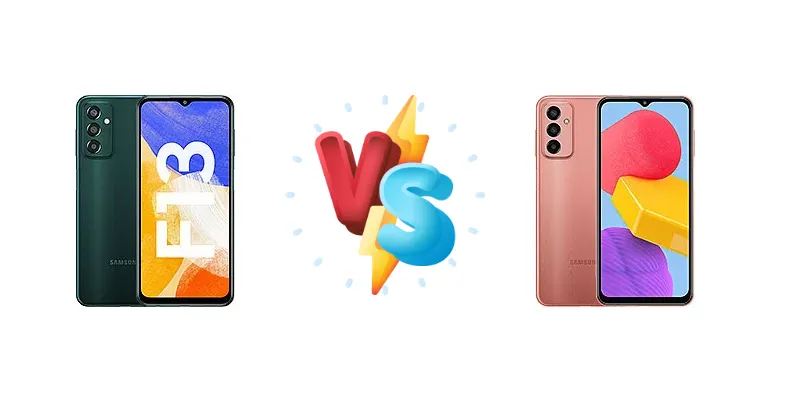
Samsung's Galaxy F and M series offer compelling budget options, and the F13 and M13 are prime examples. Both phones share a similar core, but subtle differences can impact your daily experience. This comprehensive comparison will help you determine which phone best suits your needs and budget.
🏆 Quick Verdict
The Samsung Galaxy F13 and M13 are remarkably similar, sharing the same chipset and charging speed. The M13 generally offers a slightly larger battery and potentially a more refined design, making it a marginally better choice for most users, though pricing and availability will be key factors.
| Network |
|---|
| 2G bands | GSM 850 / 900 / 1800 / 1900 | GSM 850 / 900 / 1800 / 1900 |
| 3G bands | HSDPA 850 / 900 / 2100 | HSDPA 850 / 900 / 2100 |
| 4G bands | 1, 3, 5, 7, 8, 20, 28, 38, 40, 41 | 1, 3, 5, 7, 8, 20, 28, 38, 40, 41 |
| Speed | HSPA, LTE | HSPA, LTE |
| Technology | GSM / HSPA / LTE | GSM / HSPA / LTE |
| Launch |
|---|
| Announced | 2022, June 22 | 2022, May 27 |
| Status | Available. Released 2022, June 29 | Available. Released 2022, July 01 |
| Body |
|---|
| Build | Glass front (Gorilla Glass 5), plastic back, plastic frame | Glass front, plastic back, plastic frame |
| Dimensions | 165.4 x 76.9 x 9.3 mm (6.51 x 3.03 x 0.37 in) | 165.4 x 76.9 x 8.4 mm (6.51 x 3.03 x 0.33 in) |
| SIM | Nano-SIM + Nano-SIM | Nano-SIM + Nano-SIM |
| Weight | 207 g (7.30 oz) | 192 g (6.77 oz) |
| Display |
|---|
| Protection | Corning Gorilla Glass 5 | - |
| Resolution | 1080 x 2408 pixels, 20:9 ratio (~400 ppi density) | 1080 x 2408 pixels, 20:9 ratio (~400 ppi density) |
| Size | 6.6 inches, 104.9 cm2 (~82.5% screen-to-body ratio) | 6.6 inches, 104.9 cm2 (~82.5% screen-to-body ratio) |
| Type | PLS LCD | PLS LCD |
| Platform |
|---|
| CPU | Octa-core (4x2.0 GHz Cortex-A55 & 4x2.0 GHz Cortex-A55) | Octa-core (4x2.0 GHz Cortex-A55 & 4x2.0 GHz Cortex-A55) |
| Chipset | Exynos 850 (8 nm) | Exynos 850 (8 nm) |
| GPU | Mali-G52 | Mali-G52 |
| OS | Android 12, upgradable to Android 13, One UI Core 5 | Android 12, One UI Core 4.1 |
| Memory |
|---|
| Card slot | microSDXC (dedicated slot) | microSDXC (dedicated slot) |
| Internal | 64GB 4GB RAM, 128GB 4GB RAM, 128GB 6GB RAM | 64GB 4GB RAM, 128GB 4GB RAM |
| | eMMC 5.1 | eMMC 5.1 |
| Main Camera |
|---|
| Features | LED flash, panorama, HDR | LED flash, panorama, HDR |
| Single | 8 MP, f/2.2, (wide) | 8 MP, f/2.2, (wide) |
| Triple | 50 MP, f/1.8, (wide), PDAF
5 MP, f/2.2, 123˚ (ultrawide)
Auxiliary lens | 50 MP, f/1.8, (wide), PDAF
5 MP, f/2.2, 123˚ (ultrawide)
Auxiliary lens |
| Video | 1080p@30fps | 1080p@30fps |
| Selfie camera |
|---|
| Features | HDR | HDR |
| Single | 8 MP, f/2.2, (wide) | 8 MP, f/2.2, (wide) |
| Video | 1080p@30fps | 1080p@30fps |
| Sound |
|---|
| 3.5mm jack | Yes | Yes |
| 35mm jack | Yes | Yes |
| Loudspeaker | Yes | Yes |
| Comms |
|---|
| Bluetooth | 5.0, A2DP, LE | 5.0, A2DP, LE |
| NFC | Yes | Yes (market/region dependent) |
| Positioning | GPS, GLONASS, GALILEO, BDS | GPS, GLONASS, GALILEO, BDS |
| Radio | FM radio | No |
| USB | USB Type-C 2.0, OTG | USB Type-C 2.0 |
| WLAN | Wi-Fi 802.11 a/b/g/n/ac, dual-band | Wi-Fi 802.11 a/b/g/n/ac, dual-band |
| Features |
|---|
| Sensors | Fingerprint (side-mounted), accelerometer, compass | Fingerprint (side-mounted), accelerometer, compass |
| | Virtual proximity sensing | Virtual proximity sensing |
| Battery |
|---|
| Charging | 15W wired | 15W wired |
| Type | Li-Po 6000 mAh | Li-Po 5000 mAh |
| Misc |
|---|
| Colors | Waterfall Blue, Sunrise Copper, Nightsky Green | Deep Green, Orange Copper, Light Blue |
| Models | SM-E135F, SM-E135F/DS | SM-M135F, SM-M135F/DSN |
| Price | About 150 EUR | £ 139.99 / € 135.81 |
| SAR | 0.55 W/kg (head) | - |
| SAR EU | 0.45 W/kg (head) 1.36 W/kg (body) | 0.45 W/kg (head) 1.36 W/kg (body) |
Samsung Galaxy F13
- More compact design
- Generally more affordable
- Decent performance for everyday tasks
- Smaller battery
- Potentially lower screen refresh rate
- Less versatile camera system
Samsung Galaxy M13
- Larger battery for extended usage
- Potentially better display quality
- More versatile camera system
- Slightly larger and heavier
- May be slightly more expensive
- 15W charging is relatively slow
Display Comparison
Both phones typically feature a 6.6-inch FHD+ display, likely with a 90Hz refresh rate on the M13 and potentially 60Hz on the F13. The M13 might have slightly better color accuracy or brightness due to panel variations, but the difference is likely minimal. Check specific model variations for confirmation.
Camera Comparison
The M13 generally boasts a more versatile camera setup, often including a higher resolution main sensor (50MP) and potentially additional macro and depth sensors. The F13's camera is typically adequate but may lack some of the M13's features. Image quality in good lighting should be comparable, but the M13 might offer better low-light performance.
Performance
Powered by the Exynos 850, both phones offer adequate performance for everyday tasks like browsing, social media, and light gaming. Don't expect flagship-level speeds, but they should handle most common workloads without significant lag. RAM configurations (4GB/6GB) will influence multitasking capabilities.
Battery Life
The Galaxy M13 typically features a larger battery capacity (6000mAh) compared to the F13 (5000mAh), translating to longer battery life. Both support 15W charging, so charging times will be similar.
Buying Guide
The Samsung Galaxy F13 is ideal for users prioritizing affordability and a compact design. The Galaxy M13 is a better fit for those who value a larger battery for extended usage and potentially a more premium feel, assuming the design differences are noticeable and appealing.
Frequently Asked Questions
❓ Are the Samsung Galaxy F13 and M13 the same phone?
No, while they share the same chipset and charging speed, the M13 typically has a larger battery, potentially a better display, and a more versatile camera system. The F13 is generally more compact and often more affordable.
❓ Which phone is better for gaming?
Both phones offer adequate performance for casual gaming. The M13's larger battery might provide longer gaming sessions, but neither phone is designed for demanding games.