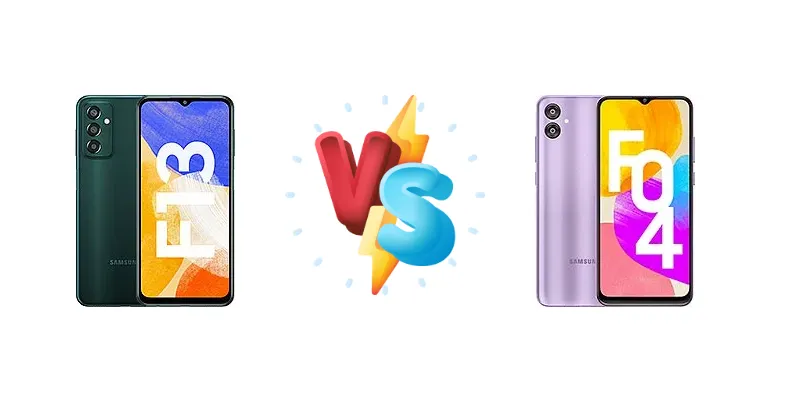
Looking for an affordable Samsung smartphone? The Galaxy F13 and F04 are both contenders in the budget segment, offering a range of features at attractive price points. But which one delivers the best overall experience? This comprehensive comparison will break down the key differences to help you decide.
🏆 Quick Verdict
The Samsung Galaxy F13 edges out the F04 thanks to its more powerful Exynos 850 chipset, resulting in smoother performance and better gaming capabilities. While the F04 offers a slightly more modern design, the F13's performance advantage makes it the better choice for most users.
| Network |
|---|
| 2G bands | GSM 850 / 900 / 1800 / 1900 | GSM 850 / 900 / 1800 / 1900 |
| 3G bands | HSDPA 850 / 900 / 2100 | HSDPA 850 / 900 / 2100 |
| 4G bands | 1, 3, 5, 7, 8, 20, 28, 38, 40, 41 | 1, 3, 5, 7, 8, 20, 28, 38, 40, 41 |
| Speed | HSPA, LTE | HSPA, LTE |
| Technology | GSM / HSPA / LTE | GSM / HSPA / LTE |
| Launch |
|---|
| Announced | 2022, June 22 | 2023, January 04 |
| Status | Available. Released 2022, June 29 | Available. Released 2023, January 12 |
| Body |
|---|
| Build | Glass front (Gorilla Glass 5), plastic back, plastic frame | Glass front, plastic back, plastic frame |
| Dimensions | 165.4 x 76.9 x 9.3 mm (6.51 x 3.03 x 0.37 in) | 164.2 x 75.9 x 9.1 mm (6.46 x 2.99 x 0.36 in) |
| SIM | Nano-SIM + Nano-SIM | Nano-SIM + Nano-SIM |
| Weight | 207 g (7.30 oz) | 188 g (6.63 oz) |
| Display |
|---|
| Protection | Corning Gorilla Glass 5 | - |
| Resolution | 1080 x 2408 pixels, 20:9 ratio (~400 ppi density) | 720 x 1600 pixels, 20:9 ratio (~270 ppi density) |
| Size | 6.6 inches, 104.9 cm2 (~82.5% screen-to-body ratio) | 6.5 inches, 102.0 cm2 (~81.8% screen-to-body ratio) |
| Type | PLS LCD | PLS LCD |
| Platform |
|---|
| CPU | Octa-core (4x2.0 GHz Cortex-A55 & 4x2.0 GHz Cortex-A55) | Octa-core (4x2.35 GHz Cortex-A53 & 4x1.8 GHz Cortex-A53) |
| Chipset | Exynos 850 (8 nm) | Mediatek MT6765 Helio P35 (12 nm) |
| GPU | Mali-G52 | PowerVR GE8320 |
| OS | Android 12, upgradable to Android 13, One UI Core 5 | Android 12, One UI |
| Memory |
|---|
| Card slot | microSDXC (dedicated slot) | microSDXC (dedicated slot) |
| Internal | 64GB 4GB RAM, 128GB 4GB RAM, 128GB 6GB RAM | 64GB 4GB RAM |
| | eMMC 5.1 | - |
| Main Camera |
|---|
| Dual | - | 13 MP, f/2.2, (wide), AF
Auxiliary lens |
| Features | LED flash, panorama, HDR | LED flash |
| Single | 8 MP, f/2.2, (wide) | - |
| Triple | 50 MP, f/1.8, (wide), PDAF
5 MP, f/2.2, 123˚ (ultrawide)
Auxiliary lens | - |
| Video | 1080p@30fps | 1080p@30fps |
| Selfie camera |
|---|
| Features | HDR | - |
| Single | 8 MP, f/2.2, (wide) | 5 MP, f/2.2 |
| Video | 1080p@30fps | Yes |
| Sound |
|---|
| 3.5mm jack | Yes | Yes |
| 35mm jack | Yes | Yes |
| Loudspeaker | Yes | Yes |
| Comms |
|---|
| Bluetooth | 5.0, A2DP, LE | 5.0, A2DP, LE |
| NFC | Yes | No |
| Positioning | GPS, GLONASS, GALILEO, BDS | GPS, GLONASS, GALILEO, BDS |
| Radio | FM radio | Unspecified |
| USB | USB Type-C 2.0, OTG | USB Type-C 2.0 |
| WLAN | Wi-Fi 802.11 a/b/g/n/ac, dual-band | Wi-Fi 802.11 b/g/n, Wi-Fi Direct |
| Features |
|---|
| Sensors | Fingerprint (side-mounted), accelerometer, compass | Accelerometer, proximity |
| | Virtual proximity sensing | - |
| Battery |
|---|
| Charging | 15W wired | 15W wired |
| Type | Li-Po 6000 mAh | Li-Po 5000 mAh |
| Misc |
|---|
| Colors | Waterfall Blue, Sunrise Copper, Nightsky Green | Jade Purple, Opal Green |
| Models | SM-E135F, SM-E135F/DS | SM-E045F, SM-E045F/DS |
| Price | About 150 EUR | About 90 EUR |
| SAR | 0.55 W/kg (head) | 0.38 W/kg (head) |
| SAR EU | 0.45 W/kg (head) 1.36 W/kg (body) | - |
Samsung Galaxy F13
- More powerful processor (Exynos 850)
- Larger display (6.6 inches)
- 90Hz refresh rate
- Slightly better gaming performance
- Design may be less modern than F04
- 15W charging is slow
Samsung Galaxy F04
- More compact design
- Potentially slightly more modern aesthetics
- Excellent battery life (6000mAh)
- Weaker processor (Helio P35)
- 60Hz refresh rate
- Lower performance for demanding tasks
Display Comparison
The Galaxy F13 typically features a 6.6-inch FHD+ display, offering a larger viewing area. The F04 usually has a 6.5-inch display. Both utilize LCD panels, so don't expect OLED-level color accuracy or contrast. The F13 often has a slightly higher refresh rate (90Hz vs F04's 60Hz), leading to smoother scrolling.
Camera Comparison
Both phones feature a triple-camera setup. The F13 generally has a higher resolution main sensor (50MP vs F04's 50MP), potentially capturing more detail in well-lit conditions. Image processing and low-light performance are areas where Samsung's software optimization plays a crucial role, and both phones are adequate but not exceptional.
Performance
This is where the F13 shines. The Exynos 850 chipset is significantly more powerful than the Helio P35 in the F04. Expect noticeably faster app loading times, smoother multitasking, and better gaming performance on the F13. The F04's Helio P35 is adequate for basic tasks but struggles with more demanding applications.
Battery Life
Both devices typically offer a 6000mAh battery, promising excellent battery life. Expect all-day usage with moderate use on either phone. Charging speeds are identical at 15W wired, which is relatively slow by modern standards.
Buying Guide
The Samsung Galaxy F13 is ideal for users who prioritize performance and a slightly larger display for media consumption. The Galaxy F04 is a good option for those seeking a more compact design and a slightly more modern aesthetic, but are less concerned about raw processing power.
Frequently Asked Questions
❓ Which phone is better for gaming?
The Samsung Galaxy F13 is significantly better for gaming due to its more powerful Exynos 850 chipset. It can handle more demanding games with smoother frame rates.
❓ Is the Samsung Galaxy F04 worth considering if I only use my phone for basic tasks?
Yes, the Galaxy F04 is a viable option if your usage is limited to calls, texts, browsing, and social media. However, the F13 still offers a better overall experience, even for basic users.