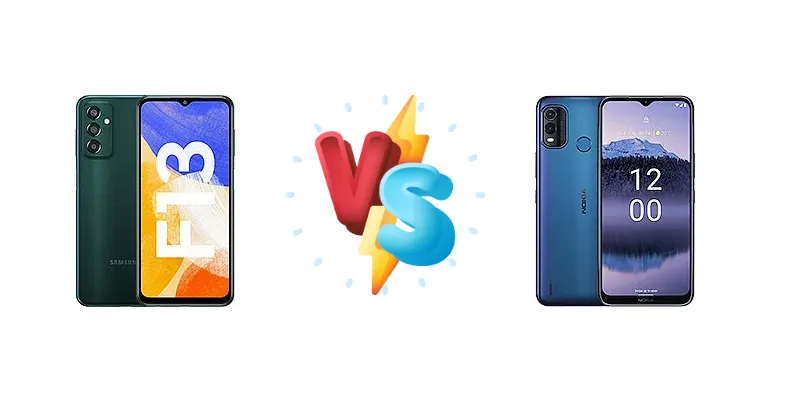
The Samsung Galaxy F13 and Nokia G11 Plus represent two distinct approaches to the ultra-budget smartphone market. The F13 leverages Samsung’s established brand and a more modern, though still entry-level, chipset. The G11 Plus, on the other hand, aims for affordability with a Unisoc processor and a focus on software simplicity. This comparison dives deep into the specifications to determine which device offers the best value.
🏆 Quick Verdict
For the average user prioritizing sustained performance and a slightly more refined experience, the Samsung Galaxy F13 is the better choice. Its Exynos 850, built on an 8nm process, offers superior efficiency and processing power compared to the Nokia G11 Plus’s 12nm Unisoc T606, despite similar CPU core counts. However, the G11 Plus remains a viable option for those on a very tight budget.
| Network |
|---|
| 2G bands | GSM 850 / 900 / 1800 / 1900 | GSM 850 / 900 / 1800 / 1900 |
| 3G bands | HSDPA 850 / 900 / 2100 | HSDPA 850 / 900 / 2100 - International |
| 4G bands | 1, 3, 5, 7, 8, 20, 28, 38, 40, 41 | 1, 3, 5, 7, 8, 20, 28, 38, 40, 41 - International |
| Speed | HSPA, LTE | HSPA 42.2/5.76 Mbps, LTE Cat4 150/50 Mbps |
| Technology | GSM / HSPA / LTE | GSM / HSPA / LTE |
| | - | 1, 3, 5, 8, 40, 41 - India |
| Launch |
|---|
| Announced | 2022, June 22 | 2022, June 29 |
| Status | Available. Released 2022, June 29 | Available. Released 2022, July 20 |
| Body |
|---|
| Build | Glass front (Gorilla Glass 5), plastic back, plastic frame | Glass front, plastic frame, plastic back |
| Dimensions | 165.4 x 76.9 x 9.3 mm (6.51 x 3.03 x 0.37 in) | 164.8 x 75.9 x 8.6 mm (6.49 x 2.99 x 0.34 in) |
| SIM | Nano-SIM + Nano-SIM | · Nano-SIM· Nano-SIM + Nano-SIM |
| Weight | 207 g (7.30 oz) | 192 g (6.77 oz) |
| | - | Splash protection |
| Display |
|---|
| Protection | Corning Gorilla Glass 5 | - |
| Resolution | 1080 x 2408 pixels, 20:9 ratio (~400 ppi density) | 720 x 1600 pixels, 20:9 ratio (~269 ppi density) |
| Size | 6.6 inches, 104.9 cm2 (~82.5% screen-to-body ratio) | 6.52 inches, 102.6 cm2 (~82.1% screen-to-body ratio) |
| Type | PLS LCD | IPS LCD, 90Hz, 400 nits (typ) |
| Platform |
|---|
| CPU | Octa-core (4x2.0 GHz Cortex-A55 & 4x2.0 GHz Cortex-A55) | Octa-core (2x1.6 GHz Cortex-A75 & 6x1.6 GHz Cortex-A55) |
| Chipset | Exynos 850 (8 nm) | Unisoc T606 (12 nm) |
| GPU | Mali-G52 | Mali-G57 MP1 |
| OS | Android 12, upgradable to Android 13, One UI Core 5 | Android 12, upgradable to Android 13 |
| Memory |
|---|
| Card slot | microSDXC (dedicated slot) | microSDXC (dedicated slot) |
| Internal | 64GB 4GB RAM, 128GB 4GB RAM, 128GB 6GB RAM | 32GB 3GB RAM, 64GB 3GB RAM, 64GB 4GB RAM, 128GB 3GB RAM |
| | eMMC 5.1 | eMMC 5.1 |
| Main Camera |
|---|
| Dual | - | 50 MP, f/1.8, (wide), 1/2.67", PDAF
Auxiliary lens |
| Features | LED flash, panorama, HDR | LED flash |
| Single | 8 MP, f/2.2, (wide) | 8 MP, f/2.0, (wide), 1/4.0" |
| Triple | 50 MP, f/1.8, (wide), PDAF
5 MP, f/2.2, 123˚ (ultrawide)
Auxiliary lens | - |
| Video | 1080p@30fps | 1080p@30fps |
| Selfie camera |
|---|
| Features | HDR | - |
| Single | 8 MP, f/2.2, (wide) | 8 MP, f/2.0, (wide), 1/4.0" |
| Video | 1080p@30fps | 1080p@30fps |
| Sound |
|---|
| 3.5mm jack | Yes | Yes |
| 35mm jack | Yes | Yes |
| Loudspeaker | Yes | Yes |
| Comms |
|---|
| Bluetooth | 5.0, A2DP, LE | 5.0, A2DP, LE |
| NFC | Yes | No |
| Positioning | GPS, GLONASS, GALILEO, BDS | GPS |
| Radio | FM radio | FM radio |
| USB | USB Type-C 2.0, OTG | USB Type-C 2.0, OTG |
| WLAN | Wi-Fi 802.11 a/b/g/n/ac, dual-band | Wi-Fi 802.11 a/b/g/n/ac, dual-band, Wi-Fi Direct |
| Features |
|---|
| Sensors | Fingerprint (side-mounted), accelerometer, compass | Fingerprint (rear-mounted), accelerometer, proximity |
| | Virtual proximity sensing | - |
| Battery |
|---|
| Charging | 15W wired | 10W wired |
| Type | Li-Po 6000 mAh | Li-Ion 5000 mAh |
| Misc |
|---|
| Colors | Waterfall Blue, Sunrise Copper, Nightsky Green | Lake Blue, Charcoal Grey |
| Models | SM-E135F, SM-E135F/DS | - |
| Price | About 150 EUR | About 130 EUR |
| SAR | 0.55 W/kg (head) | - |
| SAR EU | 0.45 W/kg (head) 1.36 W/kg (body) | - |
Samsung Galaxy F13
- More efficient Exynos 850 chipset
- Faster 15W charging
- Potentially better software optimization
- May be slightly more expensive
- Likely similar display quality to the G11 Plus
Nokia G11 Plus
- Lower price point
- Clean Android experience
- Potentially longer standby time due to less demanding chipset
- Slower 10W charging
- Less powerful Unisoc T606 chipset
- Potential for performance throttling under load
Display Comparison
Neither device boasts a standout display. Both likely utilize LCD panels, a common trait in this price bracket. However, the lack of detailed display specs necessitates focusing on the chipset's impact on rendering. The Exynos 850, while not a graphical powerhouse, benefits from a more efficient architecture, potentially leading to smoother scrolling and transitions compared to the Unisoc T606, which may struggle with demanding UI elements. Bezels are expected to be substantial on both devices, and color accuracy is unlikely to be a strong point.
Camera Comparison
Without detailed camera specifications, a direct comparison is difficult. Both phones likely feature a primary camera accompanied by auxiliary sensors (potentially including a 2MP macro lens on both). The image processing capabilities of Samsung’s software are generally more sophisticated than Nokia’s, potentially resulting in more pleasing images, particularly in challenging lighting conditions. However, the sensor size and lens aperture are critical factors missing from the provided data, making it impossible to definitively declare a winner. Expect similar limitations in low-light performance from both.
Performance
The core difference lies in the chipsets. The Samsung Galaxy F13’s Exynos 850 (8nm) is a significant advantage over the Nokia G11 Plus’s Unisoc T606 (12nm). While both are octa-core CPUs, the Exynos 850’s smaller fabrication node translates to better power efficiency and thermal performance. The Unisoc T606 utilizes a Cortex-A75/A55 configuration, offering a slight performance boost in single-core tasks compared to the F13’s all-A55 setup, but the Exynos 850’s overall system-level optimization and GPU performance will likely provide a smoother experience in most real-world scenarios. The 8nm process also means less throttling during sustained loads.
Battery Life
The Nokia G11 Plus’s 10W charging is a clear disadvantage compared to the Samsung Galaxy F13’s 15W charging. While battery capacity isn’t specified, the Exynos 850’s superior efficiency means the F13 will likely achieve comparable or better battery life despite potentially having a smaller battery. The slower charging speed of the G11 Plus will require significantly more time to reach a full charge, impacting usability for users who rely on quick top-ups.
Buying Guide
Buy the Samsung Galaxy F13 if you need a phone capable of handling moderate multitasking, streaming video, and light gaming without significant slowdowns. Its more efficient chipset translates to better battery life under load. Buy the Nokia G11 Plus if you prioritize absolute affordability and a clean Android experience, and your usage primarily consists of basic tasks like calls, texts, and occasional social media browsing. The G11 Plus is ideal for first-time smartphone users or those seeking a simple, reliable device.
Frequently Asked Questions
❓ Does the Exynos 850 in the Galaxy F13 overheat during prolonged gaming sessions?
The Exynos 850, built on an 8nm process, is relatively efficient. While it won't deliver flagship-level gaming performance, it's unlikely to overheat significantly during moderate gaming. Expect some throttling after extended periods, but it shouldn't lead to a complete shutdown.
❓ Is the Unisoc T606 in the Nokia G11 Plus sufficient for everyday tasks like browsing and social media?
Yes, the Unisoc T606 is perfectly adequate for basic tasks like web browsing, social media, and messaging. However, it may struggle with demanding applications or multitasking. Expect some lag when switching between apps or loading complex web pages.
❓ How long will it take to fully charge the Nokia G11 Plus with its 10W charging?
With its 10W charging, the Nokia G11 Plus will likely take over 3 hours to fully charge from 0% to 100%. This is significantly slower than the Samsung Galaxy F13's 15W charging, making it less convenient for users who need a quick top-up.
❓ Will I notice a significant difference in app loading times between the two phones?
Yes, you will likely notice a difference. The Exynos 850's more powerful CPU and GPU will result in faster app loading times and smoother overall performance compared to the Unisoc T606. This difference will be most noticeable with larger, more complex applications.