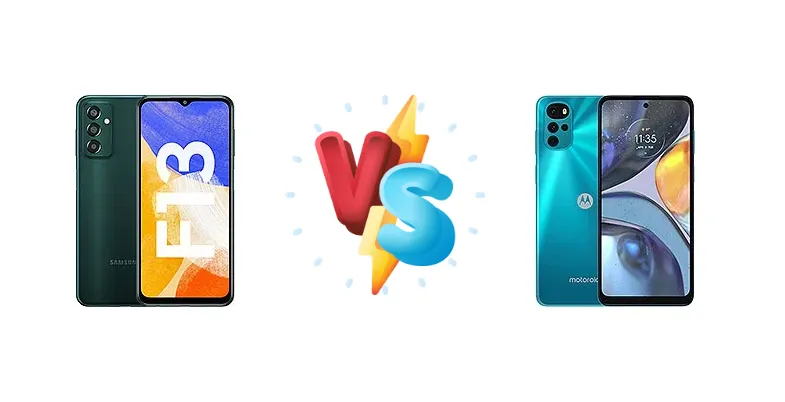
The Samsung Galaxy F13 and Motorola Moto G22 represent two distinct approaches to the budget smartphone market. The F13 focuses on efficient processing with Samsung’s Exynos 850, while the Moto G22 aims for a more immediate performance boost with the MediaTek Helio G37, coupled with potentially faster charging. This comparison dissects their key differences to determine which device delivers the best value.
🏆 Quick Verdict
For the average user prioritizing sustained performance and long-term efficiency, the Samsung Galaxy F13 is the better choice. Its Exynos 850, built on an 8nm process, offers a more refined experience than the 12nm Helio G37 in the Moto G22, despite the latter’s slightly higher clock speeds. However, the Moto G22’s 20W charging (in India) is a significant advantage for those who need quick top-ups.
| Network |
|---|
| 2G bands | GSM 850 / 900 / 1800 / 1900 | GSM 850 / 900 / 1800 / 1900 |
| 3G bands | HSDPA 850 / 900 / 2100 | HSDPA 850 / 900 / 1900 / 2100 |
| 4G bands | 1, 3, 5, 7, 8, 20, 28, 38, 40, 41 | 1, 3, 5, 7, 8, 20, 38, 40, 41 |
| Speed | HSPA, LTE | HSPA 42.2/5.76 Mbps, LTE Cat4 150/50 Mbps |
| Technology | GSM / HSPA / LTE | GSM / HSPA / LTE |
| Launch |
|---|
| Announced | 2022, June 22 | 2022, March 04 |
| Status | Available. Released 2022, June 29 | Available. Released 2022, March 04 |
| Body |
|---|
| Build | Glass front (Gorilla Glass 5), plastic back, plastic frame | Glass front, plastic frame, plastic back |
| Dimensions | 165.4 x 76.9 x 9.3 mm (6.51 x 3.03 x 0.37 in) | 164 x 75 x 8.5 mm (6.46 x 2.95 x 0.33 in) |
| SIM | Nano-SIM + Nano-SIM | · Nano-SIM· Nano-SIM + Nano-SIM |
| Weight | 207 g (7.30 oz) | 185 g (6.53 oz) |
| | - | Water-repellent design |
| Display |
|---|
| Protection | Corning Gorilla Glass 5 | - |
| Resolution | 1080 x 2408 pixels, 20:9 ratio (~400 ppi density) | 720 x 1600 pixels, 20:9 ratio (~268 ppi density) |
| Size | 6.6 inches, 104.9 cm2 (~82.5% screen-to-body ratio) | 6.5 inches, 103.5 cm2 (~84.2% screen-to-body ratio) |
| Type | PLS LCD | IPS LCD, 90Hz |
| Platform |
|---|
| CPU | Octa-core (4x2.0 GHz Cortex-A55 & 4x2.0 GHz Cortex-A55) | Octa-core (4x2.3 GHz Cortex-A53 & 4x1.8 GHz Cortex-A53) |
| Chipset | Exynos 850 (8 nm) | Mediatek MT6765V/CB Helio G37 (12 nm) |
| GPU | Mali-G52 | PowerVR GE8320 |
| OS | Android 12, upgradable to Android 13, One UI Core 5 | Android 12 |
| Memory |
|---|
| Card slot | microSDXC (dedicated slot) | microSDXC (dedicated slot) |
| Internal | 64GB 4GB RAM, 128GB 4GB RAM, 128GB 6GB RAM | 64GB 4GB RAM, 128GB 4GB RAM |
| | eMMC 5.1 | - |
| Main Camera |
|---|
| Features | LED flash, panorama, HDR | LED flash, HDR, panorama |
| Quad | - | 50 MP, f/1.8, (wide), 0.64µm, PDAF
8 MP, f/2.2, 118˚ (ultrawide), 1/4.0", 1.12µm
2 MP (macro)
Auxiliary lens |
| Single | 8 MP, f/2.2, (wide) | - |
| Triple | 50 MP, f/1.8, (wide), PDAF
5 MP, f/2.2, 123˚ (ultrawide)
Auxiliary lens | - |
| Video | 1080p@30fps | 1080p@30fps |
| Selfie camera |
|---|
| Features | HDR | HDR |
| Single | 8 MP, f/2.2, (wide) | 16 MP, f/2.5, (wide), 1.0µm |
| Video | 1080p@30fps | 1080p@30fps |
| Sound |
|---|
| 3.5mm jack | Yes | Yes |
| 35mm jack | Yes | Yes |
| Loudspeaker | Yes | Yes |
| Comms |
|---|
| Bluetooth | 5.0, A2DP, LE | 5.0, A2DP, LE |
| NFC | Yes | Yes (market/region dependent) |
| Positioning | GPS, GLONASS, GALILEO, BDS | GPS, GLONASS, GALILEO |
| Radio | FM radio | Unspecified |
| USB | USB Type-C 2.0, OTG | USB Type-C 2.0 |
| WLAN | Wi-Fi 802.11 a/b/g/n/ac, dual-band | Wi-Fi 802.11 a/b/g/n/ac, dual-band, Wi-Fi Direct |
| Features |
|---|
| Sensors | Fingerprint (side-mounted), accelerometer, compass | Fingerprint (side-mounted), accelerometer, gyro, proximity, compass |
| | Virtual proximity sensing | - |
| Battery |
|---|
| Charging | 15W wired | 20W wired (India)
15W wired (Global) |
| Type | Li-Po 6000 mAh | Li-Po 5000 mAh |
| Misc |
|---|
| Colors | Waterfall Blue, Sunrise Copper, Nightsky Green | Pearl White, Iceberg Blue, Cosmic Black, Mint Green |
| Models | SM-E135F, SM-E135F/DS | XT2231-1, XT2231-2, XT2231-5 |
| Price | About 150 EUR | About 120 EUR |
| SAR | 0.55 W/kg (head) | - |
| SAR EU | 0.45 W/kg (head) 1.36 W/kg (body) | - |
Samsung Galaxy F13
- More efficient processor (Exynos 850, 8nm)
- Potentially better sustained performance
- Refined image processing (Samsung's algorithms)
- Slower charging speed (15W)
- Potentially lower peak CPU performance
Motorola Moto G22
- Faster charging (20W in India)
- Higher CPU clock speed (Helio G37)
- Competitive price point
- Less efficient processor (Helio G37, 12nm)
- Potential for thermal throttling
- Image processing may be less refined
Display Comparison
Neither device boasts a standout display. Both likely utilize LCD panels, common in this price bracket. The key difference lies under the hood: display driver efficiency. While specific display specs are unavailable, the Exynos 850’s integrated display engine is likely more optimized for power consumption, potentially leading to slightly better battery life during video playback on the F13. Bezels are expected to be comparable, and color accuracy will likely be standard for the segment.
Camera Comparison
Camera performance is likely to be similar, with both phones targeting the budget segment. The absence of detailed sensor information necessitates a focus on processing. Samsung’s image processing algorithms are generally more refined, potentially resulting in more pleasing images from the F13, even with comparable sensor hardware. The Moto G22 may lean towards more saturated colors. The presence of a 2MP macro camera on both devices is largely a marketing tactic, offering limited practical benefit due to the small sensor size and lack of autofocus.
Performance
The chipset battle is central here. The Motorola Moto G22’s MediaTek Helio G37 (12nm) features a higher peak CPU clock speed (2.3 GHz vs 2.0 GHz on the F13’s Exynos 850), but the Exynos 850 benefits from a smaller 8nm fabrication process. This translates to greater transistor density and improved power efficiency. While the G37 might show a slight edge in short burst tasks, the F13 will likely maintain performance for longer periods without thermal throttling. Both CPUs utilize Cortex-A53 cores, but the Exynos’s architecture is more modern, offering better instructions per clock (IPC).
Battery Life
The battery capacity is not specified, but both phones likely feature around a 5000mAh battery. The critical difference is charging speed. The Moto G22 supports 20W wired charging in India, while globally it’s limited to 15W – matching the Galaxy F13. This faster charging capability (where available) gives the G22 a significant advantage for users who prioritize quick top-ups. However, the Exynos 850’s efficiency means the F13 may offer longer overall battery life between charges.
Buying Guide
Buy the Samsung Galaxy F13 if you need a phone that prioritizes consistent performance for everyday tasks, streaming, and light gaming, and value long-term battery life. Buy the Motorola Moto G22 if you prefer a phone that can charge quickly, even if it means sacrificing some sustained performance and efficiency. The G22 is ideal for users who frequently find themselves needing to rapidly replenish their battery.
Frequently Asked Questions
❓ Does the Exynos 850 chip in the Galaxy F13 overheat during prolonged gaming sessions?
The Exynos 850, built on an 8nm process, is relatively efficient and less prone to overheating compared to the Helio G37. While it won't deliver flagship-level gaming performance, it should handle moderate gaming sessions without significant throttling. Expect playable frame rates in titles like PUBG Mobile at medium settings.
❓ Is the 2MP macro camera on either phone actually useful for taking detailed close-up photos?
Unfortunately, the 2MP macro cameras on both the Galaxy F13 and Moto G22 are largely marketing features. The small sensor size and lack of autofocus result in images that lack detail and sharpness. They are best avoided in favor of the main camera.
❓ Can the Motorola Moto G22 achieve a full 0-100% charge in under 2 hours with the 20W charger (India)?
Yes, with the 20W charger (available in India), the Moto G22 should be able to charge from 0-100% in approximately 1 hour and 45 minutes to 2 hours, depending on usage during charging. This is a significant improvement over the F13's 15W charging.
❓ Which phone is better for multitasking and running multiple apps simultaneously?
The Samsung Galaxy F13, with its more efficient Exynos 850 chipset, is better suited for multitasking. The 8nm process allows it to handle multiple apps in the background without significant performance degradation, offering a smoother overall experience.