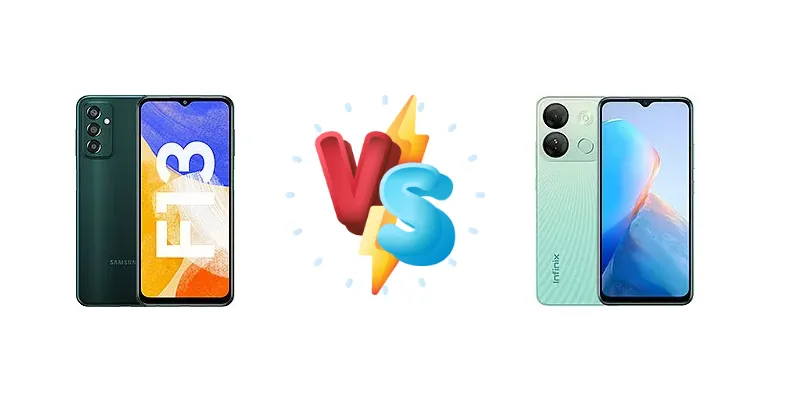
The Samsung Galaxy F13 and Infinix Smart 7 HD represent two approaches to the ultra-budget smartphone market. The F13, leveraging Samsung’s Exynos chipset, aims for a balance of features and performance. The Smart 7 HD, meanwhile, focuses on delivering the absolute lowest possible price point. This comparison dissects their key differences to help you determine which device best suits your needs.
🏆 Quick Verdict
For most users, the Samsung Galaxy F13 is the better choice. Its Exynos 850 chipset, built on an 8nm process, provides a significant performance advantage over the Infinix Smart 7 HD’s unspecified CPU. While the Smart 7 HD is cheaper, the F13’s superior processing power and faster 15W charging justify the price difference for those who value responsiveness and convenience.
| Network |
|---|
| 2G bands | GSM 850 / 900 / 1800 / 1900 | GSM 850 / 900 / 1800 / 1900 |
| 3G bands | HSDPA 850 / 900 / 2100 | HSDPA 850 / 900 / 2100 |
| 4G bands | 1, 3, 5, 7, 8, 20, 28, 38, 40, 41 | 1, 3, 5, 8, 38, 40, 41 |
| Speed | HSPA, LTE | HSPA, LTE |
| Technology | GSM / HSPA / LTE | GSM / HSPA / LTE |
| | - | 1, 2, 3, 4, 5, 7, 8, 20, 28, 38, 40, 41 |
| Launch |
|---|
| Announced | 2022, June 22 | 2023, April 14 |
| Status | Available. Released 2022, June 29 | Available. Released 2023, April 14 |
| Body |
|---|
| Build | Glass front (Gorilla Glass 5), plastic back, plastic frame | Glass front, plastic back, plastic frame |
| Dimensions | 165.4 x 76.9 x 9.3 mm (6.51 x 3.03 x 0.37 in) | 163.9 x 75.5 x 8.7 mm (6.45 x 2.97 x 0.34 in) |
| SIM | Nano-SIM + Nano-SIM | Nano-SIM + Nano-SIM |
| Weight | 207 g (7.30 oz) | 196.5 g (6.95 oz) |
| Display |
|---|
| Protection | Corning Gorilla Glass 5 | - |
| Resolution | 1080 x 2408 pixels, 20:9 ratio (~400 ppi density) | 720 x 1612 pixels, 20:9 ratio (~267 ppi density) |
| Size | 6.6 inches, 104.9 cm2 (~82.5% screen-to-body ratio) | 6.6 inches, 104.6 cm2 (~84.6% screen-to-body ratio) |
| Type | PLS LCD | IPS LCD, 500 nits |
| Platform |
|---|
| CPU | Octa-core (4x2.0 GHz Cortex-A55 & 4x2.0 GHz Cortex-A55) | Octa-core 1.6 GHz |
| Chipset | Exynos 850 (8 nm) | - |
| GPU | Mali-G52 | - |
| OS | Android 12, upgradable to Android 13, One UI Core 5 | Android 12 (Go edition) |
| Memory |
|---|
| Card slot | microSDXC (dedicated slot) | microSDXC (dedicated slot) |
| Internal | 64GB 4GB RAM, 128GB 4GB RAM, 128GB 6GB RAM | 64GB 2GB RAM |
| | eMMC 5.1 | UFS 2.1 |
| Main Camera |
|---|
| Dual | - | 8 MP, f/2.0
0.08 MP, (depth) |
| Features | LED flash, panorama, HDR | Dual-LED flash, HDR, panorama |
| Single | 8 MP, f/2.2, (wide) | 8 MP, f/2.0
Auxiliary lens |
| Triple | 50 MP, f/1.8, (wide), PDAF
5 MP, f/2.2, 123˚ (ultrawide)
Auxiliary lens | - |
| Video | 1080p@30fps | 1080p@30fps |
| Selfie camera |
|---|
| Features | HDR | LED flash |
| Single | 8 MP, f/2.2, (wide) | 5 MP, f/2.0 |
| Video | 1080p@30fps | 720p@30fps |
| Sound |
|---|
| 3.5mm jack | Yes | Yes |
| 35mm jack | Yes | Yes |
| Loudspeaker | Yes | Yes |
| Comms |
|---|
| Bluetooth | 5.0, A2DP, LE | 5.0, A2DP, LE |
| NFC | Yes | No |
| Positioning | GPS, GLONASS, GALILEO, BDS | GPS |
| Radio | FM radio | FM radio |
| USB | USB Type-C 2.0, OTG | microUSB 2.0, OTG |
| WLAN | Wi-Fi 802.11 a/b/g/n/ac, dual-band | Wi-Fi 802.11 b/g/n |
| Features |
|---|
| Sensors | Fingerprint (side-mounted), accelerometer, compass | Fingerprint (rear-mounted), accelerometer, proximity |
| | Virtual proximity sensing | - |
| Battery |
|---|
| Charging | 15W wired | 10W wired |
| Type | Li-Po 6000 mAh | 5000 mAh |
| Misc |
|---|
| Colors | Waterfall Blue, Sunrise Copper, Nightsky Green | Ink Black, Silk Blue, Jade White, Green Apple |
| Models | SM-E135F, SM-E135F/DS | X6516 |
| Price | About 150 EUR | About 110 EUR |
| SAR | 0.55 W/kg (head) | - |
| SAR EU | 0.45 W/kg (head) 1.36 W/kg (body) | - |
Samsung Galaxy F13
- Faster Exynos 850 processor for smoother performance
- 15W fast charging for quicker top-ups
- Likely better image processing due to Samsung’s ISP
- Potentially higher price point
- May lack features found on more expensive models
Infinix Smart 7 HD
- Lower price point makes it very accessible
- Simple and straightforward user experience
- Potentially longer battery life due to less powerful processor
- Significantly slower performance
- Slower 10W charging
- Likely lower quality camera performance
Display Comparison
Neither device’s display specifications are provided, so a direct comparison is limited. However, given the market positioning, both likely utilize LCD panels. The F13, benefiting from Samsung’s display expertise, likely offers slightly better color accuracy and viewing angles. The absence of high refresh rate support on either device is typical for this price bracket, focusing instead on maximizing battery life.
Camera Comparison
Without detailed camera specifications, a thorough comparison is challenging. Both devices likely feature a primary camera alongside auxiliary lenses (potentially a 2MP macro on the Smart 7 HD). However, the Exynos 850’s image signal processor (ISP) within the F13 will likely deliver superior image processing, resulting in better dynamic range and noise reduction. The F13 is likely to offer more consistent image quality across various lighting conditions.
Performance
The Samsung Galaxy F13’s Exynos 850 (8nm) chipset is the clear performance leader. The 8nm fabrication process allows for greater transistor density and improved power efficiency compared to the Infinix Smart 7 HD’s CPU, which is clocked at 1.6 GHz. While both are octa-core, the Exynos 850’s Cortex-A55 cores, while not the newest architecture, are more efficient and capable than those likely found in the Smart 7 HD. This translates to faster app loading times, smoother multitasking, and a more responsive user experience on the F13. The lack of RAM specifications for both devices makes a precise comparison difficult, but the chipset advantage remains significant.
Battery Life
The Samsung Galaxy F13’s 15W wired charging is a notable advantage over the Infinix Smart 7 HD’s 10W charging. While battery capacity isn’t specified for either, the faster charging speed will significantly reduce the time spent tethered to a power outlet. A 15W charger will replenish the battery more quickly, offering greater convenience for users who are frequently on the go. The difference in charging speed will be particularly noticeable for users upgrading from older, slower-charging devices.
Buying Guide
Buy the Samsung Galaxy F13 if you need a phone capable of handling everyday tasks smoothly, occasional gaming, and appreciate faster charging speeds. It’s ideal for users who prioritize a more responsive experience and are willing to spend a little more. Buy the Infinix Smart 7 HD if your primary concern is minimizing cost and you only need a phone for basic communication – calls, texts, and light social media use. It’s best suited for first-time smartphone users or those on a very tight budget.
Frequently Asked Questions
❓ Does the Exynos 850 chip in the Samsung Galaxy F13 overheat during prolonged use, like gaming?
The Exynos 850, built on an 8nm process, is relatively efficient and unlikely to overheat significantly during typical use. While it won’t deliver flagship-level gaming performance, it should handle moderate gaming sessions without excessive throttling. Thermal management will depend on the phone’s internal design, but the chipset itself is not prone to overheating.
❓ Is the 10W charging on the Infinix Smart 7 HD noticeably slow compared to the Samsung Galaxy F13’s 15W charging?
Yes, the difference between 10W and 15W charging is quite noticeable. While neither is exceptionally fast by modern standards, the 15W charging on the F13 will reduce charging times by a significant margin – potentially shaving off an hour or more for a full charge. This is particularly beneficial for users who need to quickly top up their battery throughout the day.
❓ Can the Samsung Galaxy F13 handle popular games like PUBG Mobile, and if so, at what settings?
The Samsung Galaxy F13 can run PUBG Mobile, but you’ll likely need to compromise on graphics settings. Expect to play at medium or low settings with a balanced frame rate to maintain a smooth experience. The Exynos 850 isn’t a gaming powerhouse, but it’s capable of providing a playable experience with reasonable settings adjustments.