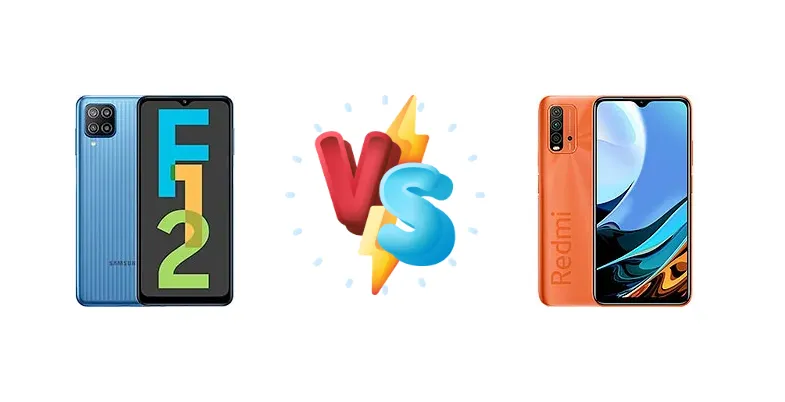
The Samsung Galaxy F12 and Xiaomi Redmi 9 Power represent compelling options in the crowded budget smartphone market. Both aim to deliver essential features at an accessible price point, but they take different approaches to achieving this. The F12 leverages Samsung’s in-house Exynos 850, while the Redmi 9 Power opts for Qualcomm’s Snapdragon 662. This comparison dissects these key differences to determine which device offers the best overall experience.
🏆 Quick Verdict
For the average user prioritizing consistent performance and slightly faster charging, the Xiaomi Redmi 9 Power emerges as the better choice. Its Snapdragon 662, built on an 11nm process, offers a more efficient architecture than the Exynos 850’s 8nm node, translating to smoother multitasking and potentially better sustained performance. However, the F12 remains a viable option for Samsung ecosystem loyalists.
| Network |
|---|
| 2G bands | GSM 850 / 900 / 1800 / 1900 | GSM 850 / 900 / 1800 / 1900 |
| 3G bands | HSDPA 850 / 900 / 2100 | HSDPA 850 / 900 / 2100 |
| 4G bands | 1, 3, 5, 7, 8, 38, 40, 41 | 1, 3, 5, 8, 40, 41 |
| Speed | HSPA, LTE | HSPA, LTE |
| Technology | GSM / HSPA / LTE | GSM / HSPA / LTE |
| Launch |
|---|
| Announced | 2021, April 05 | 2020, December 17 |
| Status | Available. Released 2021, April 12 | Available. Released 2020, December 22 |
| Body |
|---|
| Build | Glass front, plastic back, plastic frame | Glass front (Gorilla Glass 3), plastic frame, plastic back |
| Dimensions | 164 x 75.9 x 9.7 mm (6.46 x 2.99 x 0.38 in) | 162.3 x 77.3 x 9.6 mm (6.39 x 3.04 x 0.38 in) |
| SIM | Nano-SIM + Nano-SIM | Nano-SIM + Nano-SIM |
| Weight | 221 g (7.80 oz) | 198 g (6.98 oz) |
| Display |
|---|
| Protection | Corning Gorilla Glass | Corning Gorilla Glass 3 |
| Resolution | 720 x 1600 pixels, 20:9 ratio (~270 ppi density) | 1080 x 2340 pixels, 19.5:9 ratio (~395 ppi density) |
| Size | 6.5 inches, 102.0 cm2 (~81.9% screen-to-body ratio) | 6.53 inches, 104.7 cm2 (~83.4% screen-to-body ratio) |
| Type | PLS LCD, 90Hz | IPS LCD, 400 nits (typ) |
| Platform |
|---|
| CPU | Octa-core (4x2.0 GHz Cortex-A55 & 4x2.0 GHz Cortex-A55) | Octa-core (4x2.0 GHz Kryo 260 Gold & 4x1.8 GHz Kryo 260 Silver) |
| Chipset | Exynos 850 (8 nm) | Qualcomm SM6115 Snapdragon 662 (11 nm) |
| GPU | Mali-G52 | Adreno 610 |
| OS | Android 11, upgradable to Android 13, One UI 5 | Android 10, MIUI 12 |
| Memory |
|---|
| Card slot | microSDXC (dedicated slot) | microSDXC (dedicated slot) |
| Internal | 64GB 4GB RAM, 128GB 4GB RAM | 64GB 4GB RAM, 128GB 4GB RAM, 128GB 6GB RAM |
| | eMMC 5.1 | eMMC 4.5 |
| Main Camera |
|---|
| Features | LED flash, panorama, HDR | LED flash, HDR, panorama |
| Quad | 48 MP, f/2.0, (wide), 1/2.0", 0.8µm, PDAF
5 MP, f/2.2, (ultrawide)
2 MP (macro)
Auxiliary lens | 48 MP, f/1.8, 26mm (wide), 1/2.0", 0.8µm, PDAF
8 MP, f/2.2, 120˚ (ultrawide), 1/4.0", 1.12µm
2 MP (macro)
Auxiliary lens |
| Single | 8 MP, f/2.2, (wide) | 5 MP, AF |
| Video | 1080p@30fps | 1080p@30fps |
| Selfie camera |
|---|
| Features | HDR | - |
| Single | 8 MP, f/2.2, (wide) | 8 MP, f/2.0, 27mm (wide), 1/4.0", 1.12µm |
| Video | 1080p@30fps | 1080p@30fps |
| Sound |
|---|
| 3.5mm jack | Yes | Yes |
| 35mm jack | Yes | Yes |
| Loudspeaker | Yes | Yes, with stereo speakers |
| Comms |
|---|
| Bluetooth | 5.0, A2DP, LE | 5.0, A2DP, LE |
| Infrared port | - | Yes |
| NFC | No | No |
| Positioning | GPS, GLONASS, GALILEO, BDS | GPS, GLONASS, BDS |
| Radio | FM radio, recording | FM radio |
| USB | USB Type-C 2.0, OTG | USB Type-C 2.0, OTG |
| WLAN | Wi-Fi 802.11 b/g/n, Wi-Fi Direct | Wi-Fi 802.11 a/b/g/n/ac, dual-band, Wi-Fi Direct |
| Features |
|---|
| Sensors | Fingerprint (side-mounted), accelerometer | Fingerprint (side-mounted), accelerometer, proximity, compass |
| | Virtual proximity sensing | - |
| Battery |
|---|
| Charging | 15W wired | 18W wired
2.5W reverse wired |
| Stand-by | - | Up to 350 h (3G) |
| Talk time | - | Up to 8 h (3G) |
| Type | Li-Po 6000 mAh | Li-Po 6000 mAh |
| Misc |
|---|
| Colors | Sea Green, Sky Blue, Celestial Black | Mighty Black, Fiery Red, Electric Green, Blazing Blue |
| Models | SM-F127G, SM-F127G/DS, SM-F127F, SM-F127F/DS | M2010J19SI, M2010J19SL |
| Price | About 130 EUR | About 120 EUR |
| SAR | 1.19 W/kg (head) | 0.87 W/kg (head) 0.86 W/kg (body) |
Samsung Galaxy F12
- Samsung Brand Recognition
- Potentially smoother software experience (One UI)
- Access to Samsung ecosystem
- Less powerful chipset (Exynos 850)
- Slower charging (15W)
- Potentially more thermal throttling
Xiaomi Redmi 9 Power
- More efficient chipset (Snapdragon 662)
- Faster charging (18W) with reverse charging
- Better performance for the price
- Xiaomi’s MIUI software can be polarizing
- Less brand recognition than Samsung
Display Comparison
Neither device boasts a standout display. Both likely feature LCD panels, typical for this price bracket. The key difference lies in the chipsets powering them, which don't directly impact display quality. However, the Redmi 9 Power's processor might allow for slightly smoother scrolling in some UI elements. We can infer that both will have similar color accuracy and viewing angles, given their market positioning.
Camera Comparison
Without detailed camera specs, a direct comparison is difficult. However, both phones likely feature a primary camera paired with multiple auxiliary lenses (depth, macro). The Redmi 9 Power’s processor may offer slightly better image signal processing (ISP) capabilities, potentially leading to improved image quality in challenging lighting conditions. The usefulness of the 2MP macro cameras on both devices is questionable, offering limited detail and often serving as a marketing gimmick. The larger sensor (if present on the Redmi 9 Power) would be a significant advantage.
Performance
The core of the difference lies in the chipsets. The Xiaomi Redmi 9 Power’s Qualcomm Snapdragon 662 (11nm) utilizes Kryo 260 Gold and Silver cores, offering a balanced approach to performance and efficiency. The Samsung Galaxy F12’s Exynos 850 (8nm) features Cortex-A55 cores across the board. While both are octa-core, the Snapdragon 662’s architecture generally provides a performance edge in real-world usage, particularly in graphics-intensive tasks. The 11nm process node of the Snapdragon 662 also suggests better thermal management, potentially reducing throttling during extended gaming sessions. This benefits users who enjoy mobile gaming or frequently use demanding applications.
Battery Life
The Redmi 9 Power’s 18W wired charging is a clear advantage over the Galaxy F12’s 15W charging. This translates to faster top-up times, crucial for users on the go. While battery capacity isn’t specified, the Snapdragon 662’s efficiency could offset a potentially smaller battery size in the Redmi 9 Power, resulting in comparable real-world battery life. The Redmi 9 Power also includes 2.5W reverse wired charging, a niche feature allowing it to charge other devices, a capability absent in the Galaxy F12.
Buying Guide
Buy the Samsung Galaxy F12 if you prioritize brand recognition and a potentially more refined software experience within the Samsung ecosystem. It’s a good fit for users who primarily use their phone for basic tasks like calling, texting, and light social media. Buy the Xiaomi Redmi 9 Power if you value performance-per-dollar and need a phone that can handle moderate gaming and multitasking without significant slowdowns. Its 18W charging is also a boon for users who need to quickly top up their battery.
Frequently Asked Questions
❓ Does the Exynos 850 in the Galaxy F12 overheat during prolonged gaming sessions?
The Exynos 850, built on an 8nm process, is prone to thermal throttling under sustained load. While it can handle casual gaming, demanding titles may experience frame drops and reduced performance after extended play. The Snapdragon 662 in the Redmi 9 Power, with its 11nm process, generally manages heat more effectively.
❓ Is the 2MP macro camera on either phone actually useful for taking detailed close-up photos?
Unfortunately, the 2MP macro cameras on both the Galaxy F12 and Redmi 9 Power are largely marketing features. Their low resolution results in images lacking detail and sharpness. They are unlikely to provide a significant improvement over using the main camera in standard photo mode.
❓ Can the Redmi 9 Power charge other devices using its reverse wired charging feature?
Yes, the Redmi 9 Power supports 2.5W reverse wired charging. While slow, this feature allows you to use the phone as a power bank to charge accessories like wireless earbuds or smartwatches in emergencies.
❓ Which phone is better for running multiple apps simultaneously (multitasking)?
The Xiaomi Redmi 9 Power, powered by the Snapdragon 662, is better suited for multitasking. Its more efficient architecture and potentially larger RAM allocation (depending on the configuration) allow it to handle multiple apps running in the background with less slowdown compared to the Galaxy F12’s Exynos 850.