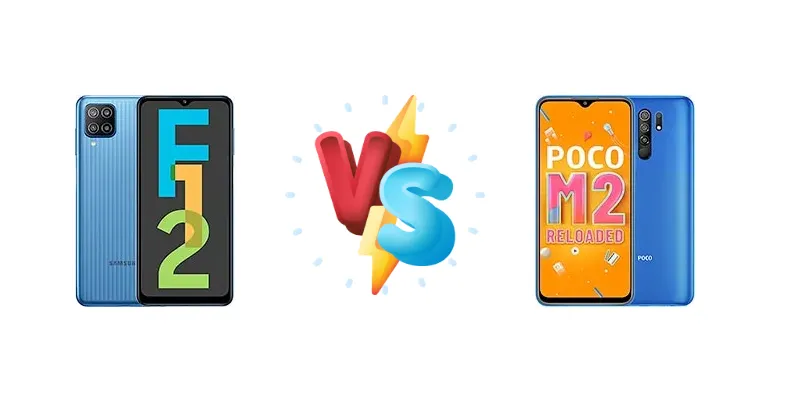
The Samsung Galaxy F12 and Xiaomi Poco M2 Reloaded represent compelling options in the ultra-budget smartphone segment. Both aim to deliver essential features at a low price point, but they take different approaches to achieving this. The F12 leverages Samsung’s in-house Exynos 850, while the Poco M2 Reloaded opts for MediaTek’s Helio G80. This comparison dissects their key differences to help you choose the right device.
🏆 Quick Verdict
For the average user prioritizing sustained performance and a slightly more refined software experience, the Xiaomi Poco M2 Reloaded emerges as the better choice. Its Helio G80, despite being built on a larger process, offers a more capable CPU configuration, translating to snappier multitasking and gaming. However, the F12’s Exynos chip offers better power efficiency.
| Network |
|---|
| 2G bands | GSM 850 / 900 / 1800 / 1900 | GSM 850 / 900 / 1800 / 1900 |
| 3G bands | HSDPA 850 / 900 / 2100 | HSDPA 850 / 900 / 1900 / 2100 |
| 4G bands | 1, 3, 5, 7, 8, 38, 40, 41 | 1, 3, 5, 8, 40, 41 |
| Speed | HSPA, LTE | HSPA, LTE |
| Technology | GSM / HSPA / LTE | GSM / HSPA / LTE |
| Launch |
|---|
| Announced | 2021, April 05 | 2021, April 21 |
| Status | Available. Released 2021, April 12 | Available. Released 2021, April 21 |
| Body |
|---|
| Build | Glass front, plastic back, plastic frame | Glass front (Gorilla Glass 3), plastic back, plastic frame |
| Dimensions | 164 x 75.9 x 9.7 mm (6.46 x 2.99 x 0.38 in) | 163.3 x 77 x 9.1 mm (6.43 x 3.03 x 0.36 in) |
| SIM | Nano-SIM + Nano-SIM | Nano-SIM + Nano-SIM |
| Weight | 221 g (7.80 oz) | 198 g (6.98 oz) |
| | - | Water-repellent coating |
| Display |
|---|
| Protection | Corning Gorilla Glass | Corning Gorilla Glass 3 |
| Resolution | 720 x 1600 pixels, 20:9 ratio (~270 ppi density) | 1080 x 2340 pixels, 19.5:9 ratio (~395 ppi density) |
| Size | 6.5 inches, 102.0 cm2 (~81.9% screen-to-body ratio) | 6.53 inches, 104.7 cm2 (~83.2% screen-to-body ratio) |
| Type | PLS LCD, 90Hz | IPS LCD, 400 nits (typ) |
| Platform |
|---|
| CPU | Octa-core (4x2.0 GHz Cortex-A55 & 4x2.0 GHz Cortex-A55) | Octa-core (2x2.0 GHz Cortex-A75 & 6x1.8 GHz Cortex-A55) |
| Chipset | Exynos 850 (8 nm) | Mediatek MT6769V/CU Helio G80 (12 nm) |
| GPU | Mali-G52 | Mali-G52 MC2 |
| OS | Android 11, upgradable to Android 13, One UI 5 | Android 10, MIUI 12 |
| Memory |
|---|
| Card slot | microSDXC (dedicated slot) | microSDXC (dedicated slot) |
| Internal | 64GB 4GB RAM, 128GB 4GB RAM | 64GB 4GB RAM |
| | eMMC 5.1 | eMMC 5.1 |
| Main Camera |
|---|
| Features | LED flash, panorama, HDR | LED flash, HDR, panorama |
| Quad | 48 MP, f/2.0, (wide), 1/2.0", 0.8µm, PDAF
5 MP, f/2.2, (ultrawide)
2 MP (macro)
Auxiliary lens | 13 MP, f/2.2, 28mm (wide), 1/3.1", 1.12µm, PDAF
8 MP, f/2.2, 118˚ (ultrawide), 1/4.0", 1.12µm
5 MP (macro)
Auxiliary lens |
| Single | 8 MP, f/2.2, (wide) | 8 MP, f/2.0, 27mm (wide), 1/4.0", 1.12µm |
| Video | 1080p@30fps | 1080p@30fps |
| Selfie camera |
|---|
| Features | HDR | HDR |
| Single | 8 MP, f/2.2, (wide) | 8 MP, f/2.0, 27mm (wide), 1/4.0", 1.12µm |
| Video | 1080p@30fps | 1080p@30fps |
| Sound |
|---|
| 3.5mm jack | Yes | Yes |
| 35mm jack | Yes | Yes |
| Loudspeaker | Yes | Yes |
| Comms |
|---|
| Bluetooth | 5.0, A2DP, LE | 5.0, A2DP, LE |
| Infrared port | - | Yes |
| NFC | No | No |
| Positioning | GPS, GLONASS, GALILEO, BDS | GPS, GLONASS, BDS |
| Radio | FM radio, recording | Wireless FM radio (no wired headphones required) |
| USB | USB Type-C 2.0, OTG | USB Type-C 2.0, OTG |
| WLAN | Wi-Fi 802.11 b/g/n, Wi-Fi Direct | Wi-Fi 802.11 a/b/g/n/ac, dual-band, Wi-Fi Direct |
| Features |
|---|
| Sensors | Fingerprint (side-mounted), accelerometer | Fingerprint (rear-mounted), accelerometer, proximity, compass |
| | Virtual proximity sensing | - |
| Battery |
|---|
| Charging | 15W wired | 18W wired |
| Type | Li-Po 6000 mAh | Li-Po 5000 mAh |
| Misc |
|---|
| Colors | Sea Green, Sky Blue, Celestial Black | Pitch Black (Greyish Black), Slate Blue (Mostly Blue) |
| Models | SM-F127G, SM-F127G/DS, SM-F127F, SM-F127F/DS | MZB0957IN |
| Price | About 130 EUR | About 100 EUR |
| SAR | 1.19 W/kg (head) | 0.85 W/kg (head) 0.42 W/kg (body) |
Samsung Galaxy F12
- Potentially better battery life due to Exynos 850 efficiency
- Samsung’s brand reputation for software updates (though limited)
- Slightly more refined software experience (potentially)
- Less powerful CPU for multitasking and gaming
- Slower 15W charging
- Homogenous CPU core configuration limits peak performance
Xiaomi Poco M2 Reloaded
- More powerful CPU (Helio G80) for smoother performance
- Faster 18W charging
- Heterogenous CPU core setup for better responsiveness
- Potentially shorter battery life due to Helio G80’s 12nm process
- MIUI software can include pre-installed apps
- MediaTek chipsets generally receive fewer software updates
Display Comparison
Neither device boasts a standout display. Both likely feature LCD panels, common in this price bracket. The key difference lies under the hood. While specific display specs are missing, the F12’s Exynos 850 likely powers a 720p+ display, while the Poco M2 Reloaded’s Helio G80 is similarly paired with a 720p+ panel. The absence of high refresh rates or advanced panel technologies like LTPO is expected. Bezels are likely comparable, focusing on maximizing screen real estate within the budget constraints.
Camera Comparison
Camera performance is likely to be similar, with both phones relying on budget sensors. Details are limited, but it’s safe to assume both feature a primary sensor around 13-16MP. The Poco M2 Reloaded may have a slight edge due to MediaTek’s image signal processor (ISP) optimizations for its Helio G80. However, the inclusion of 2MP macro and depth sensors on both devices adds little practical value. Image processing will likely lean towards vibrant colors and boosted contrast to compensate for sensor limitations. Low-light performance will be a weakness on both.
Performance
The chipset is where the most significant divergence occurs. The Samsung Galaxy F12’s Exynos 850, fabricated on an 8nm process, features an octa-core configuration with four Cortex-A55 cores clocked at 2.0 GHz, repeated. This is a homogenous core setup, prioritizing efficiency. Conversely, the Xiaomi Poco M2 Reloaded’s MediaTek Helio G80 (12nm) employs a more heterogenous approach: two Cortex-A75 cores at 2.0 GHz paired with six Cortex-A55 cores at 1.8 GHz. The A75 cores provide a noticeable performance boost in CPU-intensive tasks and gaming, despite the larger manufacturing process. While the Exynos 850 excels in power efficiency, the Helio G80’s CPU architecture delivers superior peak performance. The Poco M2 Reloaded will likely handle multitasking and demanding apps more smoothly.
Battery Life
Both phones offer respectable battery capacities, but the charging speeds differ. The Galaxy F12’s 15W charging is slower than the Poco M2 Reloaded’s 18W wired charging. The Exynos 850’s efficiency could translate to slightly longer battery life during moderate use, but the Helio G80’s faster charging mitigates this advantage. Expect approximately 2-3 hours of screen-on time from both devices, with the Poco M2 Reloaded reaching a full charge approximately 30 minutes faster.
Buying Guide
Buy the Samsung Galaxy F12 if you prioritize long-term battery life and a brand known for software stability, even if it means sacrificing some raw processing power. This phone is ideal for users who primarily browse the web, use social media, and make calls. Buy the Xiaomi Poco M2 Reloaded if you prefer a more responsive experience for gaming and multitasking, and are comfortable with Xiaomi’s MIUI software, which offers more customization options but can include pre-installed apps.
Frequently Asked Questions
❓ Does the Exynos 850 in the Galaxy F12 overheat during prolonged gaming sessions?
The Exynos 850 is designed for efficiency, so overheating is unlikely during moderate gaming. However, demanding titles may cause some thermal throttling, reducing performance slightly. The Helio G80 in the Poco M2 Reloaded may also throttle, but its more powerful cores can sustain higher performance for longer before throttling becomes noticeable.
❓ Is the 18W charging on the Poco M2 Reloaded significantly faster than the 15W charging on the Galaxy F12?
Yes, the 18W charging on the Poco M2 Reloaded will noticeably reduce charging times. Expect a full charge to take approximately 30-45 minutes less compared to the Galaxy F12, making it more convenient for users who need a quick power boost.
❓ Are the 2MP macro and depth cameras on either phone actually useful?
Generally, no. These 2MP sensors are often included for marketing purposes but deliver limited image quality. Macro shots are typically soft and lack detail, and the depth sensor’s impact on portrait mode is minimal. Rely on the main camera for the best results.
❓ Can the Poco M2 Reloaded handle games like PUBG Mobile at high settings?
The Helio G80 in the Poco M2 Reloaded can run PUBG Mobile, but you’ll likely need to compromise on graphics settings. Expect smooth gameplay at medium settings with a stable frame rate. High settings may result in noticeable frame drops and stuttering.