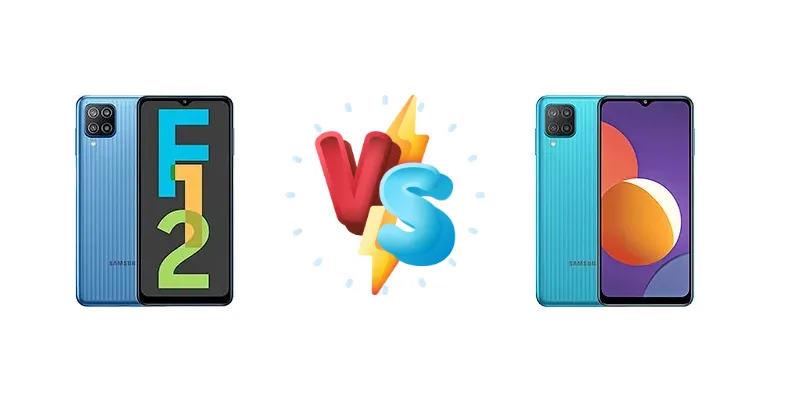
Samsung frequently releases model variants targeting specific regional markets and sales channels. The Galaxy F12 and M12 are prime examples, appearing nearly identical on paper. This comparison dissects the nuances between these two devices, acknowledging their shared core hardware and focusing on where they diverge to help you determine the best value.
🏆 Quick Verdict
For the average user, the Samsung Galaxy M12 emerges as the slightly better choice, primarily due to its typically wider availability and potentially more aggressive pricing. However, given the identical core specifications, the decision ultimately hinges on which model offers the best deal in your region.
| Network |
|---|
| 2G bands | GSM 850 / 900 / 1800 / 1900 | GSM 850 / 900 / 1800 / 1900 |
| 3G bands | HSDPA 850 / 900 / 2100 | HSDPA 850 / 900 / 1700(AWS) / 1900 / 2100 |
| 4G bands | 1, 3, 5, 7, 8, 38, 40, 41 | 1, 2, 3, 4, 5, 7, 8, 12, 17, 20, 26, 28, 38, 40, 41, 66 |
| Speed | HSPA, LTE | HSPA, LTE |
| Technology | GSM / HSPA / LTE | GSM / HSPA / LTE |
| Launch |
|---|
| Announced | 2021, April 05 | 2021, April 19 |
| Status | Available. Released 2021, April 12 | Available. Released 2021, April 30 |
| Body |
|---|
| Build | Glass front, plastic back, plastic frame | Glass front, plastic back, plastic frame |
| Dimensions | 164 x 75.9 x 9.7 mm (6.46 x 2.99 x 0.38 in) | 164 x 75.9 x 9.7 mm (6.46 x 2.99 x 0.38 in) |
| SIM | Nano-SIM + Nano-SIM | Nano-SIM + Nano-SIM |
| Weight | 221 g (7.80 oz) | 212 g (7.48 oz) |
| Display |
|---|
| Protection | Corning Gorilla Glass | - |
| Resolution | 720 x 1600 pixels, 20:9 ratio (~270 ppi density) | 720 x 1600 pixels, 20:9 ratio (~270 ppi density) |
| Size | 6.5 inches, 102.0 cm2 (~81.9% screen-to-body ratio) | 6.5 inches, 102.0 cm2 (~81.9% screen-to-body ratio) |
| Type | PLS LCD, 90Hz | PLS LCD, 90Hz |
| Platform |
|---|
| CPU | Octa-core (4x2.0 GHz Cortex-A55 & 4x2.0 GHz Cortex-A55) | Octa-core (4x2.0 GHz Cortex-A55 & 4x2.0 GHz Cortex-A55) |
| Chipset | Exynos 850 (8 nm) | Exynos 850 (8 nm) |
| GPU | Mali-G52 | Mali-G52 |
| OS | Android 11, upgradable to Android 13, One UI 5 | Android 11, One UI Core 3.1 |
| Memory |
|---|
| Card slot | microSDXC (dedicated slot) | microSDXC (dedicated slot) |
| Internal | 64GB 4GB RAM, 128GB 4GB RAM | 32GB 3GB RAM, 32GB 4GB RAM, 64GB 4GB RAM, 128GB 4GB RAM |
| | eMMC 5.1 | eMMC 5.1 |
| Main Camera |
|---|
| Features | LED flash, panorama, HDR | LED flash, panorama, HDR |
| Quad | 48 MP, f/2.0, (wide), 1/2.0", 0.8µm, PDAF
5 MP, f/2.2, (ultrawide)
2 MP (macro)
Auxiliary lens | 48 MP, f/2.0, (wide), 1/2.0", 0.8µm, PDAF
5 MP, f/2.2, 123˚ (ultrawide)
2 MP (macro)
Auxiliary lens |
| Single | 8 MP, f/2.2, (wide) | 8 MP, f/2.2, (wide) |
| Video | 1080p@30fps | 1080p@30fps |
| Selfie camera |
|---|
| Features | HDR | HDR |
| Single | 8 MP, f/2.2, (wide) | 8 MP, f/2.2, (wide) |
| Video | 1080p@30fps | 1080p@30fps |
| Sound |
|---|
| 3.5mm jack | Yes | Yes |
| 35mm jack | Yes | Yes |
| Loudspeaker | Yes | Yes |
| Comms |
|---|
| Bluetooth | 5.0, A2DP, LE | 5.0, A2DP, LE |
| NFC | No | Yes |
| Positioning | GPS, GLONASS, GALILEO, BDS | GPS, GLONASS, GALILEO, BDS |
| Radio | FM radio, recording | Unspecified |
| USB | USB Type-C 2.0, OTG | USB Type-C 2.0 |
| WLAN | Wi-Fi 802.11 b/g/n, Wi-Fi Direct | Wi-Fi 802.11 b/g/n, Wi-Fi Direct |
| Features |
|---|
| Sensors | Fingerprint (side-mounted), accelerometer | Fingerprint (side-mounted), accelerometer |
| | Virtual proximity sensing | Virtual proximity sensing |
| Battery |
|---|
| Charging | 15W wired | 15W wired |
| Type | Li-Po 6000 mAh | Li-Po 5000 mAh |
| Misc |
|---|
| Colors | Sea Green, Sky Blue, Celestial Black | Black, Blue, Green |
| Models | SM-F127G, SM-F127G/DS, SM-F127F, SM-F127F/DS | SM-M127F, SM-M127F/DSN, SM-M127N |
| Price | About 130 EUR | About 170 EUR |
| SAR | 1.19 W/kg (head) | - |
| SAR EU | - | 0.54 W/kg (head) 1.39 W/kg (body) |
Samsung Galaxy F12
- Identical Exynos 850 performance to the M12
- Potential for lower price in specific regions
- Reliable Samsung build quality
- Potentially limited availability compared to the M12
- 15W charging is slow
Samsung Galaxy M12
- Identical Exynos 850 performance to the F12
- Wider availability in many markets
- Reliable Samsung build quality
- 15W charging is slow
- May be slightly more expensive than the F12
Display Comparison
Both the Galaxy F12 and M12 utilize LCD panels, and detailed display specifications (resolution, brightness, color gamut) are not provided. Given their positioning, expect a 720p+ resolution. The lack of high refresh rate technology is standard for this price segment. The user experience will likely be similar, with color accuracy and viewing angles being typical of LCDs. Differences, if any, will be minor and difficult to discern without direct comparison.
Camera Comparison
Camera specifications beyond the chipset are absent. Given the target market, both phones likely feature a multi-camera setup with a primary sensor, an ultrawide, and potentially macro/depth sensors. The image processing algorithms will likely be identical, resulting in similar photo and video quality. The absence of Optical Image Stabilization (OIS) is expected. The usefulness of any 2MP macro camera is questionable, offering limited detail and requiring ideal lighting conditions.
Performance
The heart of both devices is the Exynos 850 (8nm) chipset, paired with an octa-core CPU configuration of 4x2.0 GHz Cortex-A55 and 4x2.0 GHz Cortex-A55 cores. This means identical CPU performance. The GPU within the Exynos 850 is capable of handling everyday tasks and light gaming, but demanding titles will require reduced settings. Thermal management will be similar on both, with the 8nm process offering reasonable efficiency. RAM configurations are likely similar, impacting multitasking capabilities, but are not specified in the provided data.
Battery Life
Both the Galaxy F12 and M12 support 15W wired charging. Battery capacity is not specified, but given the phone's size and target market, a 5000mAh battery is highly probable for both. 15W charging is relatively slow by modern standards, requiring approximately 2-3 hours for a full charge. Real-world battery life will depend on usage patterns, but both devices should comfortably last a full day with moderate use.
Buying Guide
Buy the Samsung Galaxy F12 if you find it significantly cheaper than the M12, as the core performance will be indistinguishable. Buy the Samsung Galaxy M12 if you prioritize broader availability and potentially better long-term software support, as it's often the more widely distributed model. Both are excellent choices for users needing a reliable, basic smartphone experience.
Frequently Asked Questions
❓ Does the Exynos 850 chip in either the F12 or M12 struggle with demanding games like PUBG?
The Exynos 850 is a capable chip for casual gaming, but demanding titles like PUBG will require significant graphics settings reductions to achieve playable frame rates. Expect to play at lower settings and potentially with occasional frame drops, even on the F12 or M12.
❓ Is the 15W charging speed on these phones a significant drawback?
Yes, 15W charging is relatively slow compared to modern smartphones. Expect a full charge to take around 2-3 hours. This is acceptable for overnight charging, but inconvenient if you need a quick power boost.
❓ Are software updates guaranteed for both the Galaxy F12 and M12?
Samsung typically provides at least one major Android update and several years of security patches for its devices. The M12, being a more widely distributed model, may receive updates for a slightly longer period, but both should receive a reasonable level of software support.