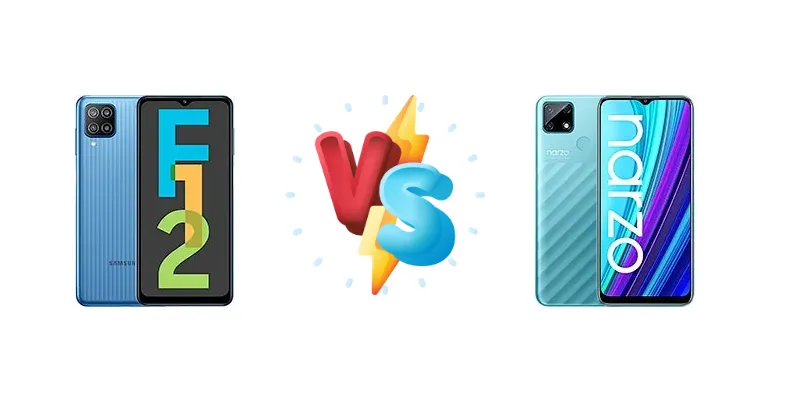
The Samsung Galaxy F12 and Realme Narzo 30A represent compelling options in the ultra-budget smartphone segment. Both aim to deliver essential features at a low price point, but they take different approaches to achieving this. The F12 leverages Samsung’s in-house Exynos 850, while the Narzo 30A opts for MediaTek’s Helio G85. This comparison dissects their key differences to help you choose the right device.
🏆 Quick Verdict
For the average user prioritizing sustained performance and a slightly more refined software experience, the Realme Narzo 30A emerges as the better choice. Its Helio G85, despite being built on a larger process, features more powerful CPU cores, translating to snappier responsiveness in demanding tasks. However, the F12’s Exynos 850 offers better power efficiency.
| Network |
|---|
| 2G bands | GSM 850 / 900 / 1800 / 1900 | GSM 850 / 900 / 1800 / 1900 |
| 3G bands | HSDPA 850 / 900 / 2100 | HSDPA 850 / 900 / 2100 |
| 4G bands | 1, 3, 5, 7, 8, 38, 40, 41 | 1, 3, 5, 8, 38, 40, 41 |
| Speed | HSPA, LTE | HSPA, LTE |
| Technology | GSM / HSPA / LTE | GSM / HSPA / LTE |
| Launch |
|---|
| Announced | 2021, April 05 | 2021, February 24 |
| Status | Available. Released 2021, April 12 | Available. Released 2021, March 05 |
| Body |
|---|
| Build | Glass front, plastic back, plastic frame | - |
| Dimensions | 164 x 75.9 x 9.7 mm (6.46 x 2.99 x 0.38 in) | 164.5 x 75.9 x 9.8 mm (6.48 x 2.99 x 0.39 in) |
| SIM | Nano-SIM + Nano-SIM | Nano-SIM + Nano-SIM |
| Weight | 221 g (7.80 oz) | 205 g (7.23 oz) |
| Display |
|---|
| Protection | Corning Gorilla Glass | - |
| Resolution | 720 x 1600 pixels, 20:9 ratio (~270 ppi density) | 720 x 1600 pixels, 20:9 ratio (~270 ppi density) |
| Size | 6.5 inches, 102.0 cm2 (~81.9% screen-to-body ratio) | 6.5 inches, 102.0 cm2 (~81.7% screen-to-body ratio) |
| Type | PLS LCD, 90Hz | IPS LCD, 470 nits (typ), 570 nits (peak) |
| Platform |
|---|
| CPU | Octa-core (4x2.0 GHz Cortex-A55 & 4x2.0 GHz Cortex-A55) | Octa-core (2x2.0 GHz Cortex-A75 & 6x1.8 GHz Cortex-A55) |
| Chipset | Exynos 850 (8 nm) | Mediatek MT6769Z Helio G85 (12 nm) |
| GPU | Mali-G52 | Mali-G52 MC2 |
| OS | Android 11, upgradable to Android 13, One UI 5 | Android 10, Realme UI |
| Memory |
|---|
| Card slot | microSDXC (dedicated slot) | microSDXC (dedicated slot) |
| Internal | 64GB 4GB RAM, 128GB 4GB RAM | 32GB 3GB RAM, 64GB 4GB RAM |
| | eMMC 5.1 | eMMC 5.1 |
| Main Camera |
|---|
| Dual | - | 13 MP, f/2.2, 26mm (wide), 1/3.06", 1.12µm, PDAF
Auxiliary lens |
| Features | LED flash, panorama, HDR | LED flash, HDR, panorama |
| Quad | 48 MP, f/2.0, (wide), 1/2.0", 0.8µm, PDAF
5 MP, f/2.2, (ultrawide)
2 MP (macro)
Auxiliary lens | - |
| Single | 8 MP, f/2.2, (wide) | 8 MP, f/2.0, 26mm (wide), 1/4", 1.12µm |
| Video | 1080p@30fps | 1080p@30fps |
| Selfie camera |
|---|
| Features | HDR | HDR, panorama |
| Single | 8 MP, f/2.2, (wide) | 8 MP, f/2.0, 26mm (wide), 1/4.0", 1.12µm |
| Video | 1080p@30fps | 1080p@30fps |
| Sound |
|---|
| 3.5mm jack | Yes | Yes |
| 35mm jack | Yes | Yes |
| Loudspeaker | Yes | Yes |
| Comms |
|---|
| Bluetooth | 5.0, A2DP, LE | 5.0, A2DP, LE |
| NFC | No | No |
| Positioning | GPS, GLONASS, GALILEO, BDS | GPS, GLONASS |
| Radio | FM radio, recording | FM radio |
| USB | USB Type-C 2.0, OTG | USB Type-C 2.0, OTG |
| WLAN | Wi-Fi 802.11 b/g/n, Wi-Fi Direct | Wi-Fi 802.11 a/b/g/n/ac, dual-band, Wi-Fi Direct |
| Features |
|---|
| Sensors | Fingerprint (side-mounted), accelerometer | Fingerprint (rear-mounted), accelerometer, proximity, compass |
| | Virtual proximity sensing | - |
| Battery |
|---|
| Charging | 15W wired | 18W wired
5W reverse wired |
| Type | Li-Po 6000 mAh | 6000 mAh |
| Misc |
|---|
| Colors | Sea Green, Sky Blue, Celestial Black | Laser Black, Laser Blue |
| Models | SM-F127G, SM-F127G/DS, SM-F127F, SM-F127F/DS | RMX3171 |
| Price | About 130 EUR | About 450 EUR |
| SAR | 1.19 W/kg (head) | 1.37 W/kg (head) 1.10 W/kg (body) |
Samsung Galaxy F12
- Potentially better power efficiency due to 8nm process.
- Samsung brand recognition and software support.
- Likely a cleaner software experience with less bloatware.
- Less powerful CPU cores compared to the Narzo 30A.
- Slower 15W charging.
- No reverse charging capability.
Realme Narzo 30A
- More powerful CPU cores (Cortex-A75) for better performance.
- Faster 18W wired charging.
- 5W reverse wired charging for emergency power sharing.
- Larger 12nm process may lead to slightly higher power consumption.
- Realme’s UI can be more heavily customized with bloatware.
- Potentially shorter software update support compared to Samsung.
Display Comparison
Neither device boasts a standout display. Both likely feature LCD panels, typical for this price bracket. The key difference lies in the chipsets powering them, which don't directly impact display quality. However, the Narzo 30A’s processor might handle display-intensive tasks like scrolling through image-heavy feeds slightly smoother. We can assume both have similar resolutions (likely 720p+), and brightness levels will be adequate for indoor use but struggle in direct sunlight.
Camera Comparison
Without detailed camera specs, a direct comparison is difficult. Both phones likely feature a primary camera alongside depth and macro sensors. Given the price point, image quality will be heavily reliant on software processing. The Narzo 30A’s more powerful processor *could* translate to faster image processing times, but this is speculative. The inclusion of a 2MP macro camera on both devices is largely a marketing tactic, offering limited practical benefit due to the low resolution and lack of autofocus.
Performance
The core difference here is the chipset architecture. The Samsung Galaxy F12’s Exynos 850 utilizes eight Cortex-A55 cores clocked at 2.0 GHz, focusing on efficiency. The Realme Narzo 30A’s Helio G85, built on a 12nm process (versus the Exynos 850’s 8nm), features a more potent configuration: two Cortex-A75 cores at 2.0 GHz and six Cortex-A55 cores at 1.8 GHz. The A75 cores provide a significant performance boost in CPU-intensive tasks and gaming, making the Narzo 30A more responsive for demanding applications. While the 8nm process of the Exynos 850 should offer better power efficiency, the architectural advantage of the Helio G85’s cores likely outweighs this in real-world usage.
Battery Life
The Realme Narzo 30A’s 18W wired charging is a clear advantage over the Galaxy F12’s 15W charging. This translates to faster top-up times, crucial for users who frequently use their phones throughout the day. While battery capacity isn’t specified, the Narzo 30A also includes 5W reverse wired charging, allowing it to act as a power bank for other devices – a feature absent on the F12. The Exynos 850’s efficiency *could* offset the slower charging, but the Narzo 30A’s faster charging is a more tangible benefit for most users.
Buying Guide
Buy the Samsung Galaxy F12 if you prioritize long-term software support and a brand reputation for reliability, and your usage is primarily focused on basic tasks like calling, texting, and light social media. Buy the Realme Narzo 30A if you prefer a more responsive experience for gaming and multitasking, and value faster charging speeds, even if it means potentially shorter software update cycles.
Frequently Asked Questions
❓ Does the Exynos 850 in the Galaxy F12 tend to overheat during prolonged gaming sessions?
The Exynos 850 is generally known for its thermal efficiency. While it won't deliver flagship-level gaming performance, it's unlikely to overheat significantly during moderate gaming. However, the Helio G85 in the Narzo 30A, despite being on a larger node, is designed for gaming and may offer slightly better sustained performance due to its more powerful cores.
❓ Is the 5W reverse charging on the Narzo 30A actually useful in real-world scenarios?
While 5W reverse charging isn't incredibly fast, it can be a lifesaver in emergencies. It's sufficient for topping up a smartwatch, wireless earbuds, or providing a small boost to a friend's phone if they're running low on battery. It's a convenient feature to have, even if it's not a primary reason to purchase the phone.
❓ How does Realme's UI compare to Samsung's One UI in terms of bloatware and updates?
Realme UI is generally known to include more pre-installed apps (bloatware) than Samsung's One UI. Samsung typically offers a cleaner software experience and a longer commitment to software updates, including security patches. However, Realme has been improving its software experience with each iteration.