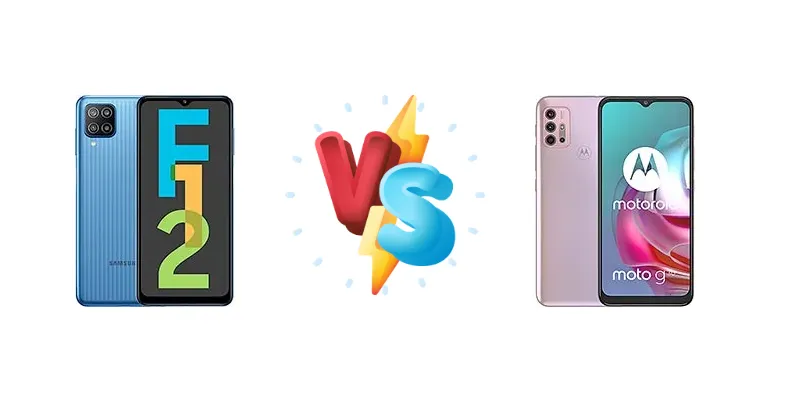
The Samsung Galaxy F12 and Motorola Moto G30 represent compelling options in the ultra-budget smartphone segment. Both aim to deliver essential features at a low price point, but they take different approaches to achieving this. The F12 leverages Samsung’s in-house Exynos 850 chipset, while the Moto G30 opts for Qualcomm’s Snapdragon 662. This comparison dives deep into the specifics to determine which device offers the best value for your money.
🏆 Quick Verdict
For most users, the Motorola Moto G30 emerges as the slightly better choice. While both phones offer similar endurance ratings (131h), the Moto G30’s Snapdragon 662, built on an 11nm process, provides a more efficient architecture, and its display boasts a measured 468 nits brightness, giving it an edge in usability.
| Network |
|---|
| 2G bands | GSM 850 / 900 / 1800 / 1900 | GSM 850 / 900 / 1800 / 1900 |
| 3G bands | HSDPA 850 / 900 / 2100 | HSDPA 850 / 900 / 1700(AWS) / 1900 / 2100 |
| 4G bands | 1, 3, 5, 7, 8, 38, 40, 41 | 1, 2, 3, 5, 7, 8, 18, 19, 20, 26, 28, 38, 40, 41 - International |
| Speed | HSPA, LTE | HSPA 42.2/5.76 Mbps, LTE Cat4 150/50 Mbps |
| Technology | GSM / HSPA / LTE | GSM / HSPA / LTE |
| | - | 1, 2, 3, 4, 5, 7, 8, 20, 38, 40, 41 - India |
| Launch |
|---|
| Announced | 2021, April 05 | 2021, February 16 |
| Status | Available. Released 2021, April 12 | Available. Released 2021, March 17 |
| Body |
|---|
| Build | Glass front, plastic back, plastic frame | Glass front, plastic back, plastic frame |
| Dimensions | 164 x 75.9 x 9.7 mm (6.46 x 2.99 x 0.38 in) | 165.2 x 75.7 x 9.1 mm (6.50 x 2.98 x 0.36 in) |
| SIM | Nano-SIM + Nano-SIM | · Nano-SIM· Nano-SIM + Nano-SIM |
| Weight | 221 g (7.80 oz) | 200 g (7.05 oz) |
| | - | Water-repellent design |
| Display |
|---|
| Protection | Corning Gorilla Glass | - |
| Resolution | 720 x 1600 pixels, 20:9 ratio (~270 ppi density) | 720 x 1600 pixels, 20:9 ratio (~269 ppi density) |
| Size | 6.5 inches, 102.0 cm2 (~81.9% screen-to-body ratio) | 6.5 inches, 102.8 cm2 (~82.2% screen-to-body ratio) |
| Type | PLS LCD, 90Hz | IPS LCD, 90Hz |
| Platform |
|---|
| CPU | Octa-core (4x2.0 GHz Cortex-A55 & 4x2.0 GHz Cortex-A55) | Octa-core (4x2.0 GHz Kryo 260 Gold & 4x1.8 GHz Kryo 260 Silver) |
| Chipset | Exynos 850 (8 nm) | Qualcomm SM6115 Snapdragon 662 (11 nm) |
| GPU | Mali-G52 | Adreno 610 |
| OS | Android 11, upgradable to Android 13, One UI 5 | Android 11, upgradable to Android 12 |
| Memory |
|---|
| Card slot | microSDXC (dedicated slot) | microSDXC (uses shared SIM slot) |
| Internal | 64GB 4GB RAM, 128GB 4GB RAM | 64GB 4GB RAM, 128GB 4GB RAM, 128GB 6GB RAM |
| | eMMC 5.1 | eMMC 5.1 |
| Main Camera |
|---|
| Features | LED flash, panorama, HDR | LED flash, HDR, panorama |
| Quad | 48 MP, f/2.0, (wide), 1/2.0", 0.8µm, PDAF
5 MP, f/2.2, (ultrawide)
2 MP (macro)
Auxiliary lens | 64 MP, f/1.7, 26mm (wide), 1/1.97", 0.7µm, PDAF
8 MP, f/2.2, 118˚ (ultrawide), 1/4.0", 1.12µm
2 MP (macro)
Auxiliary lens |
| Single | 8 MP, f/2.2, (wide) | - |
| Video | 1080p@30fps | 1080p@30/60fps |
| Selfie camera |
|---|
| Features | HDR | HDR |
| Single | 8 MP, f/2.2, (wide) | 13 MP, f/2.2, (wide), 1/3.1", 1.12µm |
| Video | 1080p@30fps | 1080p@30fps |
| Sound |
|---|
| 3.5mm jack | Yes | Yes |
| 35mm jack | Yes | Yes |
| Loudspeaker | Yes | Yes |
| Comms |
|---|
| Bluetooth | 5.0, A2DP, LE | 5.0, A2DP, LE |
| NFC | No | Yes (market/region dependent) |
| Positioning | GPS, GLONASS, GALILEO, BDS | GPS, GLONASS, GALILEO |
| Radio | FM radio, recording | FM radio, RDS, recording |
| USB | USB Type-C 2.0, OTG | USB Type-C 2.0, OTG |
| WLAN | Wi-Fi 802.11 b/g/n, Wi-Fi Direct | Wi-Fi 802.11 a/b/g/n/ac, dual-band, Wi-Fi Direct |
| Features |
|---|
| Sensors | Fingerprint (side-mounted), accelerometer | Fingerprint (rear-mounted), accelerometer, gyro, proximity |
| | Virtual proximity sensing | - |
| Battery |
|---|
| Charging | 15W wired | 15W / 20W wired (market dependent) |
| Type | Li-Po 6000 mAh | Li-Po 5000 mAh |
| Misc |
|---|
| Colors | Sea Green, Sky Blue, Celestial Black | Phantom Black (Dark Pearl), Pastel Sky |
| Models | SM-F127G, SM-F127G/DS, SM-F127F, SM-F127F/DS | XT2129-1, XT2129-2, PAML0000IN |
| Price | About 130 EUR | About 170 EUR |
| SAR | 1.19 W/kg (head) | 1.11 W/kg (head) 1.32 W/kg (body) |
| Tests |
|---|
| Battery life | - |
Endurance rating 131h
|
| Camera | - |
Photo / Video |
| Display | - |
Contrast ratio: 1984:1 (nominal) |
| Loudspeaker | - |
-28.7 LUFS (Average)
|
| Performance | - |
AnTuTu: 170968 (v8)
GeekBench: 1265 (v5.1)
GFXBench: 13fps (ES 3.1 onscreen) |
Samsung Galaxy F12
- Samsung Brand Recognition
- Potential for wider accessory availability
- Similar battery endurance to Moto G30
- Less efficient chipset (Exynos 850)
- Slower charging speed (15W)
- Display brightness data unavailable
Motorola Moto G30
- More efficient chipset (Snapdragon 662)
- Brighter display (468 nits)
- Faster charging (up to 20W)
- Motorola’s software update track record is less consistent
- Brand recognition not as strong as Samsung
Display Comparison
The Motorola Moto G30’s display takes a slight lead with a measured peak brightness of 468 nits, offering better visibility in direct sunlight compared to the Galaxy F12 (brightness data unavailable). Both displays share a similar contrast ratio around 1975:1 to 1984:1, indicating comparable color depth and black levels. While both are likely LCD panels, the G30’s higher brightness is a tangible benefit for everyday use. Bezels are expected to be similar on both devices, given their price bracket.
Camera Comparison
Both devices feature 'Photo / Video' capabilities, but lack specific details in the provided data. Given the price point, expect similar camera performance – adequate for casual snapshots in good lighting conditions. The absence of details like sensor size or aperture makes a direct comparison impossible. It’s likely both phones will include a primary camera alongside macro and depth sensors, with the 2MP macro lens on both being of limited practical use. Image processing will likely differ, with Samsung potentially leaning towards more saturated colors.
Performance
The core difference lies in the chipsets. The Samsung Galaxy F12’s Exynos 850 (8nm) and the Motorola Moto G30’s Snapdragon 662 (11nm) represent different architectural philosophies. While the Exynos 850 uses eight Cortex-A55 cores clocked at 2.0 GHz, the Snapdragon 662 employs a combination of Kryo 260 Gold (2.0 GHz) and Kryo 260 Silver (1.8 GHz) cores. The 11nm process of the Snapdragon 662 generally translates to better power efficiency, potentially leading to longer sustained performance and less thermal throttling during demanding tasks. Both phones are likely paired with similar amounts of RAM, making the chipset the primary performance differentiator.
Battery Life
Both the Samsung Galaxy F12 and Motorola Moto G30 achieve an impressive endurance rating of 131 hours, suggesting similar real-world battery life. However, the Moto G30 supports up to 20W wired charging (market dependent), while the Galaxy F12 is limited to 15W. This faster charging capability on the Moto G30 translates to quicker top-ups, reducing downtime. While both offer all-day battery life for moderate users, the G30’s charging speed provides a convenience advantage.
Buying Guide
Buy the Samsung Galaxy F12 if you prioritize the Samsung brand ecosystem and a potentially wider availability of accessories. However, buy the Motorola Moto G30 if you value a more efficient processor, a brighter display for outdoor visibility, and a slightly more refined software experience focused on clean Android.
Frequently Asked Questions
❓ Does the Exynos 850 chip in the Galaxy F12 overheat during prolonged gaming sessions?
The Exynos 850, built on an 8nm process, is not known for extreme heat generation. However, given its less efficient architecture compared to the Snapdragon 662, it's more likely to experience thermal throttling during extended gaming, potentially leading to reduced frame rates over time.
❓ Is the 2MP macro camera on either phone actually useful for taking detailed close-up photos?
Generally, 2MP macro cameras on budget phones offer limited detail and image quality. The small sensor size and fixed focus result in soft, often blurry images. They are more of a marketing feature than a genuinely useful photographic tool.
❓ Can the Motorola Moto G30 handle popular games like PUBG Mobile at acceptable frame rates?
The Snapdragon 662 in the Moto G30 can run PUBG Mobile, but you'll likely need to stick to medium graphics settings and a moderate frame rate (around 30-40fps) for a smooth experience. Expect some occasional stuttering during intense action sequences.
❓ How long does it realistically take to fully charge the Samsung Galaxy F12 with the 15W charger?
With the included 15W charger, the Samsung Galaxy F12 will likely take around 2.5 to 3 hours to fully charge from 0% to 100%. This is slower than the Moto G30 with its potential 20W charging.