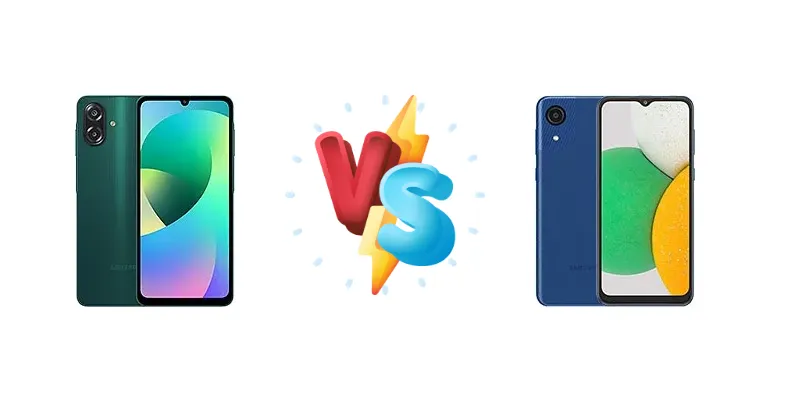
Samsung's budget lineup offers a wide range of choices, but the Galaxy F07 and A03 Core represent distinct approaches to affordability. The F07, with its more powerful Mediatek Helio G99 chipset, aims for a balance of performance and price, while the A03 Core prioritizes extreme cost-effectiveness with the Unisoc SC9863A. This comparison dissects the key differences to help you determine which phone best suits your needs.
🏆 Quick Verdict
For most users, the Samsung Galaxy F07 is the superior choice. Its Mediatek Helio G99 processor delivers significantly better performance for gaming and multitasking, justifying the likely price premium. While the A03 Core offers a lower entry point, its Unisoc chipset struggles with demanding tasks, making it suitable only for very basic use cases.
| Network |
|---|
| 2G bands | GSM 850 / 900 / 1800 / 1900 | GSM 850 / 900 / 1800 / 1900 |
| 3G bands | HSDPA 850 / 900 / 2100 | HSDPA 850 / 900 / 2100 |
| 4G bands | 1, 3, 5, 7, 8, 20, 28, 38, 40, 41 | 1, 3, 5, 7, 8, 20, 28, 38, 40, 41 |
| Speed | HSPA, LTE | HSPA 21.1/5.76 Mbps, LTE |
| Technology | GSM / HSPA / LTE | GSM / HSPA / LTE |
| Launch |
|---|
| Announced | 2025, October 04 | 2021, November 15 |
| Status | Available. Released 2025, October 04 | Available. Released 2021, December 06 |
| Body |
|---|
| Build | Glass front, plastic back, plastic frame | Plastic back, plastic frame |
| Dimensions | 167.4 x 77.4 x 7.6 mm (6.59 x 3.05 x 0.30 in) | 164.2 x 75.9 x 9.1 mm (6.46 x 2.99 x 0.36 in) |
| SIM | Nano-SIM + Nano-SIM | · Nano-SIM· Nano-SIM + Nano-SIM |
| Weight | 184 g (6.49 oz) | 211 g (7.44 oz) |
| Display |
|---|
| Resolution | 720 x 1600 pixels, 20:9 ratio (~262 ppi density) | 720 x 1600 pixels, 20:9 ratio (~270 ppi density) |
| Size | 6.7 inches, 108.4 cm2 (~83.6% screen-to-body ratio) | 6.5 inches, 102.0 cm2 (~81.8% screen-to-body ratio) |
| Type | PLS LCD, 90Hz | PLS LCD |
| Platform |
|---|
| CPU | Octa-core (2x2.2 GHz Cortex-A76 & 6x2.0 GHz Cortex-A55) | Octa-core (4x1.6 GHz Cortex-A55 & 4x1.2 GHz Cortex-A55) |
| Chipset | Mediatek Helio G99 (6 nm) | Unisoc SC9863A (28 nm) |
| GPU | Mali-G57 MC2 | IMG8322 |
| OS | Android 15, up to 6 major Android upgrades, One UI 7 | Android 11 (Go edition) |
| Memory |
|---|
| Card slot | microSDXC (dedicated slot) | microSDXC (dedicated slot) |
| Internal | 64GB 4GB RAM | 32GB 2GB RAM |
| | - | eMMC 5.1 |
| Main Camera |
|---|
| Dual | 50 MP, f/1.8, (wide), 1/2.76", 0.64µm, PDAF
Auxiliary lens | - |
| Features | LED flash | LED flash |
| Single | - | 8 MP, f/2.0, AF |
| Video | 1080p@30fps | 1080p@30fps |
| Selfie camera |
|---|
| Single | 8 MP, f/2.0, (wide), 1/4.0", 1.12µm | 5 MP, f/2.2 |
| Video | Yes | - |
| Sound |
|---|
| 3.5mm jack | - | Yes |
| 35mm jack | Yes | Yes |
| Loudspeaker | Yes | Yes |
| Comms |
|---|
| Bluetooth | 5.3, A2DP, LE | 4.2, A2DP |
| NFC | No | No |
| Positioning | GPS, GALILEO, GLONASS, BDS, QZSS | GPS, GLONASS |
| Radio | FM radio | Unspecified |
| USB | USB Type-C 2.0 | microUSB 2.0, OTG |
| WLAN | Wi-Fi 802.11 a/b/g/n/ac, dual-band, Wi-Fi Direct | Wi-Fi 802.11 b/g/n, Wi-Fi Direct |
| Features |
|---|
| Sensors | Fingerprint (side-mounted), accelerometer, proximity | Accelerometer, proximity |
| Battery |
|---|
| Charging | 25W wired | - |
| Type | 5000 mAh | Li-Ion 5000 mAh |
| Misc |
|---|
| Colors | Green | Black, Blue |
| Models | SM-E075F/DS, SM-E075F | SM-A032F, SM-A032F/DS, SM-A032M |
| Price | ₹ 7,455 | £ 74.99 |
| SAR | 0.24 W/kg (head) | 0.30 W/kg (head) |
| SAR EU | - | 0.24 W/kg (head) 1.39 W/kg (body) |
Samsung Galaxy F07
- Significantly faster processor for gaming and multitasking
- More efficient 6nm chipset for better battery life under load
- 25W fast charging for quicker top-ups
- Likely higher price point
- May have a slightly larger physical footprint
Samsung Galaxy A03 Core
- Lowest possible price point
- Potentially longer battery life with minimal usage
- Compact and lightweight design (likely)
- Very slow processor struggles with demanding tasks
- Inefficient 28nm chipset
- Slow charging speed (likely)
Display Comparison
Neither Samsung provides display specifications beyond resolution. However, the core difference lies in the processing power needed to drive the display. The Helio G99 in the F07 has a more capable GPU, suggesting it can handle higher refresh rates or more complex visual effects if the panel itself supports them. The A03 Core's Unisoc SC9863A is likely paired with a simpler, more power-efficient display to compensate for its limited graphical capabilities. Expect the F07 to offer a smoother experience when scrolling and navigating the UI.
Camera Comparison
Without detailed camera specs, it's difficult to make a definitive judgment. However, the processing power of the Helio G99 in the F07 will likely result in better image processing, including noise reduction and dynamic range optimization. The A03 Core’s Unisoc chipset will struggle to handle complex image processing algorithms, potentially leading to softer images and less detail. It's reasonable to assume the F07 will offer a more refined camera experience, even if the sensors themselves are similar.
Performance
The performance gap between these two devices is substantial. The Galaxy F07’s Mediatek Helio G99, built on a 6nm process, features a more modern CPU architecture – two Cortex-A76 cores alongside six Cortex-A55 cores – compared to the A03 Core’s Unisoc SC9863A. The A03 Core utilizes four Cortex-A55 cores at 1.6GHz and another four at 1.2GHz. The 6nm fabrication process of the Helio G99 also contributes to better power efficiency and sustained performance, reducing thermal throttling during extended use. This translates to a noticeably faster and more responsive experience on the F07, especially in demanding applications and games.
Battery Life
Battery life will depend heavily on usage patterns. While the A03 Core’s Unisoc SC9863A is less powerful, its 28nm process is less efficient than the F07’s 6nm Helio G99. The F07’s 25W wired charging is a significant advantage, allowing for much faster top-ups compared to the A03 Core’s likely slower charging speed (specifications not provided). The F07’s faster charging capability mitigates any potential battery life disadvantage due to its higher performance demands.
Buying Guide
Buy the Samsung Galaxy F07 if you need a phone capable of handling moderate gaming, streaming, and multitasking without significant lag. It's ideal for users who want a responsive experience and aren't willing to compromise too much on performance. Buy the Samsung Galaxy A03 Core if your primary needs are basic communication – calls, texts, and light social media – and you prioritize the absolute lowest possible price point. It's a good option for first-time smartphone users or as a secondary device.
Frequently Asked Questions
❓ Will the Unisoc SC9863A in the A03 Core struggle with popular apps like WhatsApp and Facebook?
While the A03 Core can run basic apps like WhatsApp and Facebook, you may experience noticeable lag and slowdowns when multitasking or using these apps extensively. The Unisoc SC9863A is simply not powerful enough to handle demanding applications smoothly.
❓ Is the 25W charging on the Galaxy F07 a significant advantage in real-world use?
Yes, the 25W charging on the F07 is a substantial benefit. It allows you to quickly replenish the battery, minimizing downtime. Expect a full charge in around 1.5 to 2 hours, compared to potentially 3+ hours on the A03 Core (assuming it supports a standard 10W charging rate).
❓ Can the Galaxy A03 Core handle light gaming, like Candy Crush or simple puzzle games?
The A03 Core can handle very basic games like Candy Crush, but don't expect a smooth or enjoyable experience with anything more demanding. Frame rates will likely be low, and you may encounter stuttering and lag.
❓ Does the Galaxy F07 overheat during prolonged gaming sessions?
The Mediatek Helio G99 is generally well-managed in terms of thermals. While it may get warm during extended gaming, the 6nm process helps to prevent significant overheating and throttling, maintaining a relatively stable performance level.