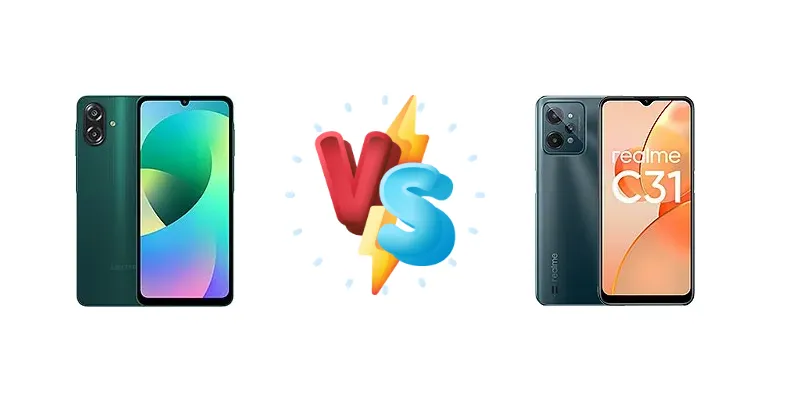
The Samsung Galaxy F07 and Realme C31 represent two approaches to the ultra-budget smartphone market. The F07, leveraging the Mediatek Helio G99, aims for a performance edge, while the C31 with the Unisoc Tiger T612 prioritizes affordability. This comparison dissects their key differences to determine which device delivers the best value for your money.
🏆 Quick Verdict
For users prioritizing performance and faster charging, the Samsung Galaxy F07 is the clear winner. Its Helio G99 chipset and 25W charging offer a significantly smoother experience, especially for gaming and multitasking. However, the Realme C31 remains a viable option for those on the tightest budgets.
| Network |
|---|
| 2G bands | GSM 850 / 900 / 1800 / 1900 | GSM 850 / 900 / 1800 / 1900 |
| 3G bands | HSDPA 850 / 900 / 2100 | HSDPA 850 / 900 / 2100 |
| 4G bands | 1, 3, 5, 7, 8, 20, 28, 38, 40, 41 | 1, 3, 5, 8, 38, 40, 41 |
| Speed | HSPA, LTE | HSPA, LTE |
| Technology | GSM / HSPA / LTE | GSM / HSPA / LTE |
| Launch |
|---|
| Announced | 2025, October 04 | 2022, March 25 |
| Status | Available. Released 2025, October 04 | Available. Released 2022, March 31 |
| Body |
|---|
| Build | Glass front, plastic back, plastic frame | Glass front, plastic frame, plastic back |
| Dimensions | 167.4 x 77.4 x 7.6 mm (6.59 x 3.05 x 0.30 in) | 164.7 x 76.1 x 8.4 mm (6.48 x 3.00 x 0.33 in) |
| SIM | Nano-SIM + Nano-SIM | Nano-SIM + Nano-SIM |
| Weight | 184 g (6.49 oz) | 197 g (6.95 oz) |
| Display |
|---|
| Protection | - | Panda Glass |
| Resolution | 720 x 1600 pixels, 20:9 ratio (~262 ppi density) | 720 x 1600 pixels, 20:9 ratio (~270 ppi density) |
| Size | 6.7 inches, 108.4 cm2 (~83.6% screen-to-body ratio) | 6.5 inches, 102.0 cm2 (~81.4% screen-to-body ratio) |
| Type | PLS LCD, 90Hz | IPS LCD, 400 nits |
| Platform |
|---|
| CPU | Octa-core (2x2.2 GHz Cortex-A76 & 6x2.0 GHz Cortex-A55) | Octa-core (2x1.8 GHz Cortex-A75 & 6x1.8 GHz Cortex-A55) |
| Chipset | Mediatek Helio G99 (6 nm) | Unisoc Tiger T612 (12 nm) |
| GPU | Mali-G57 MC2 | Mali-G57 |
| OS | Android 15, up to 6 major Android upgrades, One UI 7 | Android 11, Realme UI 2.0 |
| Memory |
|---|
| Card slot | microSDXC (dedicated slot) | microSDXC (dedicated slot) |
| Internal | 64GB 4GB RAM | 32GB 3GB RAM, 64GB 4GB RAM |
| | - | UFS 2.2 |
| Main Camera |
|---|
| Dual | 50 MP, f/1.8, (wide), 1/2.76", 0.64µm, PDAF
Auxiliary lens | - |
| Features | LED flash | LED flash, HDR, panorama |
| Single | - | 5 MP, f/2.2, 27mm (wide), 1/5.0", 1.12µm |
| Triple | - | 13 MP, f/2.2, 25mm (wide), 1/3.06", 1.12µm, AF
2 MP (macro)
Auxiliary lens |
| Video | 1080p@30fps | 1080p@30fps |
| Selfie camera |
|---|
| Features | - | HDR |
| Single | 8 MP, f/2.0, (wide), 1/4.0", 1.12µm | 5 MP, f/2.2, 27mm (wide), 1/5.0", 1.12µm |
| Video | Yes | 720p@30fps |
| Sound |
|---|
| 3.5mm jack | - | Yes |
| 35mm jack | Yes | Yes |
| Loudspeaker | Yes | Yes |
| Comms |
|---|
| Bluetooth | 5.3, A2DP, LE | 5.0, A2DP, LE |
| NFC | No | No |
| Positioning | GPS, GALILEO, GLONASS, BDS, QZSS | GPS, GLONASS, GALILEO, BDS |
| Radio | FM radio | No |
| USB | USB Type-C 2.0 | microUSB 2.0 |
| WLAN | Wi-Fi 802.11 a/b/g/n/ac, dual-band, Wi-Fi Direct | Wi-Fi 802.11 b/g/n |
| Features |
|---|
| Sensors | Fingerprint (side-mounted), accelerometer, proximity | Fingerprint (side-mounted), accelerometer, gyro, proximity |
| Battery |
|---|
| Charging | 25W wired | 10W wired |
| Type | 5000 mAh | 5000 mAh |
| Misc |
|---|
| Colors | Green | Light Silver, Dark Green |
| Models | SM-E075F/DS, SM-E075F | RMX3501 |
| Price | ₹ 7,455 | About 150 EUR |
| SAR | 0.24 W/kg (head) | - |
Samsung Galaxy F07
- Significantly faster processor for smoother performance
- 25W fast charging for quicker top-ups
- More efficient 6nm chipset for better battery life and less heat
- Potentially higher price point
- May not have a significantly better camera without detailed sensor information
Realme C31
- Lower price point, making it very accessible
- Acceptable performance for basic tasks
- Likely lightweight and comfortable to hold
- Slower processor struggles with demanding apps
- 10W charging is significantly slower
- Less efficient 12nm chipset
Display Comparison
Neither Samsung nor Realme provide display specifics beyond resolution. However, the chipset differences hint at potential display capabilities. The Helio G99 in the F07 is paired with devices often featuring higher refresh rate panels, suggesting a potentially smoother visual experience. The Unisoc T612 in the C31 is typically found on 60Hz displays. While both likely utilize LCD technology at this price point, the G99’s processing power could support a more vibrant and responsive display.
Camera Comparison
Without detailed camera specs, a direct comparison is difficult. However, the processing power of the Helio G99 in the F07 suggests superior image processing capabilities. This means better noise reduction, dynamic range, and overall image quality, even with similar sensor configurations. The C31’s T612 will likely produce acceptable photos in good lighting conditions, but will struggle in low-light scenarios. It's reasonable to assume both phones include a standard macro lens, but the F07's ISP will likely extract more detail.
Performance
The core difference lies in the chipsets. The Samsung Galaxy F07’s Mediatek Helio G99, built on a 6nm process, offers a substantial advantage over the Realme C31’s Unisoc Tiger T612 (12nm). The G99’s Cortex-A76 cores, clocked at 2.2 GHz, are significantly more powerful than the C31’s Cortex-A75 cores at 1.8 GHz. This translates to faster app loading times, smoother multitasking, and a more enjoyable gaming experience. The 6nm process also contributes to better thermal efficiency, reducing the likelihood of performance throttling under sustained load. The C31’s T612 is adequate for basic tasks, but will struggle with demanding applications.
Battery Life
While battery capacity isn't specified, the charging wattage is a key differentiator. The Samsung Galaxy F07’s 25W wired charging is a significant advantage over the Realme C31’s 10W charging. This means the F07 can replenish its battery much faster, minimizing downtime. Even if the C31 has a slightly larger battery, the F07’s faster charging will likely result in a more convenient user experience. The G99’s 6nm efficiency also contributes to potentially better battery life during usage.
Buying Guide
Buy the Samsung Galaxy F07 if you need a phone capable of handling moderate gaming, streaming, and multitasking without significant lag, and if faster charging is a priority. Buy the Realme C31 if you primarily need a phone for basic communication – calls, texts, and light social media – and are looking for the absolute lowest price point.
Frequently Asked Questions
❓ Will the Realme C31 struggle with popular apps like WhatsApp and Facebook?
While the Realme C31 can run WhatsApp and Facebook, expect slower loading times and occasional lag, especially with multiple chats or heavy media usage. The Unisoc Tiger T612 is designed for basic tasks, and these apps can be resource-intensive.
❓ Is the 25W charging on the Samsung Galaxy F07 compatible with any charger?
The Samsung Galaxy F07 supports standard USB Power Delivery (PD) charging. While it comes with a charger in the box, you can use any USB-PD compatible charger to achieve 25W charging speeds. Using a lower wattage charger will still charge the phone, but at a slower rate.
❓ Can the Samsung Galaxy F07 handle games like PUBG Mobile?
The Samsung Galaxy F07's Helio G99 chipset can run PUBG Mobile, but you'll likely need to lower the graphics settings to medium or low to achieve a playable frame rate. Expect some occasional stuttering during intense firefights. The Realme C31 is not well-suited for PUBG Mobile.
❓ Does the Unisoc Tiger T612 in the Realme C31 support VoLTE and VoWiFi?
VoLTE and VoWiFi support on the Realme C31 with the Unisoc Tiger T612 depends on your carrier. Check with your mobile provider to confirm compatibility in your region. The F07's Helio G99 generally has wider carrier support.