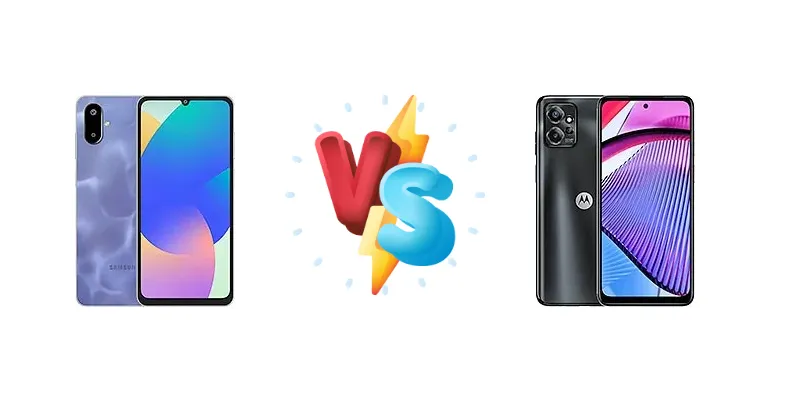
Both the Samsung Galaxy F06 5G and Motorola Moto G Power 5G target the competitive budget 5G market, but they take different approaches. The F06 focuses on a newer chip with potentially improved efficiency, while the Moto G Power 5G leverages a more powerful, albeit older, chipset. This comparison dissects the key differences to determine which phone offers the best value.
🏆 Quick Verdict
For most users, the Motorola Moto G Power 5G is the better choice. Its Dimensity 930 chipset provides a noticeable performance uplift over the F06’s Dimensity 6300, making it more capable for demanding tasks and gaming. While the F06 offers faster 25W charging, the G Power 5G’s superior processing power is a more impactful advantage.
| Network |
|---|
| 2G bands | GSM 850 / 900 / 1800 / 1900 | GSM 850 / 900 / 1800 / 1900 |
| 3G bands | HSDPA 850 / 900 / 2100 | HSDPA 850 / 900 / 1700(AWS) / 1900 / 2100 |
| 4G bands | LTE | 1, 2, 3, 4, 5, 7, 8, 12, 13, 14, 17, 20, 25, 26, 29, 30, 38, 39, 40, 41, 48, 66, 71 |
| 5G bands | SA/NSA | 2, 5, 7, 12, 25, 30, 41, 66, 71, 77, 78 SA/NSA/Sub6 |
| Speed | HSPA, LTE, 5G | HSPA, LTE, 5G |
| Technology | GSM / HSPA / LTE / 5G | GSM / HSPA / LTE / 5G |
| Launch |
|---|
| Announced | 2025, February 12 | 2023, April 06 |
| Status | Available. Released February 20 | Available. Released 2023, April 13 |
| Body |
|---|
| Build | Glass front, plastic back, plastic frame | Glass front, plastic back, plastic frame |
| Dimensions | 167.4 x 77.4 x 8 mm (6.59 x 3.05 x 0.31 in) | 163.1 x 74.8 x 8.5 mm (6.42 x 2.94 x 0.33 in) |
| SIM | Nano-SIM + Nano-SIM | Nano-SIM |
| Weight | 191 g (6.74 oz) | 185 g (6.53 oz) |
| | - | Water-repellent design |
| Display |
|---|
| Resolution | 720 x 1600 pixels, 20:9 ratio (~262 ppi density) | 1080 x 2400 pixels, 20:9 ratio (~405 ppi density) |
| Size | 6.7 inches, 108.4 cm2 (~83.6% screen-to-body ratio) | 6.5 inches, 102.0 cm2 (~83.6% screen-to-body ratio) |
| Type | PLS LCD, 800 nits (HBM) | IPS LCD, 120Hz |
| Platform |
|---|
| CPU | Octa-core (2x2.4 GHz Cortex-A76 & 6x2.0 GHz Cortex-A55) | Octa-core (2x2.2 GHz Cortex-A78 & 6x2.0 GHz Cortex-A55) |
| Chipset | Mediatek Dimensity 6300 (6 nm) | Mediatek Dimensity 930 (6 nm) |
| GPU | Mali-G57 MC2 | IMG BXM-8-256 |
| OS | Android 15, up to 4 major Android upgrades, One UI Core 7.0 | Android 13, upgradable to Android 14 |
| Memory |
|---|
| Card slot | microSDXC (uses shared SIM slot) | microSDXC (dedicated slot) |
| Internal | 64GB 4GB RAM, 128GB 4GB RAM, 128GB 6GB RAM | 128GB 4GB RAM, 256GB 6GB RAM |
| Main Camera |
|---|
| Dual | 50 MP, f/1.8, (wide), PDAF
Auxiliary lens | - |
| Features | LED flash | LED flash, HDR, panorama |
| Triple | - | 50 MP, f/1.8, (wide), 0.64µm, PDAF
2 MP (macro)
Auxiliary lens |
| Video | 1080p@30/60fps | 1080p@30fps, gyro-EIS |
| Selfie camera |
|---|
| Single | 8 MP, f/2.0, (wide), 1/4.0", 1.12µm | 16 MP, f/2.4, (wide), 1.0µm |
| Video | Yes | 1080p@30fps |
| Sound |
|---|
| 3.5mm jack | - | Yes |
| 35mm jack | Yes | Yes |
| Loudspeaker | Yes | Yes, with stereo speakers |
| Comms |
|---|
| Bluetooth | 5.3, A2DP, LE | 5.3, A2DP, LE |
| NFC | No | No |
| Positioning | GPS, GLONASS, GALILEO, BDS | GPS, GLONASS, GALILEO |
| Radio | Unspecified | No |
| USB | USB Type-C 2.0, OTG | USB Type-C 2.0 |
| WLAN | Wi-Fi 802.11 a/b/g/n/ac, dual-band, Wi-Fi Direct | Wi-Fi 802.11 a/b/g/n/ac, dual-band |
| Features |
|---|
| Sensors | Fingerprint (side-mounted), accelerometer, proximity, compass | Fingerprint (side-mounted), accelerometer, gyro, proximity, compass |
| Battery |
|---|
| Charging | 25W wired | 15W wired |
| Type | Li-Ion 5000 mAh | Li-Po 5000 mAh |
| Misc |
|---|
| Colors | Bahama Blue, Lit Violet | Dark Blue |
| Models | SM-E066B, SM-E066B/DS | - |
| Price | ₹ 8,727 | $ 97.90 / £ 199.00 |
| SAR | 1.05 W/kg (head) | - |
| SAR EU | 1.30 W/kg (head) 1.30 W/kg (body) | - |
Samsung Galaxy F06 5G
- Faster 25W wired charging
- Potential for longer software support (Samsung)
- Slightly newer chipset
- Less powerful processor (Dimensity 6300)
- Potentially lower gaming performance
- Likely less capable ISP
Motorola Moto G Power 5G
- More powerful processor (Dimensity 930)
- Superior multi-core performance
- Better graphics capabilities
- Potentially better image processing
- Slower 15W wired charging
- Potentially shorter software support (Motorola)
- May have a warmer color profile
Display Comparison
Neither Samsung nor Motorola provided display specs beyond the presence of 5G connectivity. Assuming typical displays for this price bracket, both likely feature 6.5-6.6 inch LCD panels with FHD+ resolution. The lack of information prevents a detailed comparison of brightness, color accuracy, or refresh rates. However, Motorola historically uses slightly warmer color profiles, while Samsung tends towards more vibrant, saturated colors.
Camera Comparison
Without detailed camera specifications, a direct comparison is difficult. However, given the market positioning, both phones likely feature a primary camera around 50MP. The Motorola Moto G Power 5G’s chipset has a more powerful ISP (Image Signal Processor), potentially leading to better image processing, especially in low-light conditions. The F06’s ISP, while adequate, will likely struggle to match the 930’s capabilities. The presence of a dedicated ISP on the 930 also allows for faster image capture and more advanced features. Expect both phones to include standard auxiliary lenses, but their quality will likely be limited.
Performance
The Motorola Moto G Power 5G’s Mediatek Dimensity 930 represents a significant step up in processing power compared to the Samsung Galaxy F06 5G’s Dimensity 6300. The 930 utilizes two Cortex-A78 cores clocked at 2.2 GHz, a more powerful architecture than the F06’s 2.4 GHz Cortex-A76 cores. While the F06’s higher clock speed might offer a marginal benefit in single-core tasks, the A78 cores in the 930 excel in multi-core performance and sustained workloads. Both chips are fabricated on a 6nm process, suggesting similar efficiency, but the architectural advantage of the 930 will translate to smoother multitasking and better gaming performance. The GPU within the Dimensity 930 will also provide a more capable graphics experience.
Battery Life
The Motorola Moto G Power 5G’s battery capacity is not specified, but the 'Power' branding suggests a larger battery than the F06. The F06’s 25W wired charging is faster than the G Power 5G’s 15W charging. However, the Dimensity 930’s superior efficiency could offset the slower charging speed, resulting in comparable real-world battery life. A larger battery combined with efficient power management will allow the G Power 5G to last longer on a single charge, despite the slower charging rate.
Buying Guide
Buy the Samsung Galaxy F06 5G if you prioritize faster charging speeds and potentially longer software support from Samsung. Buy the Motorola Moto G Power 5G if you value raw performance for gaming and multitasking, and are willing to trade off slightly slower charging for a more responsive user experience.
Frequently Asked Questions
❓ Will the Dimensity 930 in the Moto G Power 5G handle demanding games like Genshin Impact?
The Dimensity 930 is significantly more capable than the Dimensity 6300. While you won't achieve ultra settings, the Moto G Power 5G should provide a playable experience on medium settings with reasonable frame rates, making it suitable for casual gaming.
❓ How long will it take to fully charge the Samsung Galaxy F06 5G with the 25W charger?
While 25W charging is faster than the Moto G Power 5G's 15W, the actual 0-100% charge time will depend on the battery capacity, which is currently unknown. Expect a full charge to take between 60-90 minutes under ideal conditions.
❓ Does the Motorola Moto G Power 5G support VoLTE and 5G on all carriers?
Compatibility with VoLTE and 5G varies by carrier and region. It's crucial to check with your specific carrier to ensure the Moto G Power 5G is fully compatible with their network before purchasing.
❓ Is the image quality noticeably better on the Moto G Power 5G compared to the F06, even if the megapixel count is similar?
Yes, the Dimensity 930's superior Image Signal Processor (ISP) will likely result in better image quality, particularly in challenging lighting conditions. The ISP handles noise reduction, dynamic range, and color accuracy, all of which contribute to a more pleasing final image.