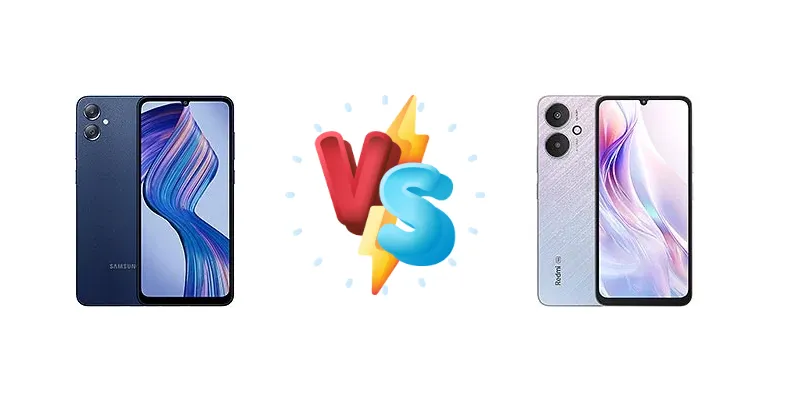
The sub-$150 5G smartphone market is fiercely competitive. The Samsung Galaxy F05 and Xiaomi Redmi 13C 5G represent compelling options, but cater to slightly different priorities. The F05 leverages Samsung’s brand recognition and a slightly older, but proven, chipset, while the Redmi 13C 5G aims to disrupt with a newer Mediatek Dimensity processor and faster 5G connectivity. This comparison will dissect their key differences to help you choose.
🏆 Quick Verdict
For most users, the Xiaomi Redmi 13C 5G emerges as the stronger choice. Its Mediatek Dimensity 6100+ chipset, built on a more efficient 6nm process, delivers noticeably better performance and future-proofing than the Galaxy F05’s Helio G85. While the F05 offers Samsung’s software experience, the Redmi 13C 5G’s performance advantage outweighs this for the average user.
| Network |
|---|
| 2G bands | GSM 850 / 900 / 1800 / 1900 | GSM 850 / 900 / 1800 / 1900 |
| 3G bands | HSDPA 850 / 900 / 2100 | HSDPA 800 / 850 / 900 / 1700(AWS) / 1900 / 2100 - International |
| 4G bands | 1, 3, 5, 7, 8, 20, 28, 38, 40, 41 | 1, 2, 3, 4, 5, 7, 8, 12, 13, 17, 18, 19, 20, 26, 28, 32, 38, 40, 41, 66 - International |
| 5G bands | - | 1, 3, 5, 7, 8, 20, 28, 38, 40, 41, 66, 77, 78 SA/NSA - International |
| Speed | HSPA, LTE | HSPA, LTE, 5G |
| Technology | GSM / HSPA / LTE | GSM / HSPA / LTE / 5G |
| Launch |
|---|
| Announced | 2024, September 17 | 2023, December 06 |
| Status | Available. Released 2024, September 20 | Available. Released 2023, December 16 |
| Body |
|---|
| Build | Glass front, plastic frame, silicone polymer (eco leather) back | Glass front (Gorilla Glass 3), plastic frame, plastic back |
| Dimensions | 168.8 x 78.2 x 8.8 mm (6.65 x 3.08 x 0.35 in) | 168.1 x 77.9 x 8.2 mm (6.62 x 3.07 x 0.32 in) |
| SIM | Nano-SIM + Nano-SIM | Nano-SIM + Nano-SIM |
| Weight | 195 g (6.88 oz) | 192 g or 195 g (6.77 oz) |
| Display |
|---|
| Protection | - | Corning Gorilla Glass 3 |
| Resolution | 720 x 1600 pixels, 20:9 ratio (~262 ppi density) | 720 x 1600 pixels, 20:9 ratio (~260 ppi density) |
| Size | 6.7 inches, 108.4 cm2 (~82.1% screen-to-body ratio) | 6.74 inches, 109.7 cm2 (~83.8% screen-to-body ratio) |
| Type | PLS LCD | IPS LCD, 90Hz, 450 nits (typ), 600 nits (HBM) |
| Platform |
|---|
| CPU | Octa-core (2x2.0 GHz Cortex-A75 & 6x1.8 GHz Cortex-A55) | Octa-core (2x2.2 GHz Cortex-A76 & 6x2.0 GHz Cortex-A55) |
| Chipset | Mediatek Helio G85 (12 nm) | Mediatek Dimensity 6100+ (6 nm) |
| GPU | Mali-G52 MC2 | Mali-G57 MC2 |
| OS | Android 14, up to 2 major Android upgrades, One UI Core 6.0 | Android 13, MIUI 14 |
| Memory |
|---|
| Card slot | microSDXC (dedicated slot) | microSDXC (dedicated slot) |
| Internal | 64GB 4GB RAM | 64GB 4GB RAM, 128GB 4GB RAM, 128GB 6GB RAM, 256GB 8GB RAM |
| Main Camera |
|---|
| Dual | 50 MP, f/1.8, (wide), AF
Auxiliary lens | - |
| Features | LED flash | LED flash, HDR |
| Single | - | 50 MP, f/1.8, 28mm (wide), 1/2.76", 1.12µm, PDAF
Auxiliary lens |
| Video | 1080p@30/60fps | 1080p@30fps |
| Selfie camera |
|---|
| Features | - | HDR |
| Single | 8 MP, f/2.0 | 5 MP, f/2.2, (wide) |
| Video | Yes | 1080p@30fps |
| Sound |
|---|
| 35mm jack | Yes | Yes |
| Loudspeaker | Yes | Yes |
| Comms |
|---|
| Bluetooth | 5.3, A2DP, LE | 5.3, A2DP, LE |
| NFC | No | Yes (market/region dependent) |
| Positioning | GPS, GLONASS, GALILEO, BDS | GPS, GLONASS, GALILEO, BDS |
| Radio | Unspecified | FM radio |
| USB | USB Type-C 2.0, OTG | USB Type-C 2.0, OTG |
| WLAN | Wi-Fi 802.11 a/b/g/n/ac, dual-band, Wi-Fi Direct | Wi-Fi 802.11 a/b/g/n/ac, dual-band |
| Features |
|---|
| Sensors | Accelerometer, proximity | Fingerprint (side-mounted), accelerometer, compass |
| Battery |
|---|
| Charging | 25W wired | 18W wired, PD |
| Type | 5000 mAh | 5000 mAh |
| Misc |
|---|
| Colors | Twilight Blue | Starry Black, Twilight Blue, Starry Silver, Starlight Black, Startrail Green, Startrail Silver |
| Models | SM-E055F, SM-E055F/DS | 23124RN87G, 23124RN87I, 23124RN87C |
| Price | ₹ 7,480 | $ 198.99 / £ 119.00 / € 116.99 / ₹ 10,895 |
| SAR | 0.46 W/kg (head) | 1.09 W/kg (head) 1.09 W/kg (body) |
| SAR EU | - | 0.98 W/kg (head) 0.98 W/kg (body) |
Samsung Galaxy F05
- Samsung Brand Recognition
- Simple and Clean Software Experience
- Potentially slightly faster peak charging wattage (25W)
- Older, Less Efficient Chipset (Helio G85)
- Lower Performance for Gaming and Multitasking
- Less Future-Proof
Xiaomi Redmi 13C 5G
- More Powerful and Efficient Chipset (Dimensity 6100+)
- Faster 5G Connectivity
- Better Performance for Gaming and Multitasking
- Power Delivery (PD) Charging
- Xiaomi’s MIUI Software (can be polarizing)
- Potentially more bloatware
- Larger size may not suit all users
Display Comparison
Neither device boasts a standout display. Both likely utilize LCD panels, a common trait in this price bracket. However, the Redmi 13C 5G’s larger screen size (typically 6.74 inches vs the F05’s 6.6 inches) offers a more immersive viewing experience. While peak brightness figures aren’t provided, the Redmi 13C 5G’s newer panel technology *may* offer slightly improved color accuracy and viewing angles. Bezels are expected to be similar on both devices, reflecting their budget positioning.
Camera Comparison
Both phones likely feature a primary camera around the 50MP mark, but details are scarce. The Redmi 13C 5G’s image processing algorithms, powered by the Dimensity 6100+’s ISP, *may* offer slightly better dynamic range and noise reduction. The presence of a dedicated 5G modem in the Redmi 13C 5G also allows for faster image uploads and sharing. It’s crucial to note that the inclusion of 2MP macro or depth sensors on either device adds minimal value to the overall camera experience; the primary sensor quality is the key differentiator.
Performance
This is where the Redmi 13C 5G pulls ahead significantly. The Mediatek Dimensity 6100+ (6nm) is a substantial upgrade over the Helio G85 (12nm). The 6nm process inherently offers better power efficiency, translating to less heat and sustained performance. The CPU configuration – 2x2.2 GHz Cortex-A76 cores in the Redmi vs 2x2.0 GHz Cortex-A75 cores in the F05 – provides a noticeable boost in single-core performance. This impacts app launch speeds, smoother scrolling, and a more responsive user experience. The Redmi 13C 5G will handle demanding games and multitasking with greater ease. The F05’s Helio G85 is adequate for everyday tasks, but will struggle with graphically intensive applications.
Battery Life
The Redmi 13C 5G’s 18W charging with Power Delivery (PD) is a slight advantage over the F05’s 25W charging, as PD offers more efficient and safer charging. While the F05’s wattage is higher, PD’s intelligent power management can result in comparable or even faster real-world charging times. Battery capacity is not specified, but both devices likely hover around the 5000mAh mark. The Dimensity 6100+’s superior power efficiency will likely translate to slightly longer battery life on the Redmi 13C 5G, even with similar capacity.
Buying Guide
Buy the Samsung Galaxy F05 if you prioritize brand familiarity and a simple, streamlined software experience, and your usage is primarily focused on basic tasks like calling, texting, and light social media. Buy the Xiaomi Redmi 13C 5G if you value performance for gaming, multitasking, and future-proofing, and are comfortable with Xiaomi’s MIUI software, which offers more customization options.
Frequently Asked Questions
❓ Will the Mediatek Dimensity 6100+ in the Redmi 13C 5G overheat during prolonged gaming sessions?
The Dimensity 6100+ is built on a 6nm process, which is significantly more efficient than the 12nm Helio G85 in the Galaxy F05. This improved efficiency translates to lower heat generation. While some throttling is inevitable during extended gaming, the Redmi 13C 5G is expected to maintain higher sustained performance levels than the F05.
❓ Does the Xiaomi Redmi 13C 5G support carrier aggregation for faster 5G speeds?
While specific carrier aggregation support varies by region and carrier, the Mediatek Dimensity 6100+ generally supports a good range of 5G bands and carrier aggregation features. This allows the Redmi 13C 5G to potentially achieve faster 5G download and upload speeds in areas with strong 5G infrastructure. Check with your carrier for specific compatibility details.
❓ Is the software on the Samsung Galaxy F05 significantly cleaner and less cluttered than on the Xiaomi Redmi 13C 5G?
Samsung’s One UI is generally considered to be a more streamlined experience than Xiaomi’s MIUI, particularly in terms of pre-installed bloatware. However, MIUI has improved significantly in recent versions, and users can often uninstall or disable unwanted apps. The F05 will likely offer a more ‘stock’ Android feel, which some users prefer.