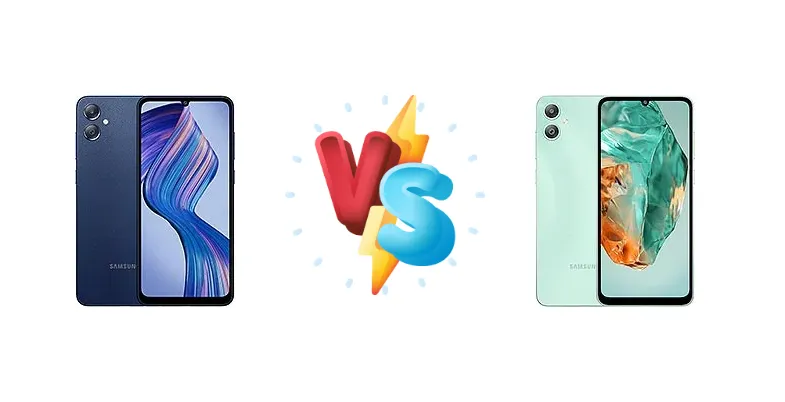
Samsung's F and M series represent their aggressive push into the budget smartphone market. The Galaxy F05 and M05 are strikingly similar on paper, both powered by the Mediatek Helio G85 and featuring 25W charging. This comparison aims to dissect the subtle differences – and lack thereof – to determine which device offers the best value for your money.
🏆 Quick Verdict
For the average user, the Samsung Galaxy M05 emerges as the slightly better choice. While both phones are functionally identical in terms of performance and charging, the M05 often benefits from more aggressive pricing and wider availability, making it the more accessible option.
| Network |
|---|
| 2G bands | GSM 850 / 900 / 1800 / 1900 | GSM 850 / 900 / 1800 / 1900 |
| 3G bands | HSDPA 850 / 900 / 2100 | HSDPA 850 / 900 / 2100 |
| 4G bands | 1, 3, 5, 7, 8, 20, 28, 38, 40, 41 | 1, 3, 5, 7, 8, 20, 28, 38, 40, 41 |
| Speed | HSPA, LTE | HSPA, LTE |
| Technology | GSM / HSPA / LTE | GSM / HSPA / LTE |
| Launch |
|---|
| Announced | 2024, September 17 | 2024, September 10 |
| Status | Available. Released 2024, September 20 | Available. Released 2024, September 10 |
| Body |
|---|
| Build | Glass front, plastic frame, silicone polymer (eco leather) back | Glass front, plastic back, plastic frame |
| Dimensions | 168.8 x 78.2 x 8.8 mm (6.65 x 3.08 x 0.35 in) | 168.8 x 78.2 x 8.8 mm (6.65 x 3.08 x 0.35 in) |
| SIM | Nano-SIM + Nano-SIM | Nano-SIM + Nano-SIM |
| Weight | 195 g (6.88 oz) | 195 g (6.88 oz) |
| Display |
|---|
| Resolution | 720 x 1600 pixels, 20:9 ratio (~262 ppi density) | 720 x 1600 pixels, 20:9 ratio (~262 ppi density) |
| Size | 6.7 inches, 108.4 cm2 (~82.1% screen-to-body ratio) | 6.7 inches, 108.4 cm2 (~82.1% screen-to-body ratio) |
| Type | PLS LCD | PLS LCD |
| Platform |
|---|
| CPU | Octa-core (2x2.0 GHz Cortex-A75 & 6x1.8 GHz Cortex-A55) | Octa-core (2x2.0 GHz Cortex-A75 & 6x1.8 GHz Cortex-A55) |
| Chipset | Mediatek Helio G85 (12 nm) | Mediatek Helio G85 (12 nm) |
| GPU | Mali-G52 MC2 | Mali-G52 MC2 |
| OS | Android 14, up to 2 major Android upgrades, One UI Core 6.0 | Android 14, up to 2 major Android upgrades, One UI Core 6.0 |
| Memory |
|---|
| Card slot | microSDXC (dedicated slot) | microSDXC (dedicated slot) |
| Internal | 64GB 4GB RAM | 64GB 4GB RAM |
| Main Camera |
|---|
| Dual | 50 MP, f/1.8, (wide), AF
Auxiliary lens | 50 MP, f/1.8, (wide), AF
Auxiliary lens |
| Features | LED flash | LED flash |
| Video | 1080p@30/60fps | 1080p@30/60fps |
| Selfie camera |
|---|
| Single | 8 MP, f/2.0 | 8 MP, f/2.0 |
| Video | Yes | Yes |
| Sound |
|---|
| 35mm jack | Yes | Yes |
| Loudspeaker | Yes | Yes |
| Comms |
|---|
| Bluetooth | 5.3, A2DP, LE | 5.3, A2DP, LE |
| NFC | No | No |
| Positioning | GPS, GLONASS, GALILEO, BDS | GPS, GLONASS, GALILEO, BDS |
| Radio | Unspecified | Unspecified |
| USB | USB Type-C 2.0, OTG | USB Type-C 2.0 |
| WLAN | Wi-Fi 802.11 a/b/g/n/ac, dual-band, Wi-Fi Direct | Wi-Fi 802.11 a/b/g/n/ac, dual-band, Wi-Fi Direct |
| Features |
|---|
| Sensors | Accelerometer, proximity | Accelerometer, proximity |
| Battery |
|---|
| Charging | 25W wired | 25W wired |
| Type | 5000 mAh | 5000 mAh |
| Misc |
|---|
| Colors | Twilight Blue | Mint Green |
| Models | SM-E055F, SM-E055F/DS | SM-M055F, SM-M055F/DS |
| Price | ₹ 7,480 | About 90 EUR |
| SAR | 0.46 W/kg (head) | 0.46 W/kg (head) |
Samsung Galaxy F05
- Identical performance to the M05 thanks to the Helio G85 chipset.
- 25W fast charging support for quick top-ups.
- Potential for exclusive deals or promotions depending on retailer.
- Display specifications are unknown, likely a basic LCD panel.
- Camera performance is expected to be average, especially in low light.
Samsung Galaxy M05
- Identical performance to the F05 due to the shared Helio G85 chipset.
- 25W fast charging support for convenient power replenishment.
- Generally wider availability and more consistent pricing.
- Display quality is likely similar to the F05 – a basic LCD experience.
- Camera system is expected to be comparable to the F05, with similar limitations.
Display Comparison
Both the Galaxy F05 and M05 utilize unspecified LCD panels, a common cost-saving measure in this price bracket. Without knowing the peak brightness or color gamut coverage, it's safe to assume display quality will be adequate for everyday use but won't excel in direct sunlight or for color-critical work. The absence of high refresh rate technology (90Hz or 120Hz) is also expected, prioritizing battery life over visual smoothness. Bezels are likely to be substantial, contributing to a less immersive viewing experience compared to higher-end devices.
Camera Comparison
Both the F05 and M05 are expected to feature a multi-camera setup, but details are scarce. Given the price point, the primary sensor is likely a 50MP unit, but aperture and sensor size are unknown. Image quality will depend heavily on Samsung's image processing algorithms. The inclusion of a 2MP macro camera is almost certain, but its utility is limited due to the low resolution and lack of autofocus. Expect decent performance in well-lit conditions, but image quality will degrade significantly in low light. The front-facing camera is also unspecified, but will likely be sufficient for video calls and casual selfies.
Performance
The core of both devices is the Mediatek Helio G85 (12 nm) chipset, featuring an octa-core CPU configuration with 2x2.0 GHz Cortex-A75 and 6x1.8 GHz Cortex-A55 cores. This means both phones will deliver similar performance in everyday tasks like browsing, social media, and light gaming. The 12nm process node, while not the most advanced, provides a reasonable balance between performance and power efficiency. The GPU within the Helio G85 is capable of handling most mobile games at medium settings, but demanding titles may require reduced graphics settings for smooth gameplay. RAM configuration is not specified, but will likely be 4GB or 6GB, impacting multitasking capabilities.
Battery Life
Both devices support 25W wired charging, a welcome feature in this price segment. However, the actual battery capacity remains undisclosed. Assuming a typical 5000mAh battery, a full charge from 0-100% should take approximately 90-120 minutes with a compatible 25W charger (sold separately). The Helio G85's power efficiency, combined with the LCD panel, should provide all-day battery life for moderate users. Heavy gaming or prolonged video streaming will naturally reduce battery endurance.
Buying Guide
Buy the Samsung Galaxy F05 if you find it at a significantly lower price than the M05, or if it's exclusively available through a retailer you prefer. Buy the Samsung Galaxy M05 if you prioritize consistent pricing and broader availability, and want the peace of mind of a slightly more established model within Samsung's budget lineup.
Frequently Asked Questions
❓ Will the Mediatek Helio G85 struggle with demanding games like Genshin Impact?
The Helio G85 can run Genshin Impact, but you'll need to lower the graphics settings to medium or low to achieve a playable frame rate. Expect some occasional stuttering, especially during intense combat sequences. It's not ideal for a high-end gaming experience, but it's capable for casual gaming.
❓ Is the 2MP macro camera on either phone worth using?
The 2MP macro camera is primarily a marketing feature. Due to the low resolution and lack of autofocus, image quality will be limited. It can be fun for experimentation, but don't expect professional-looking macro shots. The main camera will generally produce better results even when zoomed in.
❓ Does either phone support VoLTE or VoWiFi for improved call quality?
Support for VoLTE (Voice over LTE) and VoWiFi (Voice over Wi-Fi) will depend on your carrier and region. Samsung typically includes these features on their devices, but it's crucial to verify compatibility with your specific mobile network provider before purchasing.
❓ What type of storage does each phone use – UFS or eMMC?
Given the price point, both the F05 and M05 likely utilize eMMC storage, which is slower than the more modern UFS standard. This will result in slightly longer app loading times and slower file transfer speeds, but it's a common trade-off in budget smartphones.