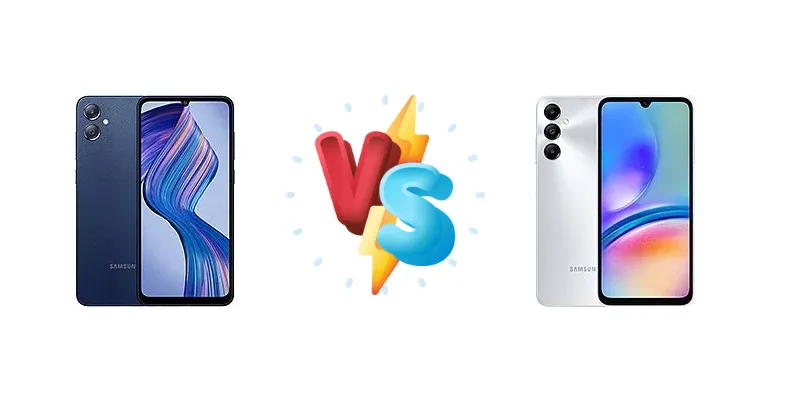
Samsung's A and F series represent their entry-level offerings, often blurring the lines between models. The Galaxy A05s and F05 are prime examples, both aiming for the sub-$200 market. However, they diverge significantly under the hood, with different chipsets and feature sets. This comparison dissects these differences to determine which phone delivers the best value for your money.
🏆 Quick Verdict
For most users, the Samsung Galaxy A05s emerges as the better choice. Its Snapdragon 680 chipset, built on a more efficient 6nm process, provides a smoother overall experience and better long-term performance than the Helio G85 in the F05. While the F05 boasts faster 25W charging, the A05s compensates with superior battery life as demonstrated by its 11:32h active use score.
| Network |
|---|
| 2G bands | GSM 850 / 900 / 1800 / 1900 | GSM 850 / 900 / 1800 / 1900 |
| 3G bands | HSDPA 850 / 900 / 2100 | HSDPA 850 / 900 / 2100 |
| 4G bands | 1, 3, 5, 7, 8, 20, 28, 38, 40, 41 | 1, 3, 5, 7, 8, 20, 28, 38, 40, 41 |
| Speed | HSPA, LTE | HSPA, LTE |
| Technology | GSM / HSPA / LTE | GSM / HSPA / LTE |
| Launch |
|---|
| Announced | 2024, September 17 | 2023, September 25 |
| Status | Available. Released 2024, September 20 | Available. Released 2023, October 18 |
| Body |
|---|
| Build | Glass front, plastic frame, silicone polymer (eco leather) back | Glass front, plastic back, plastic frame |
| Dimensions | 168.8 x 78.2 x 8.8 mm (6.65 x 3.08 x 0.35 in) | 168 x 77.8 x 8.8 mm (6.61 x 3.06 x 0.35 in) |
| SIM | Nano-SIM + Nano-SIM | · Nano-SIM· Nano-SIM + Nano-SIM |
| Weight | 195 g (6.88 oz) | 194 g (6.84 oz) |
| Display |
|---|
| Resolution | 720 x 1600 pixels, 20:9 ratio (~262 ppi density) | 1080 x 2400 pixels, 20:9 ratio (~393 ppi density) |
| Size | 6.7 inches, 108.4 cm2 (~82.1% screen-to-body ratio) | 6.7 inches, 108.4 cm2 (~82.9% screen-to-body ratio) |
| Type | PLS LCD | PLS LCD, 90Hz |
| Platform |
|---|
| CPU | Octa-core (2x2.0 GHz Cortex-A75 & 6x1.8 GHz Cortex-A55) | Octa-core (4x2.4 GHz Kryo 265 Gold & 4x1.9 GHz Kryo 265 Silver) |
| Chipset | Mediatek Helio G85 (12 nm) | Qualcomm SM6225 Snapdragon 680 4G (6 nm) |
| GPU | Mali-G52 MC2 | Adreno 610 |
| OS | Android 14, up to 2 major Android upgrades, One UI Core 6.0 | Android 13, up to 2 major Android upgrades, One UI 7 |
| Memory |
|---|
| Card slot | microSDXC (dedicated slot) | microSDXC (dedicated slot) |
| Internal | 64GB 4GB RAM | 64GB 4GB RAM, 128GB 4GB RAM, 128GB 6GB RAM |
| Main Camera |
|---|
| Dual | 50 MP, f/1.8, (wide), AF
Auxiliary lens | - |
| Features | LED flash | LED flash |
| Triple | - | 50 MP, f/1.8, (wide), 1/2.8", 0.64µm, AF
2 MP (macro)
Auxiliary lens |
| Video | 1080p@30/60fps | 1080p@30/60fps |
| Selfie camera |
|---|
| Single | 8 MP, f/2.0 | 13 MP, f/2.0, (wide), 1/3.X", 1.12µm |
| Video | Yes | 1080p@30fps |
| Sound |
|---|
| 35mm jack | Yes | Yes |
| Loudspeaker | Yes | Yes |
| Comms |
|---|
| Bluetooth | 5.3, A2DP, LE | 5.1, A2DP, LE |
| NFC | No | Yes (market/region dependent) |
| Positioning | GPS, GLONASS, GALILEO, BDS | GPS, GLONASS, GALILEO, BDS, QZSS |
| Radio | Unspecified | Unspecified |
| USB | USB Type-C 2.0, OTG | USB Type-C 2.0 |
| WLAN | Wi-Fi 802.11 a/b/g/n/ac, dual-band, Wi-Fi Direct | Wi-Fi 802.11 a/b/g/n/ac, dual-band, Wi-Fi Direct |
| Features |
|---|
| Sensors | Accelerometer, proximity | Fingerprint (side-mounted), accelerometer, proximity |
| Battery |
|---|
| Charging | 25W wired | 25W wired |
| Type | 5000 mAh | Li-Po 5000 mAh |
| Misc |
|---|
| Colors | Twilight Blue | Black, Silver, Light Green, Violet |
| Models | SM-E055F, SM-E055F/DS | SM-A057F, SM-A057F/DS, SM-A057M, SM-A057M/DS, SM-A057G/DSN, SM-A057G |
| Price | ₹ 7,480 | $ 134.00 / C$ 146.99 / £ 83.94 / € 100.99 |
| SAR | 0.46 W/kg (head) | - |
| SAR EU | - | 0.58 W/kg (head) 1.31 W/kg (body) |
Samsung Galaxy F05
- More efficient Snapdragon 680 chipset
- Superior battery life (11:32h active use)
- Brighter and higher contrast display
- May lack some of the F05's specific software features
- Potentially slightly slower charging speeds in real-world use despite 25W support
Samsung Galaxy A05s
- Faster 25W wired charging
- Potentially lower price point
- Helio G85 offers decent performance for basic tasks
- Less efficient Helio G85 chipset
- Shorter battery life compared to A05s
- Likely a less vibrant display
Display Comparison
The Galaxy A05s boasts a significantly more impressive display, achieving a measured peak brightness of 468 nits and a 1418:1 contrast ratio. This translates to better visibility outdoors and richer, more defined visuals. While the F05’s display specifications aren’t provided, it’s reasonable to assume it falls short of these figures given its positioning. The higher contrast ratio on the A05s will be particularly noticeable when viewing photos and videos, offering deeper blacks and brighter whites.
Camera Comparison
Both phones are expected to feature basic camera systems geared towards casual photography. The context data only mentions 'Photo / Video' capabilities for the A05s, suggesting a standard setup. Given the market segment, we can anticipate both phones will rely heavily on software processing to enhance image quality. Without specific sensor details, it’s difficult to make a definitive judgment, but the A05s’s more powerful chipset could potentially handle image processing tasks more efficiently, resulting in slightly better photos and videos.
Performance
The core difference lies in the chipsets. The Galaxy A05s utilizes the Qualcomm Snapdragon 680 (6nm), featuring a Kryo CPU configuration with 4x2.4 GHz Gold cores and 4x1.9 GHz Silver cores. This contrasts with the Galaxy F05’s MediaTek Helio G85 (12nm), which employs a 2x2.0 GHz Cortex-A75 and 6x1.8 GHz Cortex-A55 setup. The 6nm fabrication process of the Snapdragon 680 is a key advantage, offering superior power efficiency and reduced thermal throttling compared to the 12nm Helio G85. This means the A05s will maintain performance for longer during demanding tasks. While the Helio G85’s Cortex-A75 cores offer a slight clock speed advantage, the Snapdragon 680’s architecture and process node provide a more consistent and efficient experience.
Battery Life
The Galaxy A05s shines in battery life, achieving an impressive 11 hours and 32 minutes of active use. While the F05 also supports 25W wired charging, matching the A05s, the more efficient Snapdragon 680 chipset in the A05s allows it to extract more runtime from its battery. The F05 will likely rely on its faster charging to compensate for potentially shorter battery life, but the A05s offers a more convenient experience for users who don’t want to constantly top up their phone.
Buying Guide
Buy the Samsung Galaxy F05 if you prioritize fast charging and are primarily focused on basic tasks like calling, texting, and light social media use. Buy the Samsung Galaxy A05s if you value a more responsive user experience, better battery endurance for all-day use, and a brighter, more vibrant display for media consumption. The A05s is the better all-rounder.
Frequently Asked Questions
❓ Will the Snapdragon 680 in the A05s handle demanding games like PUBG Mobile?
While the Snapdragon 680 isn't a gaming powerhouse, it's capable of running PUBG Mobile at medium settings with reasonable frame rates. The 6nm process helps prevent significant throttling during extended gaming sessions, offering a more consistent experience than the Helio G85.
❓ Is the 25W charging on both phones truly fast, or is it just marketing?
25W charging is a decent speed for this price range, but the actual charging time will depend on the adapter and cable used. The A05s benefits from the Snapdragon 680's efficiency, potentially allowing it to reach full charge slightly faster despite the same wattage due to reduced heat generation.
❓ Does the Galaxy A05s support software updates for longer than the F05?
Samsung typically provides longer software support for its A-series devices compared to the F-series. While both phones will receive security updates, the A05s is more likely to receive major Android version updates for a longer period.
❓ How does the Helio G85 handle multitasking compared to the Snapdragon 680?
The Snapdragon 680's more efficient architecture and optimized CPU cores provide a smoother multitasking experience. The Helio G85 may exhibit more lag when switching between multiple apps, especially demanding ones.