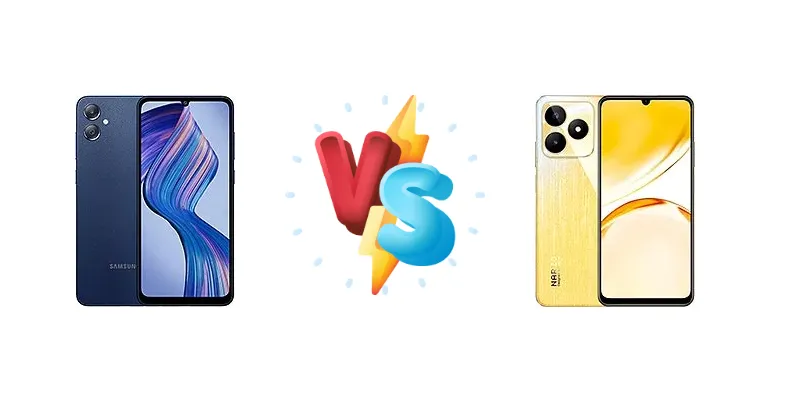
The sub-$150 smartphone market is fiercely competitive. Both the Samsung Galaxy F05 and Realme Narzo N53 aim to deliver essential features at an accessible price point. However, they take different approaches to achieving this, primarily diverging in their chipset choices and charging capabilities. This comparison dissects these differences to determine which device offers the best value.
🏆 Quick Verdict
For the average user prioritizing faster charging and potentially smoother multitasking, the Realme Narzo N53 emerges as the better choice. Its 33W charging significantly reduces downtime compared to the F05’s 25W. While the Helio G85 in the F05 is a proven performer, the N53’s Unisoc T612 offers a competitive experience at this price.
| Network |
|---|
| 2G bands | GSM 850 / 900 / 1800 / 1900 | GSM 850 / 900 / 1800 / 1900 |
| 3G bands | HSDPA 850 / 900 / 2100 | HSDPA 850 / 900 / 2100 |
| 4G bands | 1, 3, 5, 7, 8, 20, 28, 38, 40, 41 | 1, 3, 5, 8, 38, 40, 41 |
| Speed | HSPA, LTE | HSPA, LTE |
| Technology | GSM / HSPA / LTE | GSM / HSPA / LTE |
| Launch |
|---|
| Announced | 2024, September 17 | 2023, May 18 |
| Status | Available. Released 2024, September 20 | Available. Released 2023, May 22 |
| Body |
|---|
| Build | Glass front, plastic frame, silicone polymer (eco leather) back | Glass front, plastic frame, plastic back |
| Dimensions | 168.8 x 78.2 x 8.8 mm (6.65 x 3.08 x 0.35 in) | 167.3 x 76.7 x 7.5 mm (6.59 x 3.02 x 0.30 in) |
| SIM | Nano-SIM + Nano-SIM | Nano-SIM + Nano-SIM |
| Weight | 195 g (6.88 oz) | 182 g (6.42 oz) |
| Display |
|---|
| Resolution | 720 x 1600 pixels, 20:9 ratio (~262 ppi density) | 1080 x 2400 pixels, 20:9 ratio (~390 ppi density) |
| Size | 6.7 inches, 108.4 cm2 (~82.1% screen-to-body ratio) | 6.74 inches, 109.7 cm2 (~85.5% screen-to-body ratio) |
| Type | PLS LCD | IPS LCD, 90Hz, 450 nits (peak) |
| Platform |
|---|
| CPU | Octa-core (2x2.0 GHz Cortex-A75 & 6x1.8 GHz Cortex-A55) | Octa-core (2x1.8 GHz Cortex-A75 & 6x1.8 GHz Cortex-A55) |
| Chipset | Mediatek Helio G85 (12 nm) | Unisoc Tiger T612 (12 nm) |
| GPU | Mali-G52 MC2 | Mali-G57 |
| OS | Android 14, up to 2 major Android upgrades, One UI Core 6.0 | Android 13, Realme UI T |
| Memory |
|---|
| Card slot | microSDXC (dedicated slot) | microSDXC (dedicated slot) |
| Internal | 64GB 4GB RAM | 64GB 4GB RAM, 128GB 6GB RAM, 128GB 8GB RAM |
| Main Camera |
|---|
| Dual | 50 MP, f/1.8, (wide), AF
Auxiliary lens | 50 MP, f/1.8, (wide), PDAF
Auxiliary lens |
| Features | LED flash | LED flash, HDR, panorama |
| Video | 1080p@30/60fps | 1080p@30fps |
| Selfie camera |
|---|
| Features | - | HDR |
| Single | 8 MP, f/2.0 | 8 MP, f/2.0, (wide) |
| Video | Yes | 720p@30fps |
| Sound |
|---|
| 3.5mm jack | - | Yes |
| 35mm jack | Yes | Yes |
| Loudspeaker | Yes | Yes |
| Comms |
|---|
| Bluetooth | 5.3, A2DP, LE | 5.0, A2DP, LE |
| NFC | No | No |
| Positioning | GPS, GLONASS, GALILEO, BDS | GPS, GLONASS, GALILEO |
| Radio | Unspecified | Unspecified |
| USB | USB Type-C 2.0, OTG | USB Type-C 2.0 |
| WLAN | Wi-Fi 802.11 a/b/g/n/ac, dual-band, Wi-Fi Direct | Wi-Fi 802.11 a/b/g/n/ac, dual-band |
| Features |
|---|
| Sensors | Accelerometer, proximity | Fingerprint (side-mounted), accelerometer, gyro, proximity, compass |
| Battery |
|---|
| Charging | 25W wired | 33W wired, 50% in 31 min |
| Type | 5000 mAh | 5000 mAh |
| Misc |
|---|
| Colors | Twilight Blue | Black, Gold |
| Models | SM-E055F, SM-E055F/DS | RMX3761 |
| Price | ₹ 7,480 | About 100 EUR |
| SAR | 0.46 W/kg (head) | - |
Samsung Galaxy F05
- Established Samsung brand reputation
- Potentially better color calibration on the display
- Helio G85 offers a slight edge in gaming
- Slower 25W charging
- Potentially less efficient chipset compared to Unisoc T612
- Software updates may be less frequent than Realme
Realme Narzo N53
- Faster 33W charging with quick top-up times
- Unisoc T612 offers good efficiency for daily tasks
- Competitive pricing
- Less established brand recognition
- Realme UI may not appeal to all users
- Gaming performance may be slightly lower than the F05
Display Comparison
Neither Samsung nor Realme provide display specifications beyond the basic panel type. Given the price bracket, both likely utilize LCD panels with 720p+ resolution. The absence of high refresh rates is expected. The real-world difference will likely come down to color calibration and peak brightness, areas where Samsung historically has a slight edge, but without concrete data, it's difficult to definitively declare a winner. Bezels are expected to be similar, prioritizing cost-effectiveness over premium aesthetics.
Camera Comparison
Both phones likely feature a primary camera around the 13MP mark, accompanied by auxiliary sensors (often 2MP macro/depth). Without detailed sensor size or aperture information, a direct comparison is challenging. Image processing will be a key differentiator, with Samsung typically leaning towards more saturated colors and Realme aiming for a more natural look. The absence of Optical Image Stabilization (OIS) on either device means low-light performance will rely heavily on software algorithms. The usefulness of the 2MP macro cameras on both phones is questionable, offering limited detail and often inferior image quality compared to the main sensor.
Performance
The core difference lies in the chipsets. The Samsung Galaxy F05 features the Mediatek Helio G85, built on a 12nm process, with a CPU configuration of 2x2.0 GHz Cortex-A75 and 6x1.8 GHz Cortex-A55 cores. The Realme Narzo N53 counters with the Unisoc Tiger T612, also on a 12nm node, but with a slightly lower peak CPU clock speed of 2x1.8 GHz Cortex-A75 and 6x1.8 GHz Cortex-A55 cores. While the G85’s higher Cortex-A75 clock speed *suggests* a performance advantage in bursty tasks, the T612’s architecture is known for its efficiency. In real-world usage, this translates to comparable performance for most everyday tasks, but the G85 may exhibit a slight edge in gaming. However, the RAM configuration (not specified) will heavily influence multitasking smoothness on both devices.
Battery Life
Battery capacity is not specified, but both devices likely house a 5000mAh battery, standard for this price segment. The critical difference is charging speed. The Realme Narzo N53 boasts 33W wired charging, capable of reaching 50% charge in just 31 minutes. The Samsung Galaxy F05 is limited to 25W, resulting in a significantly longer charging time. This difference is substantial for users who frequently need to quickly replenish their battery. While a larger battery capacity would be ideal, the faster charging of the N53 effectively mitigates the impact of a potentially slightly smaller cell.
Buying Guide
Buy the Samsung Galaxy F05 if you prioritize a brand with a well-established ecosystem and a slightly more mature software experience, and are comfortable with slower charging speeds. Buy the Realme Narzo N53 if you value faster charging, a potentially more efficient chipset for everyday tasks, and are open to Realme’s UI. The N53 is ideal for users who frequently find themselves needing to top up their battery quickly.
Frequently Asked Questions
❓ Does the Unisoc Tiger T612 in the Narzo N53 struggle with demanding games like PUBG or Call of Duty?
While the T612 isn't a gaming powerhouse, it's capable of running PUBG and Call of Duty Mobile at medium settings with reasonable frame rates. Expect some frame drops during intense action. The Helio G85 in the F05 may offer a slightly smoother experience, but both phones are best suited for casual gaming.
❓ How significant is the difference in charging time between 25W and 33W charging on these phones?
The difference is substantial. The Realme Narzo N53 can reach 50% charge in approximately 31 minutes with its 33W charging. The Samsung Galaxy F05, with its 25W charging, will take considerably longer – likely exceeding an hour to reach the same level. This makes the N53 a much more convenient option for users who need a quick power boost.
❓ Are the software experiences on Realme UI and Samsung's One UI significantly different?
Yes. Samsung's One UI is generally considered more polished and feature-rich, but also more resource-intensive. Realme UI is lighter and faster, but may lack some of the advanced features found on One UI. Preference is subjective, but Realme UI is often favored by users who prioritize speed and simplicity.